

Marketing Team Swag Distribution Tips That Actually Work


Swag distribution succeeds when you align a measurable goal, the right audience, and reliable operations before you order a single item. The six elements that determine whether a program delivers ROI or fills a storage closet are: goal alignment, audience fit, item selection, operational infrastructure, gating, and measurement. Get all six right and you have a repeatable system. Miss one and you’re back to guessing why nobody wore the T-shirt.
Here’s what each element demands this week:
- Goal alignment: Write one sentence defining what this swag send must accomplish (lead gen, retention, onboarding). If you can’t write it, don’t order yet.
- Audience fit: Name the specific segment receiving swag (new hires, VIP clients, trade show attendees, prospects). Generic sends produce generic results.
- Item selection: Choose items people use daily, not items that look good in a catalog photo. Usefulness drives retention.
- Operational infrastructure: Decide now whether you’re warehousing inventory or using an on-demand fulfillment model. Mixing both without a plan creates the closet problem.
- Gating: Require something from recipients (a scan, a registration, a demo attendance) before handing over premium items. Gating increases perceived value and cuts waste.
- Measurement: Assign a KPI to every send before it ships. Cost per qualified lead, redemption rate, and employee NPS lift are the three most useful starting points.
Pro Tip: If you’re planning a swag send and can’t name both the goal and the KPI in under 30 seconds, pause. Ordering without those two anchors is the single fastest way to waste your budget.
Table of Contents
- 1. Your step-by-step swag distribution checklist
- 2. How to set clear swag goals and define your audience
- 3. How to choose swag items people actually use and remember
- 4. Tactics for distributing swag effectively
- 5. Budget bands, per-item cost guidance, and order quantities
- 6. Run swag like inventory: centralize ops, kitting, and tracking
- 7. How to measure swag ROI and prove impact
- 8. Best practices for remote and hybrid team swag programs
- 9. Sustainable item choices and simple compliance notes for US marketers
- 10. How to train staff and script booth handouts to increase uptake
- 11. Sample 8-week swag campaign timeline
- Discountswag makes swag distribution straightforward
- Key Takeaways
- What swag programs get wrong (and how to fix it fast)
- Useful sources and further reading
1. Your step-by-step swag distribution checklist
Use this sequence every time, whether you’re sending 50 onboarding kits or 2,000 trade show bags. The order matters because each step gates the next.
- Define the goal — one sentence, one measurable outcome.
- Identify the audience segment — name them specifically (e.g., “Q3 enterprise prospects attending the Austin demo day”).
- Set your budget band — decide low, mid, or premium tier before browsing items.
- Select items — apply the usefulness, durability, and brand-fit criteria (covered in Section 4).
- Choose your distribution channel — event handout, direct mail, company store, or limited drop.
- Set gating rules — what must a recipient do to qualify?
- Book your vendor and confirm lead times — standard production for most on-demand items runs 7–10 business days; rush production typically reduces lead time to 3–5 business days but adds roughly a 30% surcharge to the unit cost.
- Finalize artwork and get approvals — plan 3–4 weeks before campaign launch to avoid rush fees.
- Confirm shipping addresses and kitting instructions — especially critical for remote sends.
- Ship and track — use QR codes or unique promo codes to tie delivery to engagement data.
- Audit results — compare redemption rate and KPI performance against your goal within 30 days.
Critical lead-time windows to protect:
- 8+ weeks out: ideal window to order, approve, and kit without any surcharges.
- 4–6 weeks out: still safe for standard production on most items.
- 2–3 weeks out: you’re likely hitting rush territory on decorated apparel and tech items.
- Under 14 days: expect rush surcharges and limited item availability. Pivot to in-stock, ready-to-ship items only.
Pro Tip: Lock your artwork files before you book the vendor, not after. Design revisions after production starts are the single most common cause of missed ship dates.
2. How to set clear swag goals and define your audience
The primary reason swag programs fail is not poor item selection. It’s the absence of a clear link between the item and a business outcome. A branded water bottle sent to everyone on your email list is a cost center. The same bottle sent to prospects who attended a live demo, with a follow-up sequence tied to a unique promo code, is a lead-generation asset.
Start by picking one objective per send. Then map it to a KPI and a distribution trigger.

| Objective | KPI | Distribution trigger | Audience segment |
|---|---|---|---|
| Lead generation | Cost per qualified lead | Demo attendance or event registration | Prospects, event attendees |
| Employee retention | NPS lift, 90-day retention delta | Onboarding day 1, 30-day milestone | New hires |
| Client appreciation | Renewal rate, upsell rate | Contract anniversary, deal close | VIP clients |
| Brand awareness | Impressions, social mentions | Conference, product launch | General event attendees |
| Prospect nurture | Meeting booked rate | Post-webinar, content download | Mid-funnel prospects |
Leading organizations deploy targeted merchandise at each stage of the audience relationship lifecycle rather than treating swag as a single event. That sequenced approach, from recruitment through onboarding to ongoing perks and premium client gifts, ties each send to a moment when the recipient is most receptive.
Audience segments and their best distribution triggers:
- New hires: Ship a curated onboarding kit to arrive on day 1 or before their start date. The timing amplifies the emotional impact.
- VIP clients: Tie sends to contract milestones or renewal windows, not arbitrary holidays.
- Event attendees: Gate premium items behind registration or session attendance, not just badge scanning at the door.
- Mid-funnel prospects: Use swag as a follow-up after a demo or content engagement, paired with a personalized note and a tracked promo code.
3. How to choose swag items people actually use and remember
The items that earn a permanent spot on someone’s desk or in their bag share four traits: they solve a daily problem, they’re built to last, they carry your brand without screaming it, and they ship without costing more than they’re worth. That’s the filter. Everything else is noise.
Selection criteria to apply before you order:
- Usefulness: Will the recipient reach for this item at least once a week? If not, it’s a landfill candidate.
- Durability: Cheap items break fast and associate your brand with poor quality. Spend more per unit on fewer items rather than ordering a high volume of low-quality pieces.
- Brand fit: The item’s aesthetic, color, and category should feel like a natural extension of your brand, not a generic giveaway.
- Size and shipping cost: Bulky or heavy items spike fulfillment costs. For remote sends especially, prioritize items under 1 lb that ship flat.
- Sustainability: Recipients increasingly notice whether packaging is wasteful. Recycled materials and minimal packaging signal that your brand pays attention.
Category examples and when each fits:
- Tech accessories (wireless chargers, USB hubs, cable organizers): High perceived value, used daily, ideal for tech-forward audiences and VIP sends. Logo tech accessories work especially well for remote employees who spend most of their day at a desk.
- Apparel (premium tees, quarter-zips, hats): High visibility and social sharing potential, but size guessing creates returns. Best deployed through self-serve company stores where recipients pick their own size.
- Desk items (notebooks, pens, mouse pads): Low cost, high daily use, easy to ship. Ideal for mid-funnel prospect sends and conference giveaways.
- Drinkware (insulated tumblers, mugs): Consistently among the highest-retention categories. Recipients use them for years.
- Curated kits (onboarding boxes, VIP gift sets): Higher cost per unit but dramatically higher perceived value. The presentation matters as much as the contents.
Choosing swag that people keep is less about finding a clever item and more about matching the item’s daily utility to the recipient’s actual routine. A $5 item used every day outperforms a $40 item that sits in a drawer. The goal is desk real estate, not shelf space.
4. Tactics for distributing swag effectively
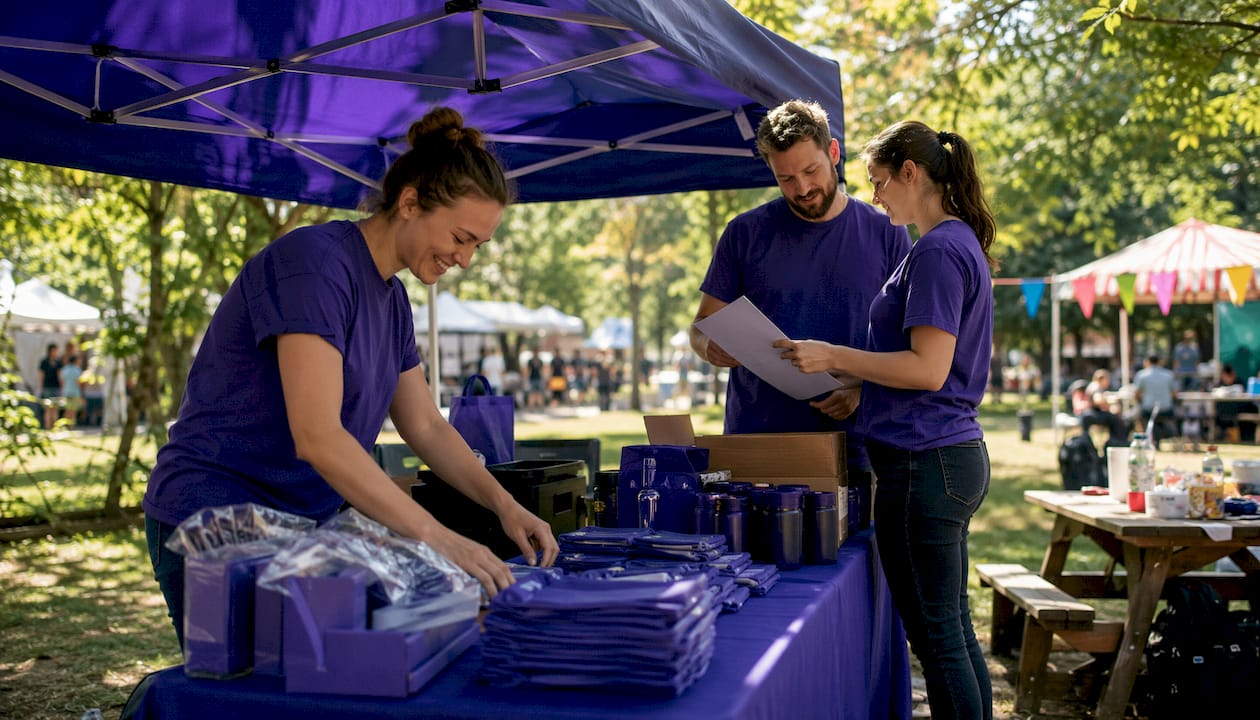
Distribution channel determines whether your swag reaches the right person at the right moment or ends up in a conference bag graveyard. Each channel has a different cost profile, lead-time requirement, and gating opportunity.
| Distribution method | Best for | Pros | Cons |
|---|---|---|---|
| Event booth handout | Trade shows, conferences | High volume, immediate brand impression | Hard to gate; attracts freebie hunters |
| Pre-event drop (direct mail before the show) | VIP attendees, speakers | High perceived value, drives booth traffic | Requires confirmed addresses; longer lead time |
| Direct mail campaign | Prospect nurture, client appreciation | Personalized, trackable with QR/promo codes | Higher per-unit cost including postage |
| On-demand company store | Remote teams, ongoing employee programs | No warehousing; recipients self-select sizes | Requires store setup; standard 7–10 day production |
| Limited-edition drop | Loyalty programs, product launches | Creates urgency; higher perceived value | Requires marketing to announce the drop |
| Onboarding kit | New hires | Emotionally timed; high retention impact | Requires address collection and kitting workflow |
Gating tactics that reduce waste and increase perceived value:
Applying drop culture tactics and limited-edition releases creates urgency and higher perceived value for loyalty campaigns. At events, the most effective gating methods are:
- Demo attendance: Only attendees who sit through a product demo receive the premium item. Casual badge scanners get a lower-tier item.
- QR code scan with form completion: Require a name, email, and opt-in before the fulfillment link is generated.
- Registration-gated fulfillment: Send a unique redemption link post-event to registered attendees only.
- Business card or badge scan: Minimum qualification for mid-tier items at booths.
For limited drops, announce a specific quantity and a claim window. Scarcity is not a trick; it’s an honest signal that the item is worth having. Limited-edition promotional items drive social sharing and brand recall in ways that unlimited giveaways rarely do.
5. Budget bands, per-item cost guidance, and order quantities
Budget without a formula is guessing. Here’s a practical framework to set spend bands and calculate order quantities before you talk to a vendor.
Budget bands by tier:
| Tier | Typical per-item range | Best use cases | Example items |
|---|---|---|---|
| Low | $2–$8 | High-volume event handouts, conference giveaways | Pens, stickers, tote bags, lanyards |
| Mid | $9–$25 | Prospect nurture, employee appreciation, webinar follow-ups | Notebooks, drinkware, phone stands |
| Premium | — | VIP clients, new hire kits, executive gifts | Insulated tumblers, tech kits, curated gift sets |
Order quantity formula:
Start with your expected audience size, then apply a qualified rate and a buffer for spoilage, shipping damage, and last-minute additions.
Formula: (Confirmed attendees or recipients) × (expected qualified rate) × (1.10–1.15 buffer)
Example calculation for a 500-person trade show:
- 500 attendees × 40% expected qualified rate = 200 qualified recipients
- 200 × 1.12 buffer = 224 units to order
Order 225 to round up cleanly. For premium items, tighten the buffer to 1.05 since you’re intentionally limiting supply.
Lead time and rush surcharge guidance:
- Order 6–8 weeks before your event for standard production with no surcharges.
- At 4 weeks out, confirm with your vendor whether your item category is still in the standard window.
- At 2–3 weeks out, assume rush production applies: typically 3–5 business days but with a roughly 30% cost surcharge.
- Under 14 days: pivot to in-stock, ready-to-ship items only. Do not attempt decorated apparel in this window.
- Always audit leftover inventory from past events before placing a new order. Excess stock from previous campaigns signals a selection or quantity problem worth fixing before repeating it.
Pro Tip: Negotiate a standing purchase order with your vendor for recurring item categories (drinkware, notebooks). Volume commitments across the year typically unlock better unit pricing than one-off orders, and you avoid the rush surcharge trap entirely.
6. Run swag like inventory: centralize ops, kitting, and tracking
The closet problem is real. Boxes of branded hoodies stacked in a regional office, nobody knowing what’s left, three teams ordering the same item from three different vendors. Swag programs fail most often because operations are decentralized, not because of product choice. The fix is treating swag like a supply chain, not a marketing afterthought.
Three fulfillment models and when to use each:
- Centralized warehouse inventory: Best for predictable, high-volume event needs where you know quantities in advance. You control stock, kitting, and ship dates. Downside: storage costs and size-guessing for apparel.
- Zero-inventory, on-demand company store: Items are produced after an order is placed. No leftover inventory, no geography constraints, and recipients self-select sizes. Standard production runs 7–10 business days. Best for distributed teams and ongoing employee programs.
- Hybrid model: Bulk orders for predictable event needs, on-demand for ad-hoc sends. This combination reduces storage costs and eliminates size-guessing while keeping per-unit costs efficient for high-volume moments. It’s the model most scaling marketing teams land on.
Sourcing to fulfillment workflow:
- Define item categories and brand standards.
- Source and approve vendor; confirm lead times and MOQs.
- Place bulk order for event inventory or set up on-demand store SKUs.
- Kit items (add inserts, personalized notes, branded packaging) at a 3PL or in-house.
- Ship to recipients or hold for event distribution.
- Track redemptions and returns in a centralized dashboard.
- Audit remaining stock within 30 days post-event.
Inventory dashboard fields to track:
- SKU and item description
- Current stock level
- Reorder point and reorder quantity
- Vendor lead time
- Cost per unit
- Allocated quantity (by campaign or event)
- Last audit date
Pro Tip: Combine a bulk order for your largest annual event with an on-demand store for everything else. You get the unit-cost advantage of volume buying where it matters and zero warehousing headaches for the rest of the year. For a deeper operational playbook, swag inventory management covers the dashboard setup in detail.
7. How to measure swag ROI and prove impact
Swag without measurement is a donation. The good news: tracking is easier than most marketing teams assume, especially when you build the tracking mechanism into the distribution flow before items ship.
Branded giveaways should be measured using both quantitative metrics and qualitative signals. Company store platforms and integrated analytics provide product-level performance data for continuous optimization.
Core KPIs by objective:
- Lead generation: Cost per qualified lead (total swag spend ÷ number of qualified leads generated)
- Event engagement: Redemption rate (items claimed ÷ items available × 100)
- Employee programs: NPS lift pre- and post-swag send; 90-day retention delta for new hire kits
- Brand awareness: Estimated impressions (items distributed × average daily use frequency × item lifespan in days)
- Client retention: Renewal rate delta for clients who received premium gifts vs. those who did not
Practical tracking mechanisms:
- QR codes: Print a unique QR on each item or in the packaging that links to a gated landing page. Track scans by campaign, event, and item type.
- Unique promo codes: Assign a code per send or per recipient segment. Redemption data ties directly to revenue or pipeline.
- Gated fulfillment flows: Require form completion before a redemption link is generated. Every field completed is a data point.
- Company store analytics: Most on-demand platforms provide order-level data by SKU, recipient, and date. Use it to identify which items drive repeat orders and which sit untouched.
- Campaign lift tracking: For performance-focused programs, a performance marketing partner can help isolate the swag variable from other campaign touchpoints to measure true lift.
Example KPI calculation:
A mid-funnel prospect swag send costs $3,200 total (items, kitting, shipping) and generates 18 qualified sales meetings. Cost per qualified lead = $3,200 ÷ 18 = $177.78. Compare that against your average cost per qualified lead from paid search or email. If swag is competitive or better, scale it.
8. Best practices for remote and hybrid team swag programs
Remote employees notice when swag programs treat them as an afterthought. A box that arrives damaged, contains the wrong size, or shows up three weeks after an in-office team already received theirs sends a clear message about how much the company values distributed workers. Getting remote swag right is an operational problem, not a creative one.
Zero-inventory, on-demand company stores solve most of the structural issues. Items are produced after an order is placed, shipped directly to the recipient’s address, and recipients self-select sizes. No warehousing, no geography constraints, no manager manually collecting 47 home addresses in a spreadsheet.
Shipping checklist for remote sends:
- Confirm recipient addresses at least 2 weeks before the target delivery date.
- Use address verification tools to catch errors before production starts.
- For international remote employees, confirm customs duties and import restrictions before ordering.
- Include a personalized insert (even a printed card with the recipient’s name) to replicate the unboxing experience of an in-office kit.
- Ship in branded or premium packaging. The box is part of the gift.
Personalization tactics for distributed recipients:
- Let recipients choose their preferred item from a curated selection (2–3 options) via a self-serve store link.
- Offer size selection for all apparel items. Never guess sizes for remote employees.
- Include a handwritten or digitally personalized note from the recipient’s manager.
- For milestone sends (work anniversaries, promotions), time the delivery to arrive on or before the milestone date.
- Allow recipients to update their shipping address themselves via the store portal rather than routing changes through HR.
Pro Tip: For remote apparel programs, set up a self-serve store where employees pick their own size and style. Returns drop significantly, and recipients feel more ownership over the item, which increases how often they actually wear it. Promotional items for remote employees covers the full setup process.
9. Sustainable item choices and simple compliance notes for US marketers
Sustainability in swag is no longer a differentiator. Recipients notice wasteful packaging and low-quality materials, and increasingly, procurement teams require supplier certifications before approving vendors. The practical approach is to build a short sustainability checklist into your vendor qualification process rather than treating it as a separate initiative.
Sustainability criteria to apply at vendor selection:
- Recycled or responsibly sourced materials (recycled polyester, organic cotton, FSC-certified paper products)
- Minimal or plastic-free packaging
- Supplier certifications: FSC certification for paper and wood products; GOTS (Global Organic Textile Standard) for organic textiles; OEKO-TEX for chemical safety in fabrics
- Domestic or near-shore production to reduce shipping emissions
- Supplier diversity certifications (e.g., NMSDC-certified minority-owned suppliers) if your organization has supplier diversity goals
Questions to ask your vendor before ordering:
- What percentage of your product catalog uses recycled or certified materials?
- Do you offer plastic-free or compostable packaging options?
- Can you provide documentation for any sustainability certifications on the items we’re ordering?
- What is your policy on overproduction and leftover stock?
Choosing certified materials is not just an ethical decision. It’s a procurement risk decision. A vendor who can’t answer basic questions about their supply chain is a vendor who may create compliance problems for your legal or procurement team down the line. Ask before you order, not after.
On the compliance side: US corporate gifting to clients and prospects is generally deductible as a business expense up to $25 per recipient per year under IRS guidelines. For employee gifts, different rules apply. Confirm the current thresholds with your tax advisor before structuring a large gifting program. The PPAI (Promotional Products Association International) also publishes guidance on ethical sourcing and compliance standards for promotional merchandise in the US market.
10. How to train staff and script booth handouts to increase uptake
Front-line staff at events make or break a swag program. A well-briefed team member who qualifies recipients and delivers a consistent talking point turns a giveaway into a brand conversation. An unbriefed one hands items to anyone who walks by and burns through your entire inventory by noon.
Sample qualifying scripts for booth staff:
- “We’re saving these for folks who’ve seen the demo today. Have you had a chance to check it out? I can get you set up right now.”
- “These kits are going to attendees who register for our follow-up session. Takes about 30 seconds to sign up — want me to pull up the link?”
- “We’re giving these to people in [specific role or industry]. Are you working in [X]? Perfect — here’s yours.”
Qualification rules to brief your team on before the event:
- Define the minimum qualification threshold (demo attendance, badge scan, opt-in, business card) and make it non-negotiable for premium items.
- Designate a lower-tier item (sticker, pen, small card) for unqualified visitors who ask. Never turn someone away empty-handed; just reserve the premium item for qualified recipients.
- Set a daily distribution cap for premium items so inventory lasts the full event.
- Collect contact information at the point of handout, not as a follow-up ask.
The script is not about being restrictive. It’s about making the item feel earned. A recipient who qualified for a premium item by attending a demo will remember that item differently than someone who grabbed it off a table. The qualification step is what turns swag into a brand signal rather than a freebie.
On-brand talking points to brief your team on:
- One sentence on what the company does (not a pitch, just a clear description).
- One sentence on why this specific item was chosen (e.g., “We picked this because our customers told us they use it every day”).
- One clear next step to offer the recipient (a demo booking, a follow-up email, a QR code to scan).
For leftover stock at the end of an event, designate it for a specific purpose before the show: a post-event mail send to qualified leads who didn’t receive an item, a company store addition, or a donation to a local organization. Never let it go back into the closet without a plan.
11. Sample 8-week swag campaign timeline
This timeline assumes a mid-size event or campaign send (200–500 recipients) with decorated items requiring standard production. Adjust windows for larger orders or complex kitting.
| Week | Key tasks | Critical milestones |
|---|---|---|
| Week 8 | Define goal, audience, and budget band; select item categories | Goal and KPI locked |
| Week 7 | Shortlist vendors; request samples and quotes; confirm MOQs | Vendor shortlist complete |
| Week 6 | Finalize item selection; submit artwork for approval; confirm shipping addresses | Artwork approved |
| Week 5 | Place production order; confirm lead time in writing; set up gating mechanism (QR, promo code, store link) | Order placed; gating live |
| Week 4 | Monitor production status; finalize kitting instructions; brief event staff or fulfillment team | Kitting plan confirmed |
| Week 3 | Confirm ship dates; test QR codes and redemption flows; finalize recipient list | Ship date locked |
| Week 2 | Items arrive at kitting location or 3PL; kitting and quality check; prepare inserts and packaging | Kitting complete |
| Week 1 | Ship to event venue or recipients; confirm delivery tracking; brief booth staff | Delivery confirmed |
Task checklist by phase:
- Planning (Weeks 8–7): Goal statement written, audience named, budget approved, vendor shortlist built.
- Design and approval (Weeks 6–5): Artwork finalized, vendor booked, order placed, gating mechanism set up.
- Production monitoring (Weeks 4–3): Production confirmed on schedule, kitting instructions sent, staff briefed.
- Fulfillment (Weeks 2–1): Items received, kitted, shipped, and tracked.
If you’re inside a 14-day window: Stop trying to order decorated items. Pivot to in-stock, ready-to-ship products from a vendor with confirmed inventory. Accept that you may pay a rush surcharge of roughly 30% if decorated items are unavoidable. Prioritize delivery reliability over item preference at this stage. A plain item that arrives on time beats a branded item that arrives after the event.
Discountswag makes swag distribution straightforward
Planning a swag program from scratch takes time most marketing teams don’t have. Discountswag cuts the operational overhead by handling catalog curation, kitting, and fulfillment from a single source, so you’re not coordinating three vendors and a 3PL to get one campaign out the door.
Whether you need branded merchandise that delivers for a trade show, a curated onboarding kit for new hires, or a corporate gift set for VIP clients, Discountswag’s catalog covers the full range of budget tiers and use cases described in this guide. The process is straightforward: assess your goal and audience, browse the catalog for items that fit your budget band and shipping requirements, and request a quote. For teams ready to set up an ongoing program, Discountswag can help structure a company store that lets remote employees self-select items without any manual address collection on your end. Start by browsing promotional items for brand awareness to find the right fit for your next campaign.
Key Takeaways
Effective swag distribution requires goal alignment, operational infrastructure, and measurement before a single item ships.
| Point | Details |
|---|---|
| Align goal before ordering | Define one measurable objective per send; swag without a KPI is a cost, not an investment. |
| Gate premium items | Require demo attendance, registration, or a scan to qualify recipients and increase perceived value. |
| Protect lead times | Standard production for most on-demand items runs 7–10 business days; rush production typically reduces lead time to 3–5 business days but adds roughly a 30% surcharge to the unit cost. |
| Centralize operations | A hybrid fulfillment model (bulk for events, on-demand for remote) eliminates the closet problem and size-guessing. |
| Use Discountswag for execution | Discountswag handles catalog selection, kitting, and fulfillment across budget tiers, from event giveaways to VIP gift sets. |
What swag programs get wrong (and how to fix it fast)
Most swag programs underperform for one reason: the item was chosen before the goal was written. That sequence feels harmless but it’s backwards. When you start with “what should we order?” instead of “what are we trying to accomplish?”, you end up with items that look fine in a catalog and sit in a drawer in real life.
The second trap is treating distribution as the easy part. Getting 500 branded tumblers produced is straightforward. Getting them to the right 500 people, at the right moment, with a mechanism to track whether any of them did anything useful afterward, is where most programs fall apart. The operational side of swag is where the ROI lives, and it’s consistently the most underfunded and under-planned part of the process.
One thing worth saying plainly: the zero-inventory, on-demand model is not just for remote teams. It’s a genuinely better default for any program that doesn’t have a predictable, high-volume event as its anchor. The warehousing costs, the size-guessing, the leftover inventory audits — those are all problems you’re paying to create. On-demand eliminates them. The 7–10 business day production window is the only real constraint, and it’s easy to plan around if you build the timeline before you start browsing items.
The fastest win available to most marketing teams right now: go back to your last swag order, count what’s left, and ask why. The answer to that question is worth more than any new item you could order this quarter.
Useful sources and further reading
-
Corporate Swag Strategy: A Guide to Building Brand Loyalty — Brand Vessel: Covers goal alignment, lifecycle sequencing, and why item-outcome alignment is the dominant success factor in swag programs.
-
How to Build a Corporate Swag Program From Scratch — Swag.com: Operational playbook for centralizing inventory, setting up storefronts, and avoiding the closet problem.
-
Marketing Team Swag Playbook — Merchloop: Detailed guidance on lead times, rush surcharges, and campaign planning for events and client gifts.
-
Modern Swag Infrastructure Playbook for Distributed Companies — Merchloop: Zero-inventory and on-demand fulfillment models explained for remote and hybrid teams.
-
Marketing Swag That Actually Works in 2026 — Merchloop: Drop-culture tactics, gating strategies, and limited-edition release methods for higher perceived value.
-
Effective Swag Distribution Strategies — HighVolve: KPI frameworks and analytics platform guidance for measuring swag ROI quantitatively and qualitatively.
-
FSC Certification — Forest Stewardship Council: Primary source for FSC certification standards applicable to paper and wood-based promotional products.
-
PPAI — Promotional Products Association International: Industry association publishing ethical sourcing standards, compliance guidance, and market research for US promotional merchandise.
-
Branded Swag Campaign Strategy: A 2026 Marketer’s Guide — Discountswag: Strategy-level guidance for mapping swag to lifecycle moments, budgeting, and measuring impact across campaigns.
-
How to Choose Corporate Swag That Works — Discountswag: Practical selection criteria and common mistakes to avoid when choosing promotional products recipients actually keep.
-
Why Branded Giveaways Matter for Marketing ROI — Discountswag: Methods for tracking the effectiveness and return on investment of branded merchandise initiatives.
 Bottle Carriers
 Mugs
Mugs