

Promotional Product Campaign Brief: 2026 Marketer’s Guide


A promotional product campaign brief is a concise, structured document that locks in every critical decision before a single item gets ordered. It defines your campaign goals, target audience, key message, channels, budget, timeline, and success metrics in one place, so your marketing team, creative partners, and suppliers all work from the same page. Without it, you get mismatched products, blown budgets, and last-minute scrambles that could have been avoided in week one.
A solid brief typically covers these core elements:
- Campaign name and objective tied to a specific business outcome
- Target audience with enough detail that a supplier can make smart product recommendations
- Key message and the role the promotional product plays in communicating it
- Channel strategy showing how physical products integrate with digital touchpoints
- Budget including unit cost, setup fees, freight, and contingency
- Timeline with production milestones and final delivery date
- Distribution logistics covering who gets what, when, and how
- Success metrics defined in numbers before work begins
- Stakeholder approvals with named roles and deadlines
- Legal and brand compliance requirements
What goes into an effective promotional product campaign brief
A well-built brief has ten sections, and skipping any one of them creates a question your team will spend weeks answering mid-campaign.
Campaign name and objective
Name the campaign specifically, something like “Q3 2026 Trade Show Lead Drive,” not “Summer Campaign.” The objective must be measurable. “Increase brand awareness” is not an objective. “Generate 200 qualified leads at the Chicago trade show by September 30” is. Effective campaign briefs define success in specific numerical terms and are restricted to one page to ensure alignment throughout the campaign lifecycle.
Target audience
Go beyond demographics. Include industry, company size, relationship to your brand (prospect, customer, employee), and the context in which they’ll receive the product. A conference attendee and a remote employee need completely different items, and your supplier needs to know which one they’re sourcing for.

Key message and creative direction
Commit to one primary message. Campaigns that try to communicate three things at once communicate nothing. State the single takeaway you want recipients to associate with your brand, then note the tone and any prohibited language that conflicts with your brand voice.
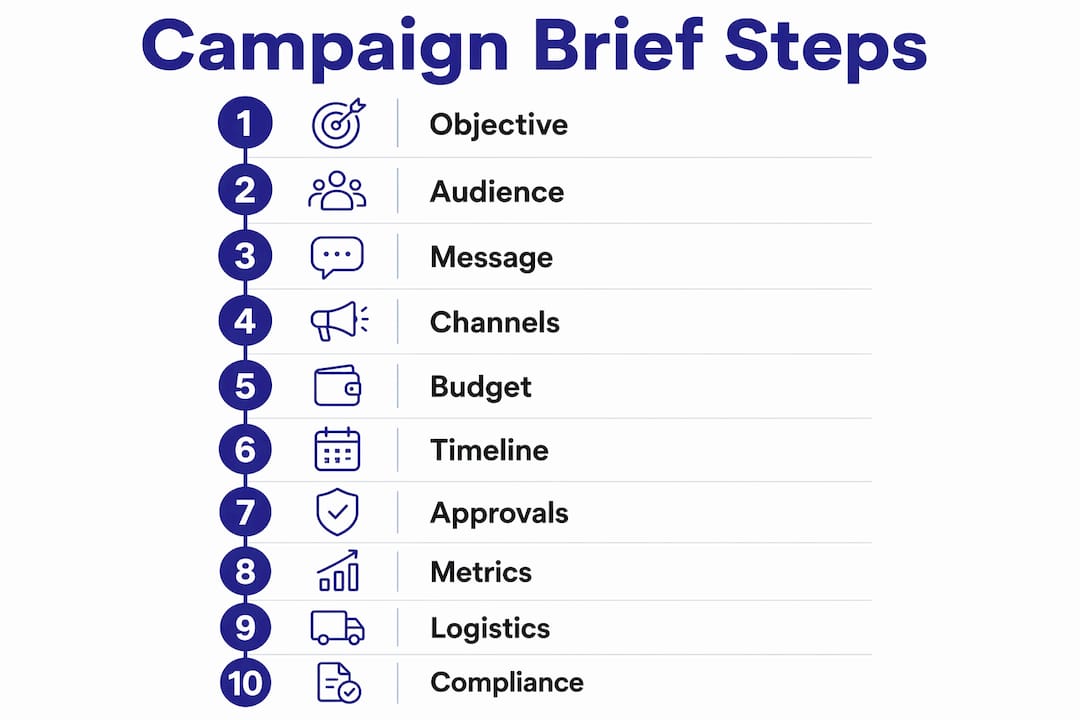
Channel strategy and product integration
Describe where the promotional product fits in the broader campaign mix. Is it the only touchpoint, or does it support an email sequence, a social push, or an in-person event? Integrating the physical distribution timeline with your digital campaign schedule is what keeps the campaign landing as one coherent experience rather than a series of disconnected moments.

Budget allocation
Break the total budget into real line items:
- Per-unit product cost
- Setup and tooling fees
- Art and design fees
- Freight and shipping
- Contingency (typically 10% of total)
A standard 2026 budget split allocates roughly 40% to paid media, 30% to creative production, 20% to tools and technology, and 10% to contingency. Adjust those ratios for a promotional-product-heavy campaign, but always build the contingency in from the start.
Timeline
Work backward from the date products need to be in recipients’ hands, not the date you want production to start. Build in buffer for sample approval, artwork revisions, and freight delays. A missed ship date on a trade show giveaway is not recoverable.
Stakeholders and approval flow
Name every approver, their role, and the deadline for their sign-off. Clear stakeholder sign-off before production significantly reduces approval delays. Vague approval processes (“the right people will see it”) are where campaigns stall.
Success metrics and reporting cadence
Set a primary metric, one number that tells you whether the campaign worked. Add three to five secondary metrics that help diagnose why. Define how often you’ll report: daily tracking for leading indicators, weekly reviews, and a post-campaign debrief within five days of wrap.
Distribution logistics
Specify delivery addresses, recipient lists, packaging requirements, and who owns the fulfillment report. Distribution strategy and shipping logistics carry as much weight as product selection. A great item that arrives two weeks late or at the wrong location delivers zero campaign value.
Legal and brand compliance
Note any regulatory requirements, safety certifications for the product category, and brand guideline mandatories. If claims on the product require legal review, flag it here so it doesn’t surface the week before launch.
How to write your promotional product campaign brief, step by step
-
Start with project context. Why is this campaign launching now? What triggered it, and have similar campaigns run before? What worked, and what didn’t? This context helps suppliers and creative partners make better recommendations without a dozen back-and-forth questions.
-
Set your goal before you pick a product. Brand awareness, lead generation, customer retention, and employee motivation each call for a different product type, price point, and distribution method. Locking the goal first drives every downstream decision. Browsing products that work for your goals before the goal is set is where a lot of budget gets quietly wasted.
-
Gather audience data. Pull demographic research, past campaign performance, and any customer survey data your sales team has collected. The more specific your audience profile, the more relevant the product, and a relevant product is one that actually gets used.
-
Define the product’s role in the campaign. Is the promotional item the centerpiece of the campaign, or does it support a broader action? A high-volume conference giveaway has a completely different quality and cost profile than a client appreciation gift sent to 50 accounts. Treating them the same at the planning stage is a common and costly mistake.
-
Estimate quantities and set budget guardrails. Nail down the quantity needed, the per-unit cost ceiling, freight allocation, and a reserve for rush orders or reprints. Without those guardrails, a freight delay or a logo correction can push a campaign over budget before anyone triggers an approval.
-
Assign ownership for every deliverable. Each task in the timeline needs a named owner and a deadline. Shared responsibility is no responsibility. Remote campaign management works only when there is a defined accountability structure, not a shared email thread.
-
Build your distribution and tracking protocol. Who receives what, through which channel, and by when? How are damaged or returned items handled? What system confirms delivery, and who gets the fulfillment report?
-
Get stakeholder sign-off before production starts. Circulate the brief, collect written approvals, and treat the signed brief as a gated document. Mid-campaign scope changes are far more expensive than an extra day spent aligning stakeholders upfront.
-
Request all-in quotes from suppliers. Ask for unit price, setup fees, art fees, tooling, and freight in a single quote. Surprises after bulk production are expensive and avoidable.
-
Run a Golden Sample approval. Before the full production run, approve a signed physical sample that confirms the bulk order will match the approved material, finish, and color. This single step prevents the most common and most painful quality disputes.
Pro Tip: Treat your supplier as a partner, not just a vendor. Share the campaign context, the audience profile, and the goal. Suppliers who understand what you’re trying to achieve can recommend better products, flag production risks early, and contribute creative ideas you wouldn’t have considered. A clear brief is the fastest way to unlock that value.
Common mistakes in promotional product campaign briefs and how to avoid them
A large majority of bidding and production errors start with an incomplete or missing brief. Most of those errors are predictable and preventable.
-
Vague objectives. “Increase visibility” gives your supplier nothing to work with. A vague goal produces a generic product that fits no one’s needs particularly well. Write the objective as a specific, measurable outcome.
-
Confusing the campaign brief with the creative brief. The campaign brief covers strategy, channels, budget, and measurement. The creative brief is a downstream document focused on design direction, visual style, and copy. Mixing the two creates scope creep where assets drift from the original strategy and budget.
-
Ignoring distribution logistics. Choosing the right product and then leaving distribution as an afterthought is one of the most common planning gaps. Items that arrive late, go to the wrong location, or have no tracking built in show up as waste at quarter-end.
-
Skipping numeric success metrics. A campaign with no pre-agreed definition of success cannot be evaluated honestly. Set the primary metric before work begins, not after the results are in.
-
Overlooking total landed cost. Unit price is one number. Total landed cost includes setup fees, tooling, art fees, and freight. Budgeting only for unit price and discovering the rest later is a reliable way to overspend. Many common marketing mistakes trace back to exactly this kind of upstream planning gap.
-
Skipping the Golden Sample process. Approving artwork on screen and assuming the physical product will match is a gamble. A signed physical sample before the full run is the only reliable quality gate.
-
No stakeholder sign-off before production. Briefs that circulate without formal approval invite mid-campaign changes. Those changes cost time and money that a signed brief would have prevented.
-
Treating the brief as a one-time form. The brief is a living reference document. It should be the artifact your team checks when a question comes up mid-campaign, not something filed after kickoff and forgotten.
Statistic callout: 85% of bidding and production errors in promotional product campaigns originate from incomplete or missing briefs, making brief quality the single highest-leverage investment in campaign planning.
When your next campaign brief is ready, Discountswag can help you source the right products to match it. Browse promotional items for brand awareness or explore the full range of branded promotional products to find items that fit your audience, budget, and timeline.
Key Takeaways
A promotional product campaign brief that defines objectives, audience, budget, distribution, and success metrics before production starts prevents the majority of costly errors and delays.
| Point | Details |
|---|---|
| Define objectives in numbers | “Increase visibility” fails; “200 qualified leads by september 30” gives suppliers and teams a real target. |
| Separate campaign and creative briefs | The campaign brief covers strategy and budget; the creative brief handles design direction downstream. |
| Budget for total landed cost | Unit price, setup fees, art fees, tooling, and freight must all appear in the brief before ordering. |
| Require a Golden Sample sign-off | A signed physical sample before the full production run is the only reliable quality gate. |
| Get written stakeholder approval | Clear sign-off before production significantly reduces approval delays and prevents mid-campaign scope changes. |
 Bottle Carriers
 Mugs
Mugs