

Three Prepacked Kits Store Opening Planners Use That Guests Keep

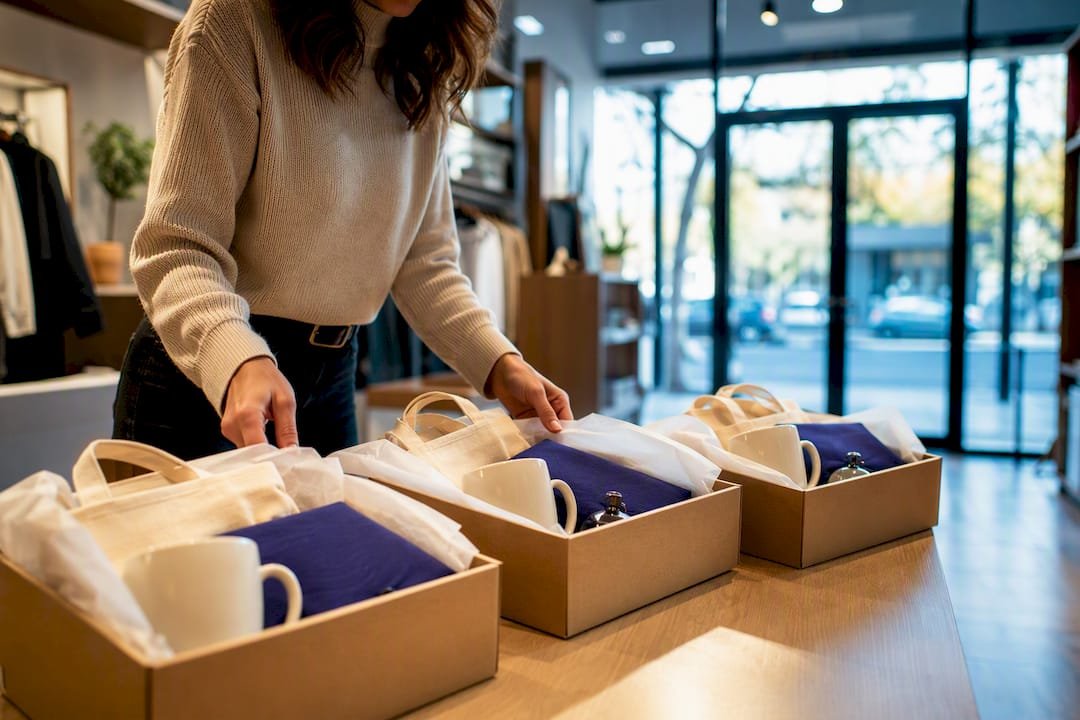
The best store opening swag pairs one genuinely useful item with a coupon and a small premium prize, packaged as a kit and ordered through a supplier that offers rush production and multi-location fulfillment. That combination controls cost, keeps quality consistent across every giveaway, and gives guests something worth carrying home instead of leaving in the parking lot.
TL;DR:
- Build swag kits combining a useful item, a coupon, and premium packaging to control costs and ensure consistent quality across all giveaways.
- Prioritize practical items like tote bags, drinkware, or tech accessories that guests will use long after the event, rather than decorative trinkets.
- Set clear, limited giveaway rules such as one prize per person and designated pickup locations to prevent chaos and bottlenecks.
- Order personalized swag at least three to four weeks in advance, accounting for lead times on apparel, tech accessories, and multistore shipping if needed.
- Focus on operational logistics and presentation to enhance the unboxing experience and maximize long-term brand engagement.
Table of Contents
- What Are the Best Store Opening Swag Ideas by Category?
- Should You Build Swag Kits Instead of Handing Out Loose Items?
- What Ceremonial Items Belong at a Ribbon-Cutting?
- How Should You Structure Giveaway Rules and On-Site Logistics?
- How Much Should a Grand Opening Swag Budget Cost?
- How Far Ahead Should You Order Store Opening Swag?
- Which Swag Items Actually Get Used After the Event?
- How Discount Swag Handles Kits, Rush Orders, and Multi-Location Fulfillment
- What Happens If Swag Arrives Damaged or the Order Needs a Last-Minute Change?
- What Legal Rules Apply to Store Opening Giveaways?
- How Should Store Opening Swag Reflect Your Brand?
- How Do You Vet a Swag Supplier for Quality and Reliability?
- How Do You Turn Swag Into Ongoing Engagement After the Event?
- Why Utility Beats Novelty Every Time
- Ready to Order Your Store Opening Swag Kits?
- Sources
- FAQ
What Are the Best Store Opening Swag Ideas by Category?
Every grand opening giveaway table needs a mix, not a single hero item. Some guests want something to use immediately; others just want proof they were there.
- Tote or reusable bag: works as the “container” for everything else and doubles as a walking billboard on the drive home. Great for families and anyone loaded down with samples.
- Branded cup or bottle: high perceived value, especially for VIPs and loyal walk-ins who’ll actually keep a good tumbler on a desk or in a car.
- Sticker or decal: cheap enough to hand to every single visitor, including kids, without blowing the budget.
- Tech cord, charging cable, or phone accessory: a strong pick for commuters and younger shoppers who’ll use it daily.
- Pens and notebooks: low cost, high volume, ideal for general foot traffic.
- Apparel like caps or tees: reserve for staff, press, or a limited raffle prize rather than mass distribution, since cost per unit climbs fast. Consider adding custom embroidered patches to staff apparel for low-cost branding, as explained by Your Logo is the Patch – OctoPatches.
- Coupon, sample, or small product: often the actual conversion driver, since it pulls people back into the store within a week or two.
For eco-conscious brands, swapping plastic bottles for aluminum, or vinyl stickers for compostable options, adds a small premium but plays well on social media and with sustainability-minded shoppers.
Should You Build Swag Kits Instead of Handing Out Loose Items?
Kits beat loose-item tables for one simple reason: they control what each guest receives instead of leaving it to whoever’s grabbing fastest off the table. Three templates cover most openings.
- Attendee kit: tote bag, sticker, coupon, and one small useful item like a pen or phone accessory. Budget-friendly and easy to prepack in bulk.
- Staff or welcome pack: branded apparel, a notebook, and an internal welcome card. Keeps the team looking uniform on camera during the ribbon cutting.
- VIP or press kit: premium drinkware or tech item, a personalized note, and packaging that actually looks like a gift, not a giveaway.
Presentation matters more than most planners assume. A branded merchandise unboxing experience with a printed box, tissue paper, and a clean label turns a $6 item into something a VIP photographs and posts. For distribution, you’ve got three real options: prepack everything and ship to the venue, hand out kits on-site from a staffed table, or set up a self-serve swag locker so guests grab their own kit without a line.
What Ceremonial Items Belong at a Ribbon-Cutting?
Giveaways are for guests. Keepsakes are for the moment itself, and they’re a different budget category entirely.
- Engraved ceremonial scissors: the classic ribbon-cutting prop, and a common presentation gift for the owner afterward.
- Plaques or framed certificates: mark the date, location, and business name for a wall the owner will actually keep.
- Commemorative signage: a printed banner or sign guests can photograph, useful for local press coverage.
Event guides consistently point to engraved scissors and plaques as the standard ribbon cutting gifts for a reason: they photograph well and last decades. Personalize each piece with the date, city, and owner’s name, and hand the scissors to the owner or a local official rather than a staffer. Unlike giveaway swag, these items aren’t mass-produced, and they’re usually what ends up in the local news photo, which is worth more than any single tote bag.
How Should You Structure Giveaway Rules and On-Site Logistics?
Loose rules create chaos. A raffle with no posted limit turns into a scrum around the prize table within minutes.
- First-in-line freebies: reward the first 50 or 100 guests with a specific prize. Local grand openings have used this to generate real buzz, including one chicken chain that gave away free chicken for a year to a first-in-line winner.
- Raffle-ticket systems: hand out tickets at check-in, draw winners on the hour to keep energy up throughout the day.
- Prize boards: let guests choose from a visible board of tiered prizes, which speeds up decision-making at the table.
- App-based digital redemption: works well for coupon-style prizes tied to a follow-up purchase.
Post clear rules before doors open: one prize per person, on-day pickup only, a single designated pickup spot, and no exchanges. Retailers running structured grand opening giveaways rely on exactly these limits to avoid disputes.
Pro Tip: Staff the redemption desk with two people minimum: one checking off names or scanning tickets, one physically handing over the prize. Splitting the job prevents the bottleneck that turns a giveaway line into a complaint.
How Much Should a Grand Opening Swag Budget Cost?
Per-unit pricing drops fast once you cross common order thresholds. A sticker that costs $0.90 at 100 units can drop under $0.30 at 1,000, and the same curve applies to totes, pens, and drinkware.
- Order 10% to 20% more than your expected headcount to cover walk-ins and staff needs.
- Tier your allocation: reserve premium items for VIPs and press, mid-tier items for the general crowd, and bulk low-cost items like stickers for everyone including kids.
- A 250-guest opening might run $800 to $1,500 for a full attendee kit mix; a 1,000-guest event, using the same bulk-pricing curve, often lands closer to $2,500 to $4,000 rather than scaling linearly, since per-unit costs keep dropping at higher volumes.
Pairing one low-cost item with a single premium prize or coupon is a common pattern for a reason: it balances visible generosity against actual spend.
How Far Ahead Should You Order Store Opening Swag?
Lead times vary by product, and cutting it too close is the most common planning mistake.
- Apparel: typically 2 to 3 weeks for standard production, often compressible to about a week with rush service.
- Drinkware: similar window, 2 to 3 weeks standard, since many designs require a curing or coating step that can’t be skipped.
- Stickers and decals: usually the fastest turnaround, sometimes under a week even without rush fees.
- Tech accessories: 2 to 4 weeks depending on complexity, since custom cables and cases often involve more assembly steps.
Build in an internal deadline for artwork approval at least a week before you place the order. Vague or last-minute logo files are the single biggest cause of delayed proofs. If you’re shipping to more than one store location, add extra days for staging and splitting shipments. A supplier that handles multi-location fulfillment directly avoids the extra step of you repacking and reshipping boxes yourself.
Which Swag Items Actually Get Used After the Event?
Usefulness beats novelty every time. A guest keeps a decent water bottle for years; a cheap branded stress ball hits the trash within a week.
- Prioritize by usefulness first: something a guest would buy anyway (a bottle, a bag, a phone accessory) beats something purely decorative.
- Match items to who’s actually attending: commuters respond to tech accessories, families respond to bags and kids’ items, professionals respond to notebooks and drinkware.
- Favor durability over flash: a slightly plainer item that survives a dishwasher or a backpack beats a flashier one that breaks in a month.
- Weigh sustainability against perceived value: eco-friendly materials cost a bit more per unit but tend to read as higher quality, not lower.
Pro Tip: If you’re only stocking one “keeper” item per guest, make it something with your logo in a spot people actually see when using it, not tucked on the bottom. A guide to choosing corporate swag that works walks through this selection logic in more depth.
How Discount Swag Handles Kits, Rush Orders, and Multi-Location Fulfillment
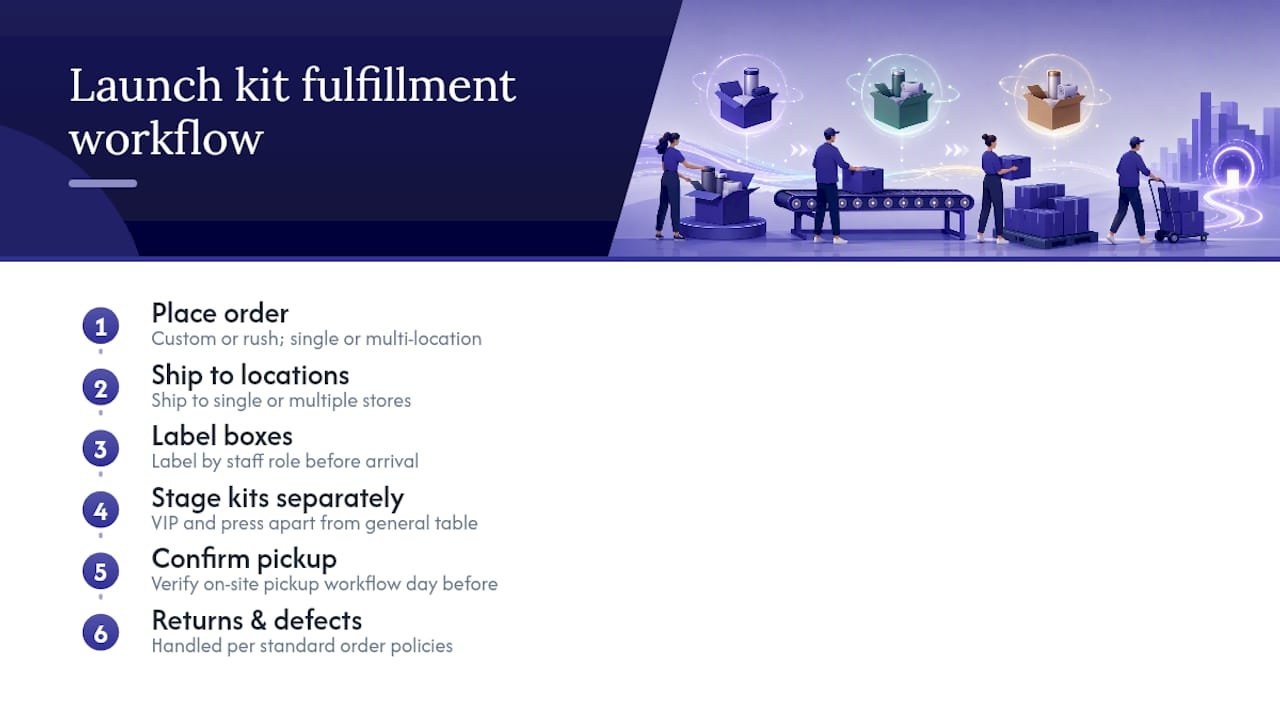
Custom kits, rush production services, and shipping to single or multiple store locations from one order are important when a chain is opening multiple locations in the same month instead of one. Practical execution tips: label boxes by staff role before they arrive on-site, stage VIP and press kits separately from the general attendee table, and confirm your on-site pickup workflow with staff the day before, not the morning of. For distribution mechanics specific to a launch, marketing team swag distribution tips covers the on-site side in more detail. Returns and defect handling follow standard order policies, covered next.
What Happens If Swag Arrives Damaged or the Order Needs a Last-Minute Change?
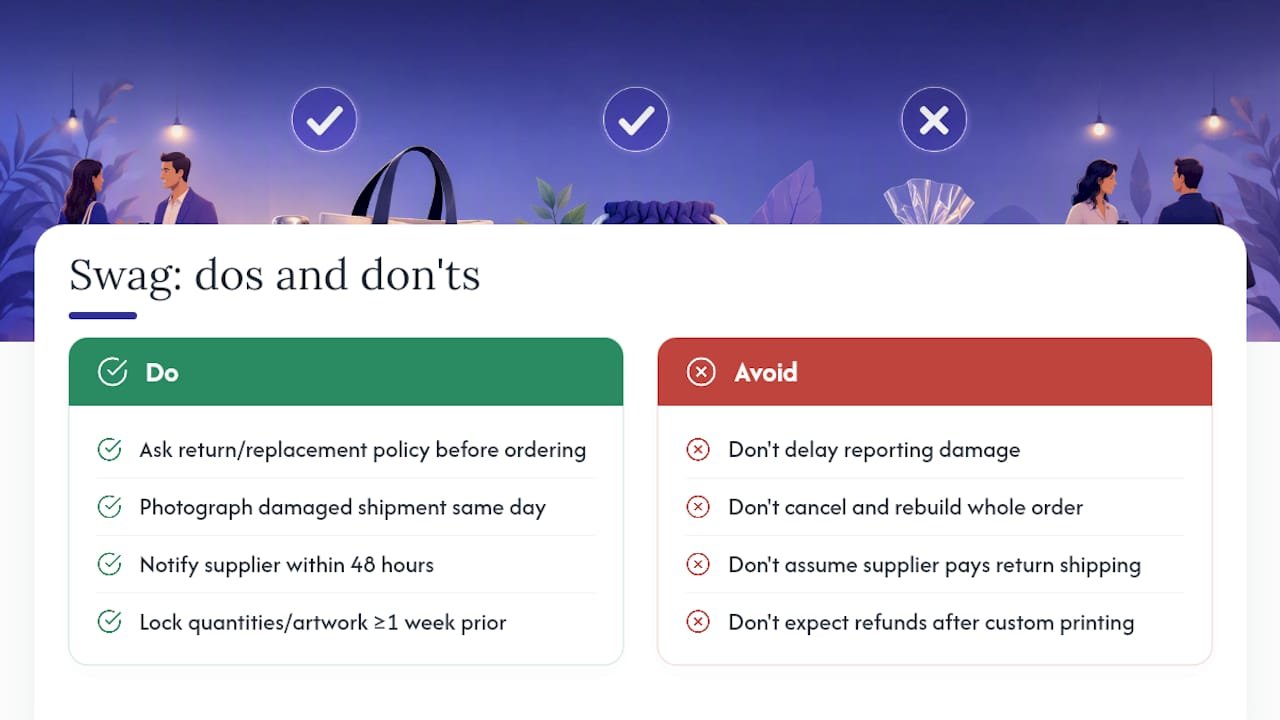
Defects happen even with good suppliers, so ask about return and replacement policy before you place a bulk order, not after boxes show up cracked. Most reputable promotional product distributors will replace a defective batch or issue a credit, but the timeline depends on catching the problem fast: photograph any damaged shipment the day it arrives and notify the supplier within 48 hours if possible, since many return windows shrink the longer you wait.
Last-minute changes are trickier, because customization is what makes swag valuable and also what makes it hard to reverse. Once a logo is printed on 500 tote bags, that order generally can’t be resold or refunded like a blank product. That’s why smart planners lock quantities and artwork at least a week before the event date, leaving only a small buffer of “maybe” units unordered until headcount firms up. If you genuinely need more units after the initial order ships, ask about a supplemental rush order rather than trying to cancel and rebuild the whole order from scratch. It’s almost always faster and cheaper than starting over.
For date or venue changes that push the event back, most suppliers can hold a completed order in their warehouse for a short period rather than force early delivery. Confirm that policy in writing before you place the order, especially if you’re coordinating a ribbon-cutting date that depends on a permit or inspection that could slip. Ask specifically: what’s the return window, who pays return shipping on a defect claim, and is there a restocking fee on unused blank inventory. Those three questions cover most of the disputes that come up after an event.
What Legal Rules Apply to Store Opening Giveaways?
Trademark and contest rules are easy to overlook until they cause a real headache. If your giveaway involves a raffle, sweepstakes, or any prize awarded by chance rather than by “first come, first served” order, many states classify that as a lottery or sweepstakes subject to specific disclosure and registration rules. First-in-line and first-100-in-line giveaways typically sidestep this issue because there’s no chance element, which is part of why so many grand openings default to that mechanic instead of a raffle.
If a raffle is genuinely the format you want, check your state’s specific rules before running it. Some states require no purchase necessary language, official rules posted publicly, and a clear alternate method of entry if any purchase is involved in qualifying. A local chamber of commerce or small business attorney can confirm what applies in your specific city and state, since rules vary and get updated periodically.
Trademark issues usually come up around co-branding. If you’re partnering with a local charity, another business, or using a licensed character or logo on your swag, get written permission before it goes to print. Using someone else’s registered trademark on branded merchandise without a license, even for a one-day event, can trigger a takedown or a legal letter after the fact. When in doubt, stick to your own logo, your own name, and your own colors, and save co-branding for cases where you have an actual signed agreement in place.
How Should Store Opening Swag Reflect Your Brand?
Logo placement matters more on small items than large ones. On a tote bag or tee, centering the logo works fine because there’s room to breathe. On a pen, sticker, or phone accessory, a full logo often gets crowded or illegible, so a simplified mark, initials, or icon version reads better at that scale.
Color consistency across every item in the kit is what makes a giveaway table look intentional instead of thrown together. Pick two, maybe three brand colors and apply them consistently across bags, cups, and packaging, rather than letting each vendor default to whatever stock color they have on hand. A mismatched giveaway table, where the tote is navy, the cup is teal, and the sticker is royal blue, reads as unplanned even if every individual item is nice.
Message alignment is the part planners skip most often. A grand opening giveaway is a chance to say something specific, not just print a logo. A coupon that reads “Welcome to the neighborhood, here’s 20% off your first visit” does more work than a blank logo tote, because it gives the guest an actual reason to come back. If your opening has a theme, a charity tie-in, or a specific product launch, work that message into at least one item in the kit, whether that’s a tag on the bag or a line on the coupon insert. Consistency between your signage, your staff apparel, and your giveaway items is what makes the whole event look like one coordinated brand moment rather than a table of unrelated freebies.
How Do You Vet a Swag Supplier for Quality and Reliability?
Ask about minimum order quantities and sample policy before you commit to a design. A supplier that requires a 500-unit minimum on every item isn’t a fit for a small single-location opening, while one that offers low minimums with volume discounts scales better as your event grows year over year.
Material durability is where cheap suppliers cut corners that guests notice immediately. A tote bag with thin seams rips on the first heavy grocery run; a tumbler with a weak coating chips after one dishwasher cycle. Ask for a physical sample of your actual order, not a stock photo, before you commit to a bulk run. Reputable suppliers expect this request and build sample turnaround into their process.
Check how a supplier handles proofing. You want to see a digital mockup with your actual logo and colors before production starts, not after, and you want a named contact you can reach if something on the proof looks off. Suppliers who batch every order through a single generic support inbox tend to be slower to catch mistakes than ones who assign a specific rep to bigger orders.
Finally, ask directly about rush capability and multi-location shipping if either applies to your event. A supplier that only ships to one address, or that treats “rush” as a marketing term rather than an actual shortened production window, will cause problems the one time you actually need speed. Get the real rush timeline in writing, not a vague “we’ll try.”
How Do You Turn Swag Into Ongoing Engagement After the Event?
The event ends, but the swag doesn’t have to stop working the next day. A branded tote or cup only pays off long term if it keeps reminding someone of your store weeks after the ribbon cutting.
Encourage social sharing at the event itself: a simple sign near the giveaway table with your handle and a suggested hashtag gets more organic posts than hoping guests remember to tag you later. Some brands go further and offer a small incentive, like an extra raffle entry, for posting a photo with the swag on-site. That’s the fastest way to turn a one-day event into a week of organic reach, since guests’ own followers see the store name attached to a real photo, not an ad.
Follow-up campaigns work best when they’re tied to something specific in the swag kit itself. If you handed out a coupon good for two weeks, schedule a reminder email or text the day before it expires. If your kit included a QR code linking to a loyalty sign-up, track how many of those codes actually got scanned; that number tells you more about real engagement than attendance count alone. Even simple moves, like following up with a “thanks for coming” email that includes a photo from the event, keep the store top of mind without feeling like another sales pitch. The goal isn’t a single big day. It’s turning opening-day traffic into people who come back a second and third time.
Why Utility Beats Novelty Every Time
Most swag advice defaults to “make it memorable,” which sounds right and usually leads planners toward the wrong purchase. A quirky, one-off novelty item gets a laugh at the table and a spot in a junk drawer within a week. A decent tote bag or a phone cable gets used, seen, and associated with your store dozens of times before it wears out.
The research on actual grand openings backs this up: the events that generate real coverage pair a genuinely useful item with one attention-grabbing prize, not a table full of forgettable trinkets. That’s a different budget conversation than most planners have. Instead of spreading a fixed budget evenly across five cute items, put most of the money into one item people will actually keep using, and let a cheap sticker or coupon cover the rest of the crowd.
The other place conventional advice falls short is logistics. Plenty of guides talk about what to buy and almost none talk about how fulfillment, lead times, and on-site rules make or break the day. A perfect item that arrives three days late, or gets handed out with no posted limit and causes a shoving match at the prize table, does more brand damage than a mediocre item handled well. Prioritize the operational plan first. The product choice matters less than most planners think.
— Jerry
Ready to Order Your Store Opening Swag Kits?
This guide recommends custom kits with a high-utility item, branded packaging, and the option to add rush production when the opening date is closer than the supplier’s standard timeline allows. If you’re opening two or three locations in the same month, multi-location shipping means one order handles staging and delivery to every site instead of you juggling separate purchase orders.
Start by browsing top branded giveaway items that earn repeat use to shortlist your primary item, then check the branded merchandise for events planner’s guide for kit structure and packaging options. Every order includes a design proof before production starts, so you approve the exact look before a single unit gets made. Reach out with your target date and headcount, and you’ll get a realistic lead time back the same day, rush or standard.
Sources
- Grand opening giveaway
- He used to drive to Ohio for Raising Cane’s – now he’s won free chicken for a year at the new Saginaw County spot
- Ribbon cutting gifts | eHow
FAQ
What is a good gift for a new store opening?
A reusable item guests will actually use, like a tote bag, a drinkware piece, or a phone accessory, paired with a coupon or small premium prize works better than a purely decorative giveaway.
What is swag in retail?
Swag refers to branded promotional items, apparel, or giveaways a retailer distributes to build brand awareness and reward customer attendance at events like store openings.
What are some creative ideas for a store opening?
First-in-line prize giveaways, raffle-ticket drawings tied to hourly prize announcements, and a charity or community tie-in tend to generate the most attendance and local coverage.
What are some good business swag ideas?
Reusable bags, drinkware, stickers, tech accessories, and apparel each fit different budgets and audiences; pairing a high-utility item with a coupon or single premium prize balances cost against impact, and a supplier like Discount Swag can build that mix into a prepacked kit.
How far in advance should I order store opening swag?
Order at least 3 to 4 weeks out for apparel and drinkware, and confirm your supplier’s rush-order window if your event date is closer, since stickers and simpler items often turn around faster than apparel or tech accessories.
 Bottle Carriers
 Mugs
Mugs