

Embroidered Polos vs Printed Tees

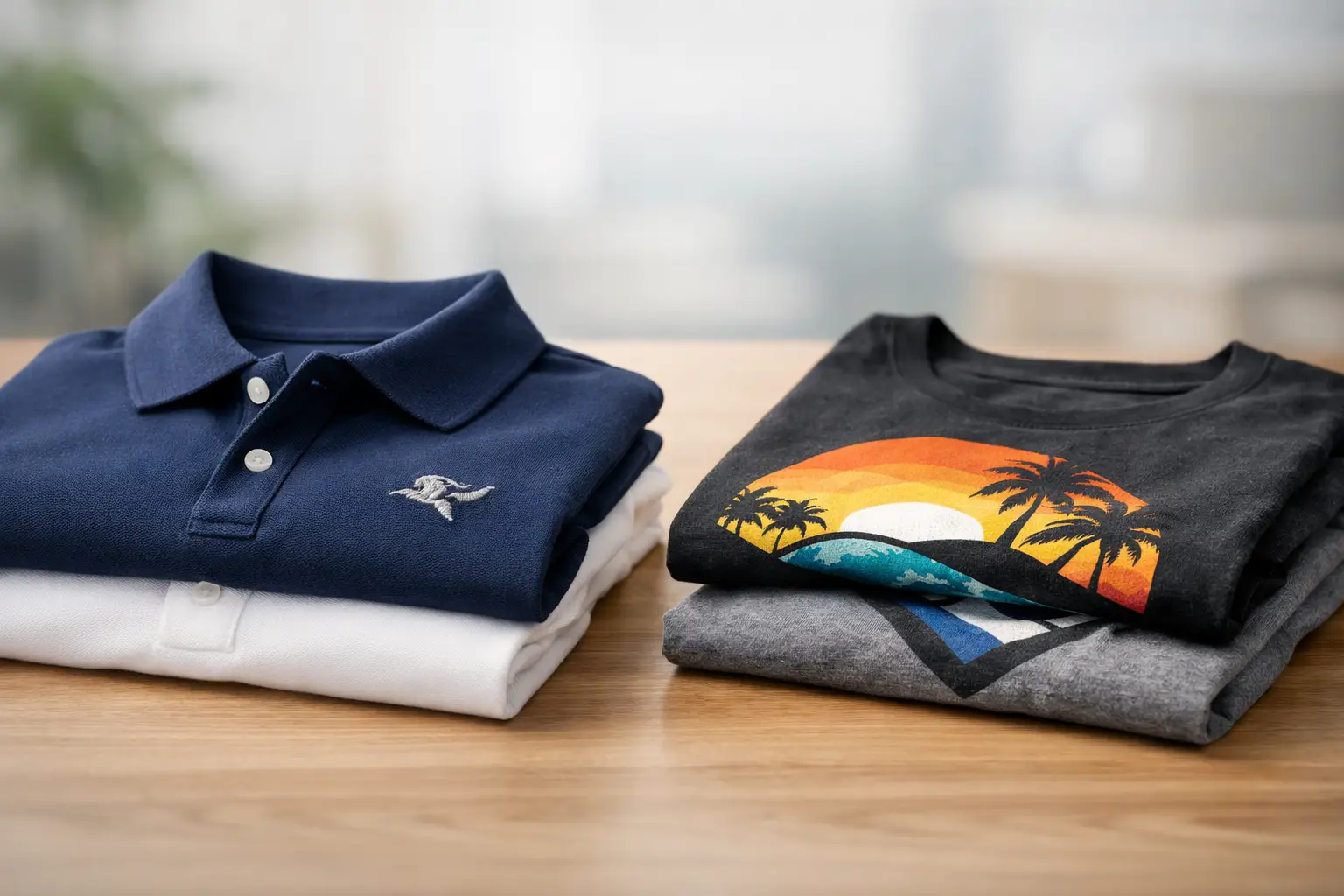
If you are choosing between embroidered polos vs printed tees, the right answer usually comes down to where the item will be worn, how long you need it to last, and what you can afford at scale. A polo with embroidery sends a different message than a T-shirt with a printed logo, and business buyers feel that difference fast – especially when the order is tied to an event date, a uniform rollout, or a fixed promo budget.
For some teams, polos are the easy call. They look polished, hold up well, and fit customer-facing roles. For others, printed tees make more sense because they are budget-friendly, easier to hand out in volume, and better for casual campaigns. The mistake is treating them as interchangeable. They are not.
Embroidered polos vs printed tees: what changes most?
The biggest difference is perceived value. Embroidered polos tend to look more premium because the logo is stitched into the fabric. That texture adds weight to the branding and makes the garment feel more like a uniform or a branded apparel piece someone would actually keep.
Printed tees are usually built for reach. They are often less expensive, faster to produce in many cases, and better suited for larger giveaway quantities. If your goal is broad visibility at the lowest cost per item, a printed tee is hard to ignore.
That does not mean polos are always better quality or tees are always disposable. It depends on the garment itself, the print method, the artwork, and the use case. But from a buyer’s perspective, polos usually support a more professional brand image, while tees support scale and flexibility.
When embroidered polos are the smarter buy
If your staff interacts with customers, partners, or prospects, embroidered polos usually earn their price. They help create a uniform look without feeling overly formal. For sales reps at trade shows, hospitality teams, field staff, branch employees, and onboarding kits for customer-facing roles, polos communicate consistency.
Embroidery also performs well over time. A stitched logo generally holds up through repeated wear and washing, especially when compared with lower-end prints on lightweight shirts. That matters if you are buying for employees rather than one-day event traffic. The cost per wear can actually be better, even if the upfront unit price is higher.
Polos also fit branded apparel programs where presentation matters. A clean chest logo on a solid-color polo is a safe, reliable choice for companies that want their brand to look established. If procurement is trying to avoid complaints about cheap-looking swag, polos reduce that risk.
There are trade-offs. Embroidery adds cost, and larger stitched designs can get expensive quickly. It is also not ideal for detailed artwork, gradients, or oversized graphics. If your logo is complex, small text can become a problem. And if you need thousands of units for a major giveaway, the budget can climb fast.
When printed tees make more sense
Printed tees win when volume, creativity, and cost control matter most. They are a practical choice for recruiting events, awareness campaigns, internal culture programs, product launches, volunteer days, and large trade show distributions. If your priority is putting branded apparel into as many hands as possible, tees usually stretch the budget further.
Printing also gives you more freedom with design. Front graphics, full-back prints, bold colors, slogans, and campaign-specific artwork are all easier to execute on a T-shirt. That makes tees especially useful when the message matters as much as the logo.
For marketing teams, this flexibility is a real advantage. A printed tee can feel less like a company uniform and more like a piece of merch. That increases the odds someone will wear it casually, which extends brand exposure beyond the event itself.
The trade-off is durability and perceived formality. Some printed shirts hold up very well, but lower-cost options may crack, fade, or lose shape over time. Even when the print quality is strong, a tee still reads as casual. That can be perfect for the right audience, but not every brand wants that look in front of clients.
Budget pressure changes the decision
Most buyers are not choosing in a vacuum. They are balancing department budgets, quantity requirements, and deadline pressure. That is why embroidered polos vs printed tees is often less about preference and more about allocation.
If you have a fixed budget, polos usually mean fewer units and a more targeted distribution. That works well for employees, VIP customers, channel partners, and smaller groups where the item needs to carry more value. Printed tees usually mean broader distribution and lower cost per impression. That works better for public-facing campaigns and high-volume events.
There is also a middle ground. Some teams split the order: embroidered polos for staff and printed tees for attendees. That approach protects the presentation of your team while keeping giveaway costs under control. It is one of the most efficient ways to match apparel to audience without forcing one product to do two different jobs.
Think about the setting, not just the garment
A lot of bad swag decisions happen because buyers focus on product type before they think about environment. Start with where the apparel will be used.
If the setting is professional, customer-facing, or operational, polos usually make the stronger case. Think hotel check-in desks, campus tours, sales floors, healthcare admin teams, and expo booth staff. In those settings, a collar adds structure and credibility.
If the setting is energetic, informal, or promotional, tees usually fit better. Think 5Ks, college recruiting fairs, warehouse appreciation events, startup launches, company retreats, and festival-style brand activations. In those cases, the relaxed look is part of the appeal.
This is also where industry matters. A law firm and a software startup can order branded apparel for the same event and need completely different answers. The best choice is the one that matches how your audience already dresses.
Branding detail matters more than buyers expect
A simple logo behaves differently on a polo than it does on a tee. Embroidery works best with clean marks, limited detail, and placements like the left chest or sleeve. It is subtle by nature. That is part of the value.
Printing can do much more visually. If your campaign depends on a large graphic, a tagline, multiple colors, or artwork that needs to stand out from across the room, tees have the advantage. They can carry the message without being restricted to a small stitched area.
This matters for internal teams too. Employees are more likely to wear apparel again if the design feels current and usable. A tasteful embroidered polo works for workwear. A well-designed printed tee works for off-hours use. If repeat wear is the goal, style matters as much as branding method.
Fulfillment, sizing, and distribution are part of the cost
Apparel orders do not end when the art is approved. Business buyers also need to think about size curves, distribution complexity, and reorder risk. Polos can be a stronger employee item, but they may require more careful sizing and tighter inventory planning. Tees are usually easier for broad event distribution because recipients are more forgiving on fit.
If you are shipping to multiple offices or remote employees, the decision gets even more practical. A premium polo sent to a new hire can feel intentional and high-value. A printed tee in a branded box can support culture and team identity at a lower cost. Neither is wrong. The better option depends on the role, the audience, and the budget attached to each recipient.
For large programs, dependable sourcing matters as much as product selection. A price-led supplier with strong fulfillment support can make the difference between a smooth rollout and a scramble. That is one reason business buyers work with partners like Discount Swag when they need competitive pricing, trusted product options, and shipping that keeps pace with real deadlines.
So which one should you buy?
Buy embroidered polos when the apparel needs to represent your brand in a polished way, hold up over time, and support employee or customer-facing use. Buy printed tees when you need volume, design flexibility, and lower unit costs for broader campaigns.
If you are still split, ask one practical question: is this item meant to impress a smaller group or reach a larger one? That answer usually gets you to the right product faster than debating apparel trends.
The best swag buys are not about picking the fanciest option. They are about matching the product to the job, protecting your budget, and making sure the item actually gets worn.
 Bottle Carriers
 Mugs
Mugs