

Promotional Keychains for Bulk Giveaways: Buyer’s Guide

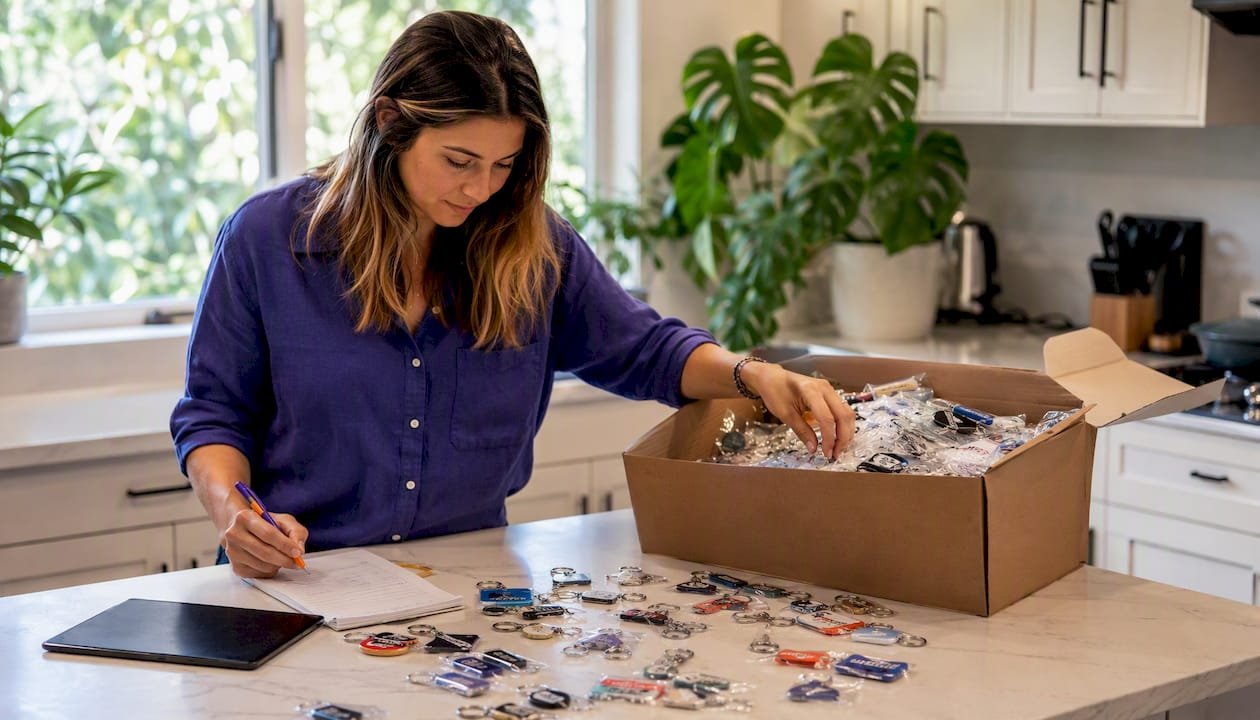
For most bulk giveaways, order metal keyrings when durability matters and soft PVC or acrylic when novelty and shape variety are the priority. Your immediate next step: request a physical sample and an itemized bulk quote from Discountswag before committing to a full run.
Here is how the three main use cases break down:
- Trade shows (large runs): Soft PVC and acrylic keychains hit the right balance of cost and visual impact. You can order hundreds or thousands without blowing the per-unit budget, and the repeat-use rate for keychains makes them one of the stronger giveaway categories for brand recall.
- Client gifts (premium): Metal die-struck or leather keychains signal quality. A recipient who keeps a well-made metal keyring on their keys for two years is delivering far more impressions than a tote bag stuffed in a closet. Discountswag’s data-driven guide on promotional product effectiveness supports this logic directly.
- Event swag (novelty): Shaped acrylic cutouts and novelty PVC pieces work well here. Custom shapes tied to your brand or event theme get noticed and kept.
Before you place any order, confirm MOQ, production lead time, imprint method, and proofing process with your supplier. Those four details determine whether your order ships on time and looks right.
Table of Contents
- What types of promotional keychains should you order?
- How to choose the right keychain for your campaign
- What imprint methods and finishes actually work on keychains?
- Typical pricing, MOQs, and lead times to plan around
- Artwork specs and the ordering checklist that prevents delays
- Packaging, kitting, and fulfillment options for bulk orders
- Why Discountswag makes bulk keychain ordering straightforward
- Key Takeaways
- Custom promotional keychains, ready to order from Discountswag
What types of promotional keychains should you order?
The material and style you choose determines durability, imprint quality, and per-unit cost. Below is a breakdown of the main types, followed by a comparison table across the decision dimensions that matter most.
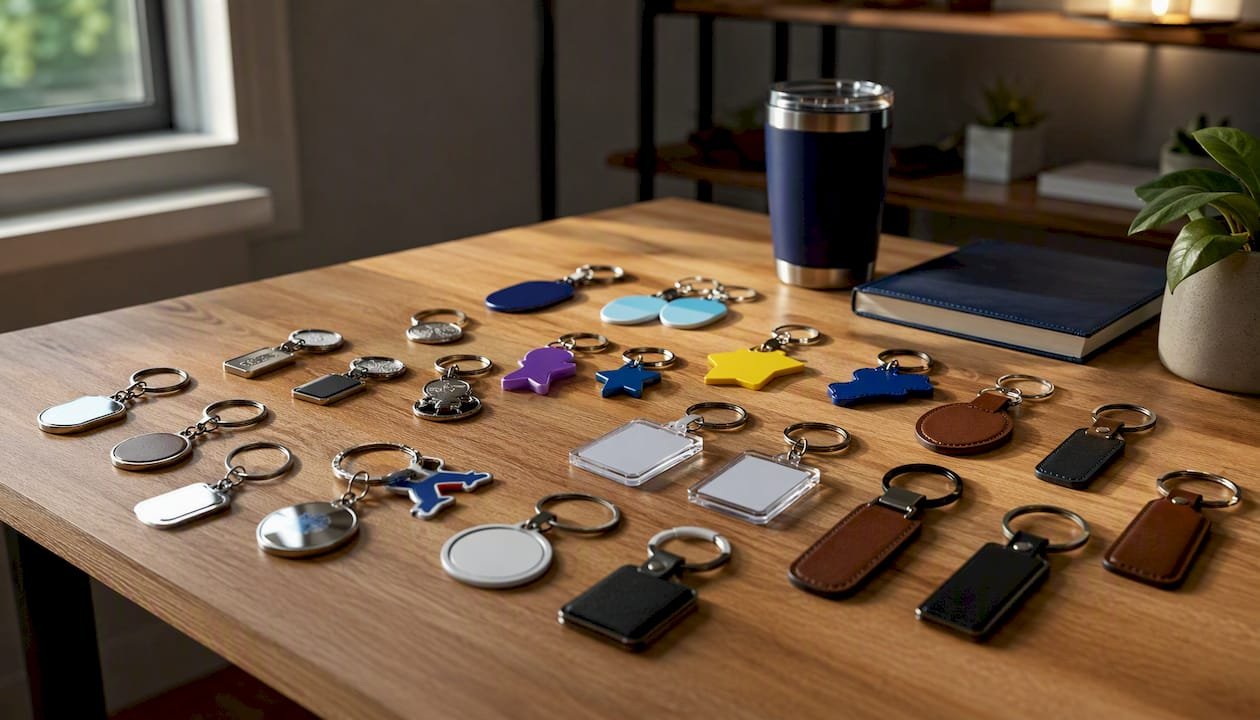
Metal keychains (die-struck, stamped, or plated) are the workhorse of the category. Die-struck metal offers crisp, permanent detail with no ink to fade. Plated finishes (gold, silver, antique brass) add perceived value at a modest cost premium. Best for client gifts, corporate anniversaries, and any campaign where longevity matters. Imprint methods: laser engraving, soft enamel fill, epoxy dome. Cost signal: mid to premium.
Soft PVC keychains are molded rubber-style pieces that can take almost any shape. A 3D PVC keychain shaped like your product, mascot, or logo is a conversation starter. They are lightweight, durable enough for daily use, and print-friendly for full-color designs. Best for trade shows, youth audiences, and novelty campaigns. Cost signal: economy to mid.
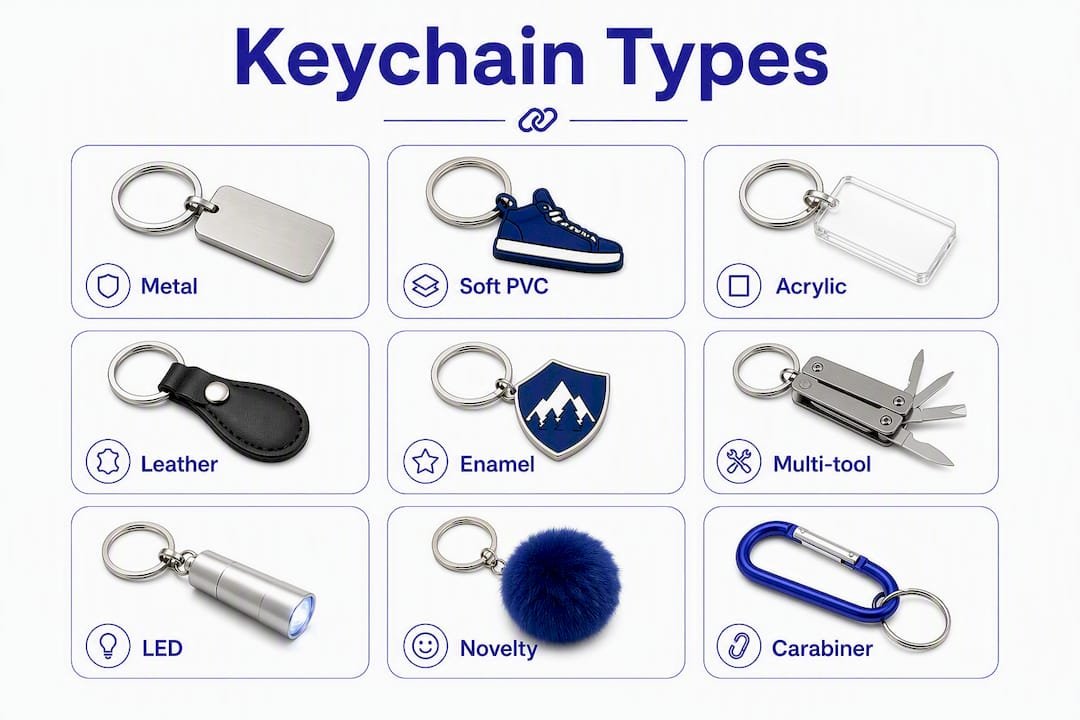
Acrylic keychains offer a clean, modern look. Clear acrylic with a printed insert or a full-color digital print on frosted acrylic both work well. Custom cutout shapes are easy to produce and photograph well for social media. Best for events, retail promotions, and campaigns with complex artwork. Cost signal: economy to mid.
Leather keychains sit at the premium end. Debossed or laser-engraved leather reads as a genuine gift rather than a freebie. Use these for VIP client appreciation, executive gifting, or onboarding kits. Cost signal: premium.
Enamel and epoxy dome keychains combine a metal base with either soft enamel color fills or a clear epoxy dome over a printed design. The epoxy dome is particularly good for full-color logos that need protection. Cost signal: mid to premium.
Multi-tool keychains (bottle opener, carabiner, USB drive, or flashlight combos) earn repeat use because they are functional. A keychain that also opens bottles or charges a phone stays on the keyring. Best for outdoor events, tech audiences, and campaigns where utility is the message. Cost signal: mid to premium.
LED and flashlight keychains are a practical novelty. They get used, which means your logo gets seen. Best for safety-focused brands, outdoor events, and trade shows where you want to stand out from a table full of pens.
Novelty shaped keychains (custom cutouts in acrylic or PVC) are the most flexible format for brand storytelling. Any shape your design team can draw, a supplier can produce.
Carabiner-style keyrings are a separate attachment category that doubles as a functional clip. The small carabiner key ring from Discountswag is a good example of how an attachment style can itself become the product’s selling point.
| Type | Best for | Typical price band | MOQ | Lead time | Imprint methods | Durability |
|---|---|---|---|---|---|---|
| Metal (die-struck/plated) | Client gifts, corporate | Mid–premium | Moderate minimum order quantity | Typical lead time | Laser engrave, enamel, epoxy | High |
| Soft PVC | Trade shows, novelty | Economy–mid | Moderate minimum order quantity | Typical lead time | Full-color mold, pad print | Medium–high |
| Acrylic (clear/frosted) | Events, retail promos | Economy–mid | Moderate minimum order quantity | Typical lead time | Digital print, UV print | Medium |
| Leather | VIP gifts, onboarding | Premium | Moderate minimum order quantity | Typical lead time | Laser engrave, deboss | High |
| Enamel/epoxy dome | Brand-forward campaigns | Mid–premium | Moderate minimum order quantity | Typical lead time | Enamel fill, epoxy dome | High |
| Multi-tool (bottle opener, USB) | Outdoor, tech events | Mid–premium | Moderate minimum order quantity | Typical lead time | Laser engrave, pad print | High |
| LED/flashlight | Safety, outdoor events | Mid | Moderate minimum order quantity | Typical lead time | Pad print, laser | Medium |
| Novelty shaped (acrylic/PVC) | Events, brand storytelling | Economy–mid | Moderate minimum order quantity | Typical lead time | Digital, full-color mold | Medium |
| Carabiner-style | Outdoor, active audiences | Economy–mid | Moderate minimum order quantity | Typical lead time | Laser engrave, pad print | High |
Pro Tip: Pick one or two attachment styles and stay consistent across your order. Split rings are universal and low-cost. Lobster clasps feel more premium and are easier to attach. Carabiners add utility for outdoor or active audiences. Mixing attachment types across a single campaign order creates fulfillment confusion and inconsistent unboxing.
How to choose the right keychain for your campaign
Start with your audience and work backward. A keychain that fits a 22-year-old at a music festival is not the same product you send to a CFO as a thank-you gift.
Key decision criteria:
- Audience profile: Age, lifestyle, and context of use. Functional multi-tools suit active or outdoor audiences; leather suits executives.
- Campaign purpose: Mass awareness (trade show) calls for economy-tier, high-volume orders. Premium gifting calls for quality over quantity. Higher-quality items drive better long-term brand impressions even when the per-unit cost is higher.
- Durability needs: Will this keychain live on a keyring for two years or get tossed after one event? Metal and leather outlast PVC for daily carry.
- Imprint size and complexity: A detailed multi-color logo needs a larger imprint area and a compatible method (digital print or epoxy dome). A single-color wordmark works fine with pad printing or laser engraving.
- Budget per unit: Set a total budget first, then divide by your target quantity to get your ceiling per unit. Factor in setup fees, which are often charged separately.
- Distribution channel: Handing out at a booth is different from mailing to a list. Mailed keychains need individual packaging; booth giveaways can ship bulk-bagged.
- Sustainability preferences: Some buyers now ask for recycled metal or eco-friendly PVC alternatives. Ask your supplier what options exist before assuming they do not.
Vendor questions checklist — ask these before you commit:
- What is your MOQ for this specific product, and do you offer small-run samples?
- What are your price breaks (e.g., at 100, 250, 500, 1,000 units)?
- What is standard production lead time, and what does rush production cost?
- Do you provide a physical sample or a digital proof before full production?
- What file formats do you accept, and what is your minimum imprint area for this product?
- What is your replacement or quality-assurance policy if items arrive defective?
Trust signals worth verifying before placing a large order: product pages that show actual dimensions and imprint area specs (not just lifestyle photos), published customer reviews, a clear sample policy, and a stated QC process. Suppliers who cannot answer questions 4 and 6 above clearly are a risk.
What imprint methods and finishes actually work on keychains?
The imprint method determines how your logo looks in five years, not just on delivery day. Choosing the wrong method for the material is one of the most common and most avoidable mistakes in bulk keychain orders.
Pad printing transfers ink from a silicone pad onto a flat or slightly curved surface. It works well on metal and PVC for simple one- to four-color logos. Cost-effective for large runs. Not ideal for photographic images or gradients.
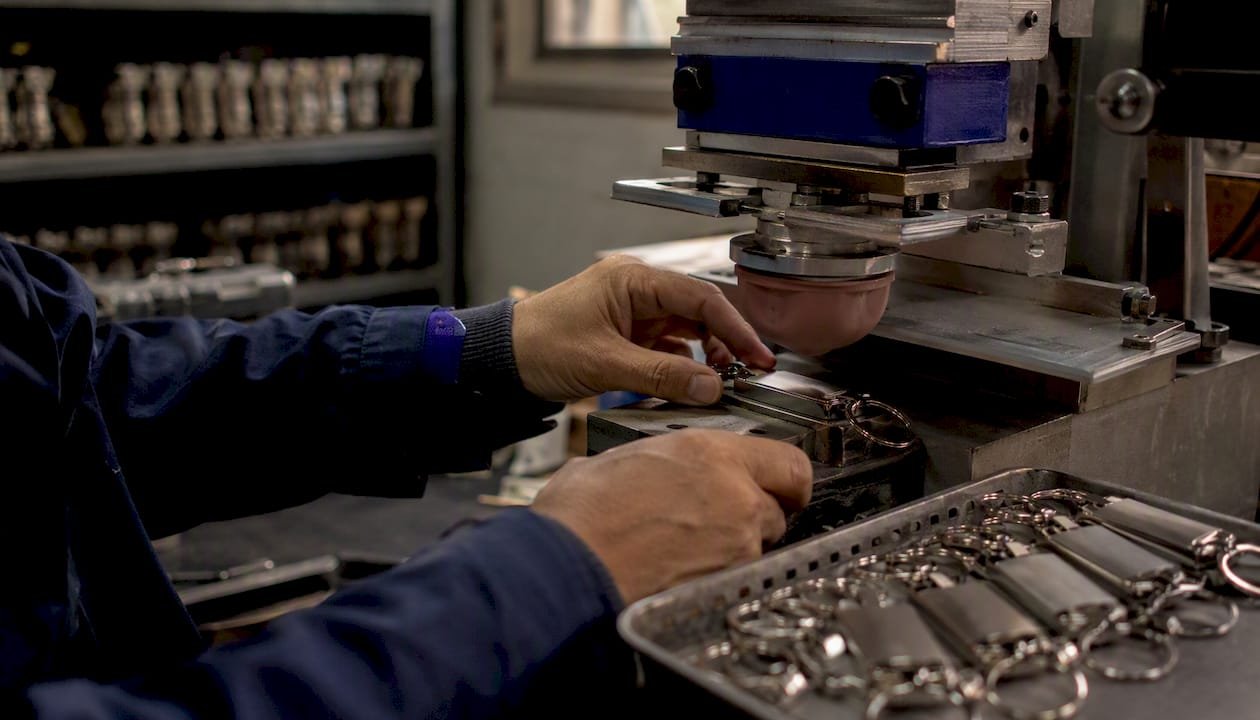
Screen printing lays down ink through a mesh stencil. Best for flat surfaces with solid spot colors. Similar limitations to pad printing on complex artwork.
Full-color digital printing (UV or dye-sublimation) handles complex artwork, gradients, and photographic images. Best on acrylic and certain coated metals. The color fidelity is high, but the process costs more per unit than pad printing.
Laser engraving removes material to create a permanent, tactile mark. No ink means no fading. The standard choice for metal and leather. The result is monochromatic (the bare metal or leather shows through), so it is not the right method for multi-color logos.
Die-struck metal creates the design in the metal itself during manufacturing. No separate imprint step. The result is a raised or recessed design with exceptional permanence. Used for high-end metal keychains and challenge coins.
Soft enamel fills recessed areas of a die-struck metal piece with colored enamel. The result is a classic, slightly textured look. Pantone color matching is standard.
Epoxy dome applies a clear resin dome over a printed design, protecting it and giving it a glossy, dimensional look. Excellent for full-color logos on metal or acrylic bases.
Matching method to material:
- Metal: laser engraving, soft enamel, epoxy dome, pad print
- PVC: full-color mold (color is built into the material), pad print
- Acrylic: digital/UV print, epoxy dome
- Leather: laser engraving, debossing
Imprint area reality check: Most standard keychains have an imprint area between 0.5" × 0.5" and 1.5" × 1.5". At that scale, a logo with fine type below 6pt or hairline details under 0.5mm will not reproduce cleanly with pad printing or laser engraving. Simplify the artwork for the keychain version of your logo, or choose an imprint method (digital print, epoxy dome) that handles fine detail better.
Pro Tip: For metal keychains, a protective clear coat or nickel plating over the base metal prevents tarnishing and keeps the finish looking sharp after months of pocket or bag carry. Ask your supplier which protective finish is included in the base price and which costs extra.
Typical pricing, MOQs, and lead times to plan around
Budget planning for a keychain order comes down to three numbers: price per unit, minimum order quantity, and production lead time. Here is what realistic ranges look like across the main categories.
| Category | Typical price per unit | Typical MOQ | Standard lead time | Rush available? |
|---|---|---|---|---|
| Economy PVC/acrylic | Inexpensive range | Moderate minimum order quantity | Typical lead time | Rush often available |
| Mid-range metal (stamped/plated) | $1.50–$3.50 | Moderate minimum order quantity | Typical lead time | Rush sometimes available |
| Enamel/epoxy dome | Moderate price range | Moderate minimum order quantity | Typical lead time | Rush sometimes available |
| Multi-tool (bottle opener) | Moderate price range | Moderate minimum order quantity | Typical lead time | Rush rarely available |
| LED/flashlight | Moderate price range | Moderate minimum order quantity | Typical lead time | Rush sometimes available |
| Premium leather | Higher price range | Moderate minimum order quantity | Typical lead time | Rush rarely available |
| Die-struck metal | Higher price range | Moderate minimum order quantity | Typical lead time | Rush rarely available |
Setup fees (die charges, screen charges) are typically charged once per design and range from $25 to $75 depending on the imprint method. They do not scale with quantity, so they matter more on small runs than large ones.
Sample policies vary. Most suppliers offer a pre-production physical sample for a fee (often $15–$50 plus shipping), with that cost credited back on the full order. Digital proofs are usually free and faster. For any order above 500 units, always request a physical sample before approving production.
Rush production typically compresses a standard 10–15 day window to 3–5 business days and adds a fee of 15%–30% to the order total. Rush is not always available for die-struck or leather products, which have longer tooling requirements.
When evaluating cost, think beyond the per-unit price. A keychain that costs $1.50 per unit but earns two years of daily carry delivers a cost-per-impression that most digital ad channels cannot match.
Pro Tip: Ordering 500 units instead of 250 frequently drops the per-unit price by 20%–35%. Run the math on your total budget: if the incremental cost of the larger quantity is modest, the per-unit savings often justify the higher upfront spend, especially for a product with a long shelf life.
Artwork specs and the ordering checklist that prevents delays
Most production delays trace back to artwork problems, not supplier issues. Submitting print-ready files the first time cuts your approval cycle from days to hours.
File format and color requirements:
- Preferred formats: Vector files (AI, EPS, PDF with outlined fonts). Never submit a JPEG or PNG as your primary art file for pad printing, laser engraving, or screen printing.
- Color mode: Pantone (PMS) spot colors for pad printing and enamel. CMYK for full-color digital print. If you only have an RGB file, convert it and check for color shift before submitting.
- Line weight minimum: 0.5pt minimum for any line that needs to reproduce cleanly. Thinner lines drop out in pad printing.
- Minimum type size: 6pt for most imprint methods. Smaller type becomes illegible at keychain scale.
- Resolution: If a raster element is included (rare but possible for digital print), 300 DPI at final print size.
Required assets before you submit:
- Vector logo file with fonts outlined
- Pantone or CMYK color codes (not just a hex code)
- A simplified alternate logo for small imprint areas
- Named contact for proof approvals and a stated turnaround for approval responses
Ordering sequence:
- Choose product type, material, and attachment style.
- Confirm MOQ, price breaks, and production lead time with your supplier.
- Upload vector artwork and specify color codes.
- Request a digital proof (and a physical sample for large orders).
- Review proof against your brand standards; approve or mark up changes.
- Confirm shipping address(es), packaging requirements, and billing details.
- Submit purchase order or complete checkout.
- Track production status and confirm ship date.
Common art mistakes to avoid: submitting a logo pulled from a website (low-res JPEG), forgetting to outline fonts (supplier’s system may not have your typeface), and sending a full-color logo for a laser-engraving job without a monochrome version. Assign one person as the single approval contact. Multiple stakeholders reviewing proofs in parallel is the fastest way to introduce conflicting feedback and delay production.
Packaging, kitting, and fulfillment options for bulk orders
How your keychains arrive at the destination matters as much as how they look. The right packaging choice depends on whether you are handing them out at a booth, mailing them to clients, or including them in a branded kit.
Common packaging options:
- Bulk polybag: Individual keychains in a plain poly bag, packed loose in a master carton. Lowest cost, best for booth giveaways where speed of distribution matters.
- Individual polybag with header card: A branded hang card above the poly bag. Adds perceived value and works well for retail-style displays or event tables.
- Gift box: A small rigid or folding box. Best for premium leather or die-struck metal keychains sent as client gifts.
- Branded pouch: A fabric or paper pouch with your logo. Adds a premium unboxing moment without the cost of a full gift box.
- Blister pack: A sealed plastic shell on a printed card. Durable for shipping and retail-style presentation.
Kitting and assembly combines your keychain with other collateral: a business card, a discount code card, a branded pen, or a product sample. Kitting adds per-unit assembly time and cost, but the result is a cohesive package that lands differently than a single loose item. Build in extra lead time (typically 2–5 additional business days) for kitted orders.
Multi-location fulfillment is relevant when your team is distributed or your event schedule spans multiple cities. Discountswag handles kitting, warehousing, and pick-and-pack services for marketers who need inventory stored and shipped to multiple addresses on a schedule. For a national sales team or a multi-city event tour, this removes the logistics burden from your internal team entirely.
For domestic U.S. shipments, standard parcel carriers (UPS, FedEx, USPS) handle most keychain orders without issue. Freight becomes relevant only for very large palletized quantities. For multi-address drops, prepare a clean spreadsheet with recipient names, addresses, and any personalization notes before you contact your supplier.
Pro Tip: For client gift programs, a simple kraft paper box with a tissue insert and a branded sticker closure costs a fraction of a rigid gift box but photographs well and feels intentional. Reserve the rigid box for your top-tier recipients and use the kraft option for the broader list.
Why Discountswag makes bulk keychain ordering straightforward
Discountswag is built for the buyer who needs a reliable path from “we need 500 keychains by the conference” to “order confirmed and tracking number in hand.” The catalog covers the full range of keychain types described in this guide, from economy PVC to premium metal, with product pages that show actual dimensions, imprint area specs, and available attachments.
What matters to bulk buyers:
- Catalog breadth: Metal, PVC, acrylic, leather, multi-tool, LED, and carabiner styles are all available, so you are not piecing together an order across multiple vendors.
- Rush ordering: Available for select products when your timeline is tight.
- Sample program: Request a physical sample before committing to a full production run.
- Kitting and multi-location fulfillment: Discountswag handles branded merchandise fulfillment, including kitting with other collateral and shipping to multiple addresses.
- Bulk pricing: Price breaks scale with quantity, and the online ordering flow makes it straightforward to see per-unit costs at different quantity tiers.
- Marketer-focused resources: Published guides on promotional items for brand awareness, lead generation, and cost-per-impression help buyers make the case internally for their spend.
The buying path is short: Request a sample, approve a proof, place the bulk order, and specify your fulfillment requirements. For repeat orders or complex multi-site programs, Discountswag’s account support handles the logistics so procurement teams are not managing spreadsheets of shipping addresses manually.
For buyers comparing options, Discountswag’s combination of product variety, fulfillment services, and marketer-oriented resources covers the full buying journey from product selection through delivery, without requiring you to coordinate multiple vendors.
Key Takeaways
Branded keychains deliver measurable repeat use and strong cost-per-impression when you match the material and imprint method to the campaign’s audience and distribution channel.
| Point | Details |
|---|---|
| Match type to use case | Metal or leather for client gifts; PVC or acrylic for trade shows and events. |
| Confirm four details before ordering | MOQ, production lead time, imprint method, and proofing process determine on-time delivery. |
| Artwork quality drives outcomes | Submit vector files with Pantone codes; simplify logos for small imprint areas to avoid legibility issues. |
| Quantity affects unit cost significantly | Modest quantity increases often drop per-unit price by 20%–35%; run the math before finalizing your order size. |
| Discountswag for bulk orders | Discountswag covers catalog breadth, rush ordering, sample programs, and multi-location fulfillment for bulk keychain campaigns. |
What buyers get wrong, and how to avoid it
The most common mistakes in bulk keychain orders are not about product selection. They are about timing and artwork. Buyers underestimate production lead time, submit a logo pulled from a website at 72 DPI, or forget to include Pantone codes. Any one of those errors can push a delivery past your event date.
The proofing step is where most of these problems surface, but only if you actually use it. A digital proof catches color and layout issues. A physical sample catches material and finish issues that a screen cannot show. Both matter for orders above a few hundred units.
At Discountswag, the QC process includes proof approval before production begins. No order moves to full production without a confirmed proof. For complex kits or multi-site fulfillment programs, the account support team works through the logistics details with you directly, so the order does not stall on a spreadsheet.
If you are planning a campaign with tight deadlines, unusual shapes, or distribution to multiple locations, reach out before you finalize the product selection. Getting the details right at the start is faster than fixing them after production.
Custom promotional keychains, ready to order from Discountswag
Discountswag gives bulk buyers a faster path to a finished keychain order than coordinating across multiple vendors. The catalog covers every material and style covered in this guide, product pages show real specs and imprint areas, and the fulfillment team handles kitting and multi-location shipping when your distribution is more complex than a single address.
Start with the promotional items brand awareness guide to align your keychain selection with your campaign goals, then browse types of branded promotional products to compare keychain categories side by side. For trade show planning specifically, the best custom trade show giveaways page narrows the field to the items that perform best in that context.
Ready to move forward? Request a sample or get a bulk quote directly at Discountswag. Upload your artwork, confirm your quantity and lead time, and get your order into production.
 Bottle Carriers
 Mugs
Mugs