

Promotional Candy for Events: The Marketer’s Buy Guide


For most trade shows and corporate giveaways, the fastest path to a solid order is this: choose individually wrapped mints or logo-printed pillow bags in your brand colors, confirm your artwork is vector format, and request a virtual proof before anything goes to production. That sequence alone prevents the most common and costly mistakes buyers make.
A few things worth knowing before you start browsing catalogs:
- Promotional candy catalogs are large. Suppliers list dozens of SKUs across candy types, packaging formats, and imprint methods. Narrowing to one candy type and one packaging format first saves hours.
- The FDA requires ingredient lists and allergen statements on commercially distributed food items, including branded candy. Confirm your supplier handles compliant labeling before placing a bulk order.
- Custom M&M’s are one of the most searched branded chocolate options, but they carry higher per-unit costs and longer lead times than mint tins or pillow bags. They work best for premium gifting, not high-volume trade-show handouts.
- Discountswag is a U.S.-based promotional products distributor that handles candy selection, virtual proofs, kitting, and multi-location fulfillment.
Pro Tip: Request a physical sample before committing to a full production run, especially for tins or custom-wrapped chocolate. Colors print differently on foil, kraft paper, and plastic, and a sample catches that before it becomes a 500-unit problem.
Table of Contents
- What types of promotional candy work best for your event?
- Which packaging format gives you the most brand impact?
- How does the customization process actually work?
- What should you budget for MOQ, pricing, and lead times?
- How do you choose the right promotional candy supplier?
- Campaign ideas by use case
- What U.S. food-safety and labeling rules apply to promotional candy?
- Fulfillment options: kitting, multi-location shipping, and dropshipping
- Why promotional candy drives real marketing results
- Key Takeaways
- The format choices that actually matter at events
- Discountswag makes branded candy ordering straightforward
- Useful sources and further reading
What types of promotional candy work best for your event?
The right candy type depends on three things: your per-unit budget, how many hands you need to reach, and how much branding surface you actually need. Here is how the main categories break down.
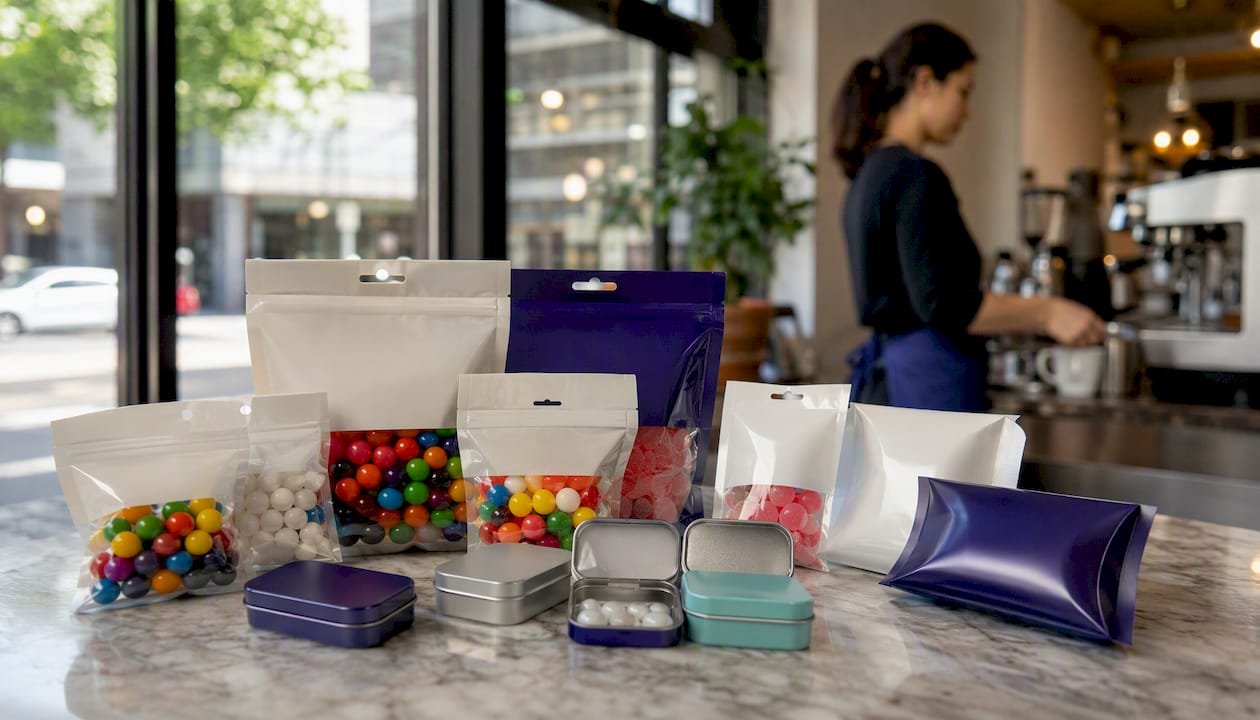
Mint tins and slide tins are the workhorse of corporate candy giveaways. The metal container feels premium in the hand, sits flat in a jacket pocket, and the lid gives you a clean, full-color imprint area. Recipients tend to keep them on their desks rather than tossing them, which extends your brand’s visibility past the event itself. They cost more per unit than bags but deliver better perceived value for client-facing situations.
Pillow bags and header bags are the volume play. When you need to hand out 1,000+ pieces at a trade show without blowing your budget, a printed pillow bag filled with gummies, jelly beans, or hard candy is the answer. The header card or printed bag face gives you solid logo real estate, and the cost per unit drops sharply at higher quantities.
Gummy bears are crowd-pleasers with broad demographic appeal and no messy melt risk, which matters if your event runs in a warm venue or involves outdoor elements. They work well in pillow bags, header bags, or small favor boxes.
Jelly beans offer a color-matching advantage most buyers overlook. Many suppliers let you select specific jelly bean colors to match your brand palette, so the candy itself becomes part of the visual identity. Pair them with a clear window box or organza bag and the effect is immediately on-brand.
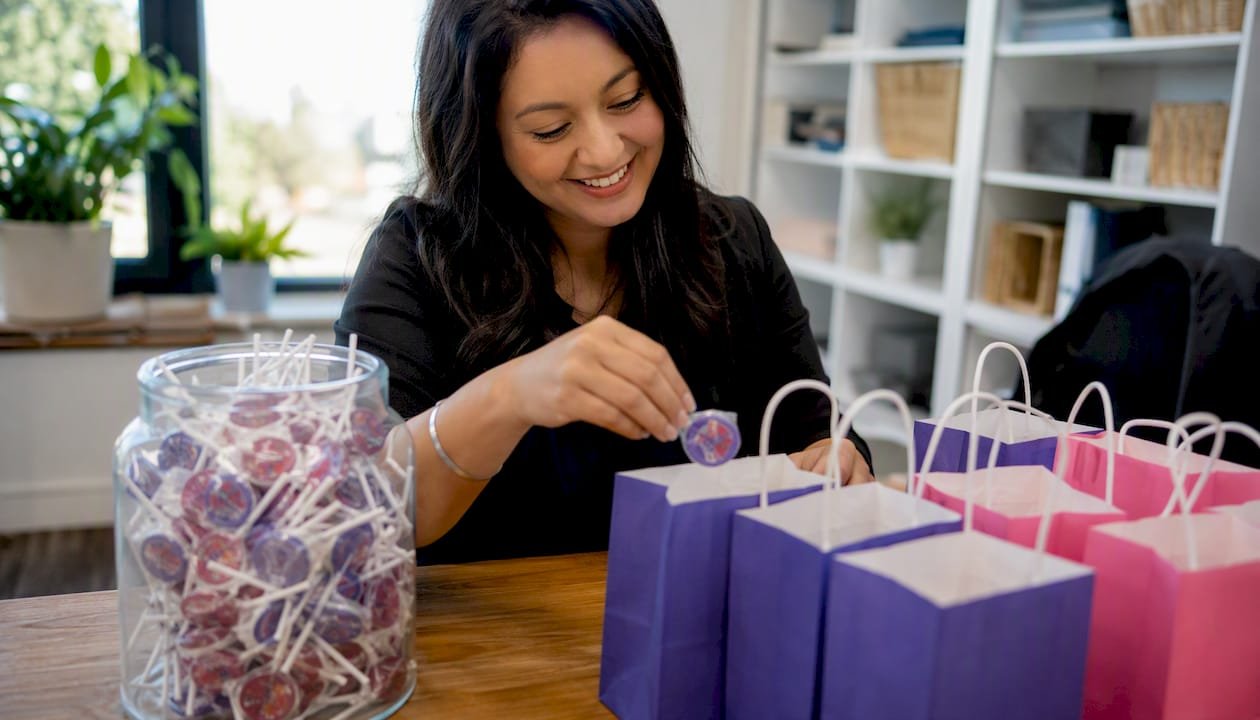
Lollipops are high-visibility, low-cost, and hard to ignore. A custom-printed lollipop stick or wrapper puts your logo at eye level while someone is actively using the product. They work especially well for consumer-facing activations, retail environments, and events with younger audiences.
Chocolate (bars, minis, coins) reads as the most premium option and is the right call for client gifts, holiday mailers, and executive gifting. The tradeoff is temperature sensitivity. Chocolate ships and stores fine in cooler months but needs climate-controlled handling in summer. Factor that into your fulfillment plan.
Custom M&M’s sit at the top of the perceived-value scale. Color selection, custom text, and gift-box formats make them a natural fit for special occasions, product launches, and premium client gifts. MOQs tend to be higher and lead times longer than standard candy options, so they are not the right pick for a last-minute trade-show order.
For a broader look at how candy fits into a full branded giveaway strategy, the product category breakdown is worth reviewing before you finalize your order.
Which packaging format gives you the most brand impact?
Some suppliers recommend choosing your packaging format before selecting the candy type because packaging drives perceived value and determines how your item ships, stores, and gets noticed at an event. That logic holds up in practice.
Here are the main formats and where each one fits:
- Pillow bags / header bags: Low cost, high volume, easy to customize with a full-color printed face or header card. Best for trade-show handouts and mass-distribution events.
- Mint tins / slide tins: Metal construction feels premium; lid imprint is clean and durable. Best for client gifts, desk giveaways, and events where perceived quality matters.
- Push-top tins / pill bottles: Compact, refillable, and distinctive. The push-top mechanism makes them memorable and keeps mints fresh longer. Good for executive gifts and conference swag.
- Window boxes: Clear panel shows the candy inside, which works especially well for color-matched jelly beans or gummies. Adds a retail-quality look without a retail price tag.
- Favor cubes / organza bags: Lower-cost options for light-touch gifting. Organza bags work for weddings and lifestyle events; favor cubes suit small candy assortments for desk drops.
Imprint locations vary by format. On a tin, you are printing on the lid. On a pillow bag, the entire front face is your canvas. On a push-top bottle, you typically get a wraparound label. Knowing the imprint area dimensions before you finalize your artwork saves a revision cycle.
Pro Tip: For logo-heavy designs, tins and push-top bottles give you the most controlled print surface. Pillow bags printed with flexography can show slight color variation at the edges, so keep critical brand elements centered.
For more on how packaging and logo placement affect brand recall, the logo merchandise examples at Discountswag show real-world applications across product types.
How does the customization process actually work?
The workflow is more predictable than most first-time buyers expect, and knowing the steps upfront prevents the delays that push orders past event deadlines.
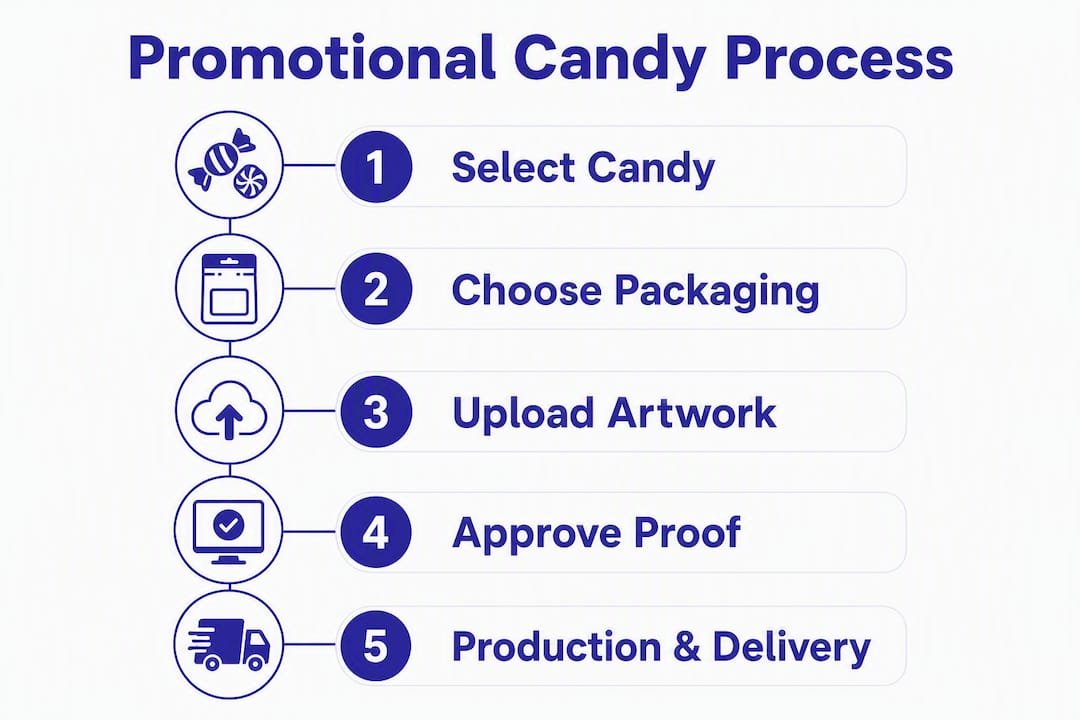
Step 1: Product and packaging selection. Pick your candy type and packaging format. These two decisions lock in your imprint area, MOQ, and base price.
Step 2: Artwork upload. Submit your logo and any supporting design files. Vector files (AI, EPS, or high-resolution PDF) are the standard requirement. Raster files like JPG or PNG work only if they are at least 300 DPI at print size. Embed all fonts or convert them to outlines. Include your Pantone color references for any color-critical elements.
Step 3: Virtual proof. Many distributors provide virtual proofs at no charge, and this step is non-negotiable. The proof shows your logo placement, text sizing, and color rendering on the actual packaging template. Review it carefully. Small type that looks fine on a screen often becomes illegible at wrapper scale.
Step 4: Sample (strongly recommended). A physical sample adds a few days but catches problems the virtual proof cannot show: how the foil takes ink, whether the tin lid color matches your brand, and whether the candy itself meets quality expectations. Most suppliers offer samples for a nominal fee.
Step 5: Production and fulfillment. Once you approve the proof (and sample), production begins. Standard lead times run 10–15 business days for most candy formats. Fulfillment options range from bulk shipment to a single address to kitted, multi-location delivery.
Common pitfalls to avoid: uploading a logo pulled from a website (72 DPI, wrong color profile), specifying brand colors without Pantone references, and approving a virtual proof without checking text size at actual print dimensions.
Pro Tip: Always request that your supplier confirm the imprint dimensions in writing before you finalize artwork. A wrapper that is 3 inches wide requires different type sizing than a tin lid that is 2.5 inches in diameter. Getting this wrong means a second proof cycle and a delayed ship date.
What should you budget for MOQ, pricing, and lead times?
Realistic numbers help you plan before you request a quote. The figures below reflect typical ranges across U.S. promotional candy suppliers, not a specific price guarantee.
| Product | Typical MOQ | Est. Price per Unit | Standard Lead Time | Rush Available? |
|---|---|---|---|---|
| Pillow bags (gummies/jelly beans) | 250 units | $1.15–$2.00 per unit | 10–15 business days | rush options often available |
| Mint tins / slide tins | 100–250 units | $2.00–$3.50 per unit | 10–15 business days | rush options sometimes available |
| Push-top tins / pill bottles | 100–250 units | $2.25–$4.00 per unit | 10–15 business days | rush options sometimes available |
| Lollipops (custom wrapper) | 250 units | $0.58–$1.25 per unit | 10–15 business days | rush options often available |
| Custom M&M’s | 200–400 units | $2.50–$4.25 per unit | 15–20 business days | rush options rarely available |
| Chocolate bars (custom wrapped) | 100–250 units | $2.25–$3.50 per unit | 10–15 business days | rush options sometimes available |
A few logistics points that affect your final cost:
- Quantity tiers: Price per unit drops meaningfully at 250, 500, and 1,000 units. If you are close to a tier threshold, ordering up often costs less per piece than ordering exactly what you need.
- Rush fees: Expedited production typically adds 15%–30% to the base order cost, and not every product qualifies. Confirm rush availability before you rely on it.
- Shipping for perishables: Chocolate and temperature-sensitive items may require expedited ground or air shipping in summer months. Budget for that separately.
- Payment terms: Most U.S. promotional candy suppliers accept major credit cards and ACH. Net-30 terms are sometimes available for established accounts or larger orders.
Pro Tip: Build at least 3 extra business days into your timeline beyond the supplier’s stated lead time. Carrier delays, customs holds on imported candy, and proof revision cycles all eat into that buffer, and running out of time is the most common reason buyers skip the sample step.
For a full event planning timeline that accounts for ordering windows, the branded merchandise event planner at Discountswag is a practical reference.
How do you choose the right promotional candy supplier?
The catalog is the easy part. Qualifying the supplier is where buyers save themselves headaches.
Selection criteria that matter:
- U.S.-based production or domestic fulfillment (faster lead times, simpler returns)
- Clear sample policy with stated costs and turnaround
- Virtual proof included in the workflow, not an upsell
- Food-safety documentation available on request
- Transparent pricing with itemized quotes (base cost, setup fee, rush fee, shipping)
- Kitting and multi-location fulfillment capability if your distribution is complex
Questions to ask before you place an order:
- What is your standard production lead time for this product, and what does rush service cost?
- Do you provide a virtual proof, and is it included in the price?
- Can I order a physical sample, and how long does it take?
- What imprint method do you use (digital print, pad print, flexography, full-color label)?
- Can you match Pantone colors, and how close is the guarantee?
- What allergen labeling and ingredient disclosure do you provide on the packaging?
- What is your minimum order quantity, and do you offer smaller test runs?
- What are your shipping options for temperature-sensitive items?
Red flags to watch for: vague lead times (“ships in a few weeks”), no proof or sample policy, pricing that appears only after you submit contact information, and suppliers who cannot confirm the imprint method in writing.
Pro Tip: Ask specifically whether the supplier’s candy is produced in a facility that also handles nuts, dairy, or gluten. “May contain” statements are a legal and reputational issue, and a supplier who cannot answer that question clearly is not a supplier you want handling food items for your brand.
Campaign ideas by use case
The right product-packaging pairing shifts depending on what you are trying to accomplish. Here is a quick map.
Trade shows: Volume is the priority. Individually wrapped mints in a branded bowl at your booth, or pillow bags handed out at the door, keep costs manageable at 500–2,000+ units. Add a QR code to the wrapper or header card that links to your demo sign-up page. Logo-wrapped candy for trade shows performs best when the packaging doubles as a conversation starter.
- Pillow bags with gummies or jelly beans in brand colors
- Individually wrapped mints with a sticker seal featuring your logo and URL
- Custom lollipops with a printed stick or wrapper for high-visibility handouts
Client and premium gifts: Perceived quality matters more than cost per unit here. A mint tin with a debossed lid, a custom-wrapped chocolate bar in a window box, or a small gift tin with assorted chocolates reads as intentional rather than generic.
- Mint tins or push-top tins with a full-color lid imprint
- Custom M&M’s in a branded gift box for product launches or milestone recognition
- Chocolate gift tins with a branded sleeve and a personalized note card
Employee onboarding and recognition: Candy works well as part of a larger kit. A branded mint tin or small candy jar alongside a welcome letter and a branded notebook lands better than candy alone. For remote employees, a branded onboarding kit that includes a sweet treat ships flat and assembles easily.
Seasonal and themed activations: Color-matched gummies for a product launch in brand colors, custom-printed holiday wrappers on chocolate bars, or limited-run flavored mints for a specific campaign window. Personalized sweet treats tied to a seasonal theme tend to generate more social sharing than year-round generic versions.
What U.S. food-safety and labeling rules apply to promotional candy?
Distributing branded candy at scale is distributing food, and U.S. food-safety rules apply regardless of whether the candy is a gift or a giveaway.
Pro Tip: Ask your supplier for a copy of their FDA facility registration number and their most recent allergen statement for the specific product you are ordering. A reputable supplier will provide this without hesitation.
The basics every buyer should confirm with their supplier:
- Ingredient lists and allergen statements: The FDA requires that commercially distributed food items carry a full ingredient list and a clear allergen statement. The major allergens to flag are peanuts, tree nuts, milk, eggs, wheat, soy, fish, and shellfish.
- “May contain” statements: If the candy is produced in a shared facility, the packaging must include a “may contain” advisory for any allergens present in that facility. This is not optional.
- Expiration dating: Most hard candy has a shelf life of 12–18 months; chocolate is typically 6–12 months depending on storage. Confirm the “best by” date on your order and factor it into your distribution timeline.
- Storage and shipping: Chocolate requires storage below 70°F. If your event is in summer or your fulfillment involves warehouse storage, confirm temperature-controlled handling.
- Third-party certifications: For audiences with dietary restrictions, ask whether the candy carries kosher, vegan, or gluten-free certification. A Certificate of Analysis from the manufacturer is the gold standard for verifying these claims.
Fulfillment options: kitting, multi-location shipping, and dropshipping
How you distribute candy matters as much as what you order. The three main fulfillment models each have different cost and complexity profiles.
- Bulk to one address: The simplest and cheapest option. One shipment, one delivery point, your team handles distribution. Works for events where everyone is in the same place.
- Multi-location fulfillment: The supplier ships to multiple offices or event venues from a central warehouse. Adds per-location handling fees but eliminates the logistics burden on your team.
- Dropshipping to recipients: Individual packages shipped directly to named recipients. Common for remote employee gifting and client mailers. Per-unit shipping costs are higher, but the experience for the recipient is polished.
- White-label kitting: Candy is assembled into a branded kit alongside other promotional items (a notebook, a pen, a tech accessory) before shipping. Setup fees apply per kit, and lead times extend by a few days for assembly.
A few practical notes on kitting:
- Provide your supplier with a clear SKU list, pack count per kit, and any gift messaging requirements in writing.
- Shrink-wrapping a kit adds cost but protects contents during shipping and improves the unboxing experience.
- For chocolate in kits, confirm that the other kit items can tolerate the same temperature range. A chocolate bar next to a heat-sensitive tech item is a problem waiting to happen.
- Establish a returns policy for damaged goods before the order ships. Edible items cannot be restocked, so damaged-in-transit claims need a clear resolution path.
Pro Tip: For dropshipping promotional items to multiple recipients, build a spreadsheet with recipient name, address, and any personalization notes before you brief your supplier. Sending that file at the start of the project, not after production, prevents fulfillment delays.
Why promotional candy drives real marketing results
Candy works in marketing for a reason that goes beyond novelty. Personalization, color-matching, and presentation transform low-cost candy into a memorable brand touchpoint for clients and employees. The sensory response is immediate and positive, which is exactly the association you want attached to your brand at a trade show or in a welcome kit.
Metrics worth tracking when you run a branded candy campaign:
- Event re-engagement rate: How many booth visitors who took your candy also scanned a QR code, signed up for a demo, or connected on LinkedIn? Candy with a CTA built into the wrapper gives you a measurable conversion signal.
- Lead-capture lift: Compare lead capture rates at events where you distributed branded candy versus events where you did not. The difference is often attributable to dwell time at the booth.
- Client retention signals: For client gifting programs, track renewal rates and response rates in the 30 days following a candy send. Customized gifts in campaigns tend to generate measurable engagement lifts when the timing aligns with a renewal or upsell conversation.
Trust signals that move buyers from browsing to ordering: proof of food-safety compliance, visible customer reviews, transparent lead times, and the option to order a sample. Order workflow clarity is one of the strongest signals buyers use to trust a distributor during the selection process.
Pro Tip: Pair your candy giveaway with a brand awareness campaign that includes a follow-up touchpoint within 48 hours of the event. Candy creates the positive first impression; the follow-up converts it into a relationship.
Key Takeaways
Branded candy works best when the packaging format, imprint method, and fulfillment plan are locked in before artwork is submitted, not after.
| Point | Details |
|---|---|
| Pick candy type and packaging first | Narrowing to one format locks in MOQ, imprint area, and base price before you spend time on artwork. |
| Always request a virtual proof | Proofs are often free and catch logo placement and color errors before bulk production begins. |
| Confirm food-safety documentation | Ask your supplier for allergen statements, ingredient lists, and facility registration before placing a food order. |
| Build timeline buffer | Standard lead times run 10–15 business days; add 3 extra days for carrier delays and proof revisions. |
| Discountswag handles end-to-end | Discountswag supports product selection, virtual proofs, kitting, and U.S. multi-location fulfillment for candy campaigns of any size. |
The format choices that actually matter at events
Most of the debate in promotional candy buying focuses on candy type, but the format decision is where campaigns actually win or lose. A mint tin that sits on someone’s desk for three months delivers more impressions than a pillow bag that gets eaten and forgotten before the attendee reaches the parking lot. That is not an argument against pillow bags at high-volume events; it is an argument for being intentional about what you are optimizing for.
The buyers who get the most out of branded candy programs are the ones who treat the packaging as the primary brand vehicle and the candy as the reason someone picks it up. A push-top tin in your brand’s exact Pantone color, filled with mints, and sitting on a prospect’s desk is a three-month billboard that cost less than a LinkedIn ad impression. A generic pillow bag with a small sticker logo is a snack.
The other thing most guides skip: temperature planning. Chocolate campaigns that ship in June without a climate-controlled fulfillment plan are a liability, not a gift. If your event or gifting window falls between May and September, either choose a heat-stable candy format or confirm cold-chain handling with your supplier before the order is placed.
Discountswag’s approach to candy campaigns prioritizes format-first selection, which means starting with the packaging that fits your distribution model and then choosing the candy that fills it. That sequence produces better results than starting with “we want gummy bears” and then figuring out how to ship them.
Discountswag makes branded candy ordering straightforward
Discountswag gives marketing teams and event coordinators a single source for the entire promotional candy process: product selection, virtual proofs, low-cost sampling, kitting, and U.S. multi-location fulfillment. The concrete advantage over piecing together a supplier relationship from scratch is speed and accountability. One vendor handles the proof, the production, and the ship-to-multiple-offices logistics, which means fewer handoffs and a cleaner audit trail when procurement asks for documentation.
For trade-show orders, Discountswag supports custom trade show giveaways at volume, with rush production available on select candy formats. For onboarding kits and client gifting, the kitting and fulfillment service handles assembly and direct-to-recipient shipping. Pricing is transparent, samples are available before bulk production, and the team can walk you through artwork specs if your files are not print-ready.
Start with a quote request or a sample order for your next event. Visit Discountswag’s branded merchandise guide to see the full range of candy and promotional product options, or go straight to a quote for your upcoming campaign.
Useful sources and further reading
- FDA Food Labeling Requirements — primary source for U.S. ingredient list, allergen statement, and labeling compliance requirements for commercially distributed food items.
- Custom Candy and Sweets | Deluxe.com — supplier page covering virtual proof workflows, product catalog breadth, and ordering logistics for branded candy.
- Personalized M&M’s | M&M’S — product page for custom-printed chocolate with color selection, text imprint, and gift-box format options.
- Promotional Candy | MyCustomCandy — supplier page that organizes the order flow by packaging format first, useful for understanding how packaging drives perceived value.
- Personalized Candy for Business | Just Candy — category page showing logo-wrapped options, color-matching, and fast-shipping claims for trade-show and corporate orders.
- 4 Benefits of Customization in Corporate Chocolate Gifts | CocoCo Chocolatiers — editorial piece on how personalization raises perceived value and emotional impact for branded chocolate gifts.
- Discountswag: Branded Merchandise for Events — event planning timeline and ordering guidance for promotional products including candy.
 Bottle Carriers
 Mugs
Mugs