


What Is a Promotional Calendar? A Marketer’s Guide


A promotional calendar is defined as a structured schedule that maps a company’s sales, discounts, product launches, and events across a 3 to 12 month horizon to align marketing activities with seasonal demand, customer behavior, and business goals. The industry term most often used alongside this concept is “promotional marketing calendar,” and both phrases describe the same planning tool. Experts recommend building the calendar at least 2 months in advance to allow enough preparation time for creative, inventory, and cross-team coordination. Without that lead time, campaigns get rushed, margins get squeezed, and opportunities get missed. A well-built promotional calendar turns scattered campaigns into predictable buying moments that protect margin and build long-term brand value.
What is a promotional calendar and what types of promotions belong in it?
A promotional calendar covers six distinct promotion types, and balancing all six is what separates a calendar that drives growth from one that just drives discounts. Relying on a single type, usually price cuts, trains customers to wait for sales rather than buy at full price. The six types work together to keep engagement high without eroding margin.
- Traffic-driving promotions. These bring new or lapsed customers into the funnel. Flash sales, limited-time offers, and giveaways fall here.
- Seasonal campaigns. Back-to-school, the holiday season, and summer clearance are the obvious examples. Seasonal promotions align with natural buying cycles.
- Product launch and newness promotions. These spotlight new arrivals or updated products. They create urgency without requiring a discount.
- Loyalty and VIP programs. Early access, exclusive pricing, and member-only events reward your best customers and increase lifetime value.
- Customer reactivation campaigns. These target customers who have gone quiet. A well-timed offer or personalized message can bring them back before they are lost for good.
- Community and referral promotions. These turn existing customers into advocates. Referral bonuses, user-generated content campaigns, and partnership events belong here.
Pro Tip: Never let discounts make up more than two of your six monthly promotion types. When discounts dominate the calendar, customers stop seeing your brand as worth full price.
Mixing these types also prevents discount fatigue, the condition where customers stop responding to offers because they expect them constantly. A calendar built on variety keeps each promotion feeling like an event rather than a routine markdown.

How do you build and structure an effective promotional calendar?
Building a promotional calendar follows a clear sequence. Skipping steps, especially the goal-setting phase, is the most common reason calendars fail by March.
- Set clear goals and scope. Define what each quarter needs to achieve. Revenue targets, new customer acquisition goals, and inventory clearance needs all shape which promotion types belong in each period.
- Identify key dates and themes. Map national holidays, industry events, trade shows, and your own product launch schedule. These anchor points give the calendar its skeleton.
- Map promotions to customer segments. Not every offer goes to every customer. Loyalty campaigns go to existing buyers. Reactivation campaigns go to lapsed ones. Newness promotions go to early adopters.
- Incorporate external market signals. Anchoring promotions to competitor sale periods, trade show calendars, and seasonal demand patterns produces better timing than planning around internal deadlines alone.
- Build monthly rhythms. Each month should follow a campaign structure: one main theme supported by three to five smaller touchpoints. Those touchpoints typically include an announcement, a best-seller spotlight, a reminder, a reactivation message, and a VIP invitation.
- Schedule rest periods. Build deliberate non-promotion windows into the calendar. These protect pricing integrity and give customers time to reset their expectations.
- Share the calendar across teams. Cross-functional visibility across marketing, merchandising, finance, and operations prevents siloed planning. A promotion that marketing launches without warning operations creates service failures and stockouts.
The table below shows how a monthly rhythm translates into a practical weekly structure.
| Week | Focus | Promotion type |
|---|---|---|
| Week 1 | Campaign launch | Main theme announcement |
| Week 2 | Engagement | Best-seller spotlight or newness |
| Week 3 | Urgency | Reminder or limited-time push |
| Week 4 | Retention | VIP or reactivation touchpoint |
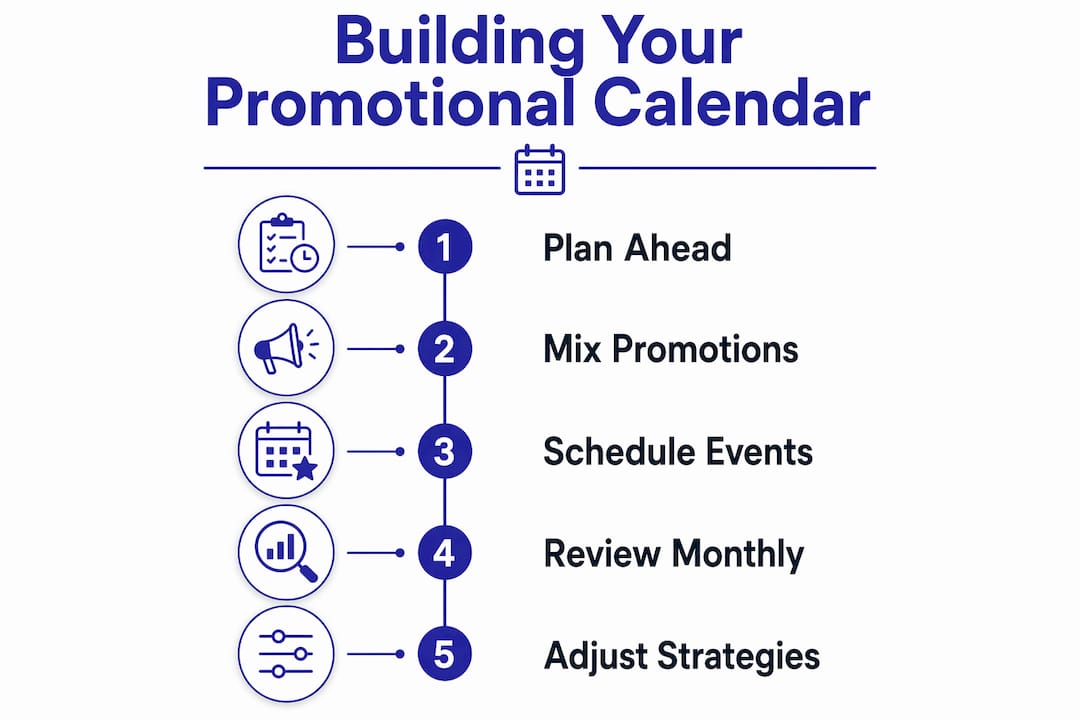
Pro Tip: Treat the calendar as a living document. Review it monthly and adjust based on what the previous period’s data shows. A calendar that never changes is a plan that never learns.
A branded swag campaign fits naturally into this rhythm. Product launches and seasonal campaigns both benefit from physical branded items that extend the campaign beyond digital channels.
What are the benefits of using a promotional calendar?
A promotional calendar delivers benefits that go well beyond knowing what sale is coming next. The real value is structural.
- Improved campaign coordination. When every team sees the same calendar, creative, inventory, and customer service all prepare together. Campaigns land cleaner and perform better.
- Higher customer engagement. Consistent, relevant promotions train customers to expect value rather than just discounts. That expectation drives repeat visits and purchases.
- Margin protection. A calendar defines which categories are excluded from discounts and how often price reductions occur. That discipline prevents the margin erosion that comes from reactive, last-minute markdowns.
- Better resource planning. Creative teams, media buyers, and logistics teams all need lead time. A calendar gives them that time, which reduces costs and improves output quality.
- Continuous improvement. Because promotions are planned and documented, teams can compare results period over period and refine what works.
“A promotional calendar is more than a list of dates. It is a brand control tool that defines when and how to market, who to target, and which categories to exclude from discounts. That control is what separates brands that grow on their own terms from brands that grow only when they discount.”
The data-driven case for planned promotions is strong. Brands that plan promotions in advance consistently outperform those that react to market conditions in real time, because planning allows for testing, iteration, and smarter resource allocation.
What are the most common pitfalls in promotional calendar planning?
Most promotional calendar failures come from the same handful of mistakes. Recognizing them early saves significant time and margin.
- Static calendars. A calendar built in january and never touched again misses market shifts, competitor moves, and internal performance signals. Review it monthly.
- Over-promotion. Running promotions every week trains customers to never pay full price. Rest periods protect pricing power and keep each promotion feeling meaningful.
- Internal-only timing. Planning promotions around internal deadlines rather than customer buying behavior produces campaigns that arrive at the wrong moment. Use external signals like competitor events and seasonal demand to set timing.
- No brand guardrails. Without defined rules around discount frequency and excluded categories, individual teams make inconsistent decisions that damage pricing integrity. The calendar itself should define those guardrails.
- No customer segmentation. Sending every offer to every customer reduces relevance and increases unsubscribe rates. Tailor offers to segments based on purchase history and engagement level.
- Siloed planning. Marketing launching a promotion that operations does not know about creates stockouts, slow fulfillment, and poor customer experiences.
Pro Tip: Build a “promotion blackout” rule into your calendar. Identify two to four weeks per quarter where no promotional messages go out. Customers who get a break from offers respond more strongly when the next one arrives.
A promotional product audit is a useful annual exercise alongside calendar planning. It identifies which physical promotional items are working and which should be retired, keeping the physical side of campaigns as disciplined as the digital side.
Key Takeaways
A promotional calendar is the single most effective tool for aligning marketing timing, team coordination, and margin discipline across an entire planning year.
| Point | Details |
|---|---|
| Definition and scope | A promotional calendar schedules all marketing activities across 3 to 12 months, aligned with business goals and seasonal demand. |
| Six promotion types | Balance traffic-driving, seasonal, newness, loyalty, reactivation, and community promotions to avoid discount fatigue. |
| Monthly rhythm | Structure each month around one main campaign plus three to five supporting touchpoints for consistent engagement. |
| Rest periods matter | Deliberate non-promotion windows protect pricing integrity and keep customers responsive to future offers. |
| Cross-team visibility | Sharing the calendar with marketing, finance, operations, and merchandising prevents siloed decisions and service failures. |
Why most promotional calendars fail before summer
The most common mistake I see is treating the promotional calendar as a content schedule rather than a business control system. Teams fill in dates, assign themes, and call it done. Then they wonder why the calendar stops working by april.
The real function of a calendar is to force decisions before the pressure hits. Which categories never go on sale? How many discount events are too many in a quarter? Which customer segments get early access and which get the standard offer? Those decisions need to be made in advance, not in the moment when a slow week creates panic.
The second mistake is building the calendar in isolation. When marketing owns the calendar and finance, operations, and merchandising find out about promotions at launch, the results are predictable: stockouts, margin surprises, and customer service overload. The calendar only works as a shared document.
What I have found works is treating the first calendar as a learning draft. You will get the timing wrong on some campaigns. You will over-promote in some months and under-promote in others. That is fine. The value comes from documenting what you planned versus what actually happened, then using that gap to build a smarter calendar the following year. The teams that do this consistently end up with a genuine competitive advantage, not because they have a better calendar template, but because they have a year of real performance data guiding every decision.
— Jerry
Branded products that make your promotional calendar work harder
Planning a promotional calendar is one thing. Executing it with the right physical touchpoints is what makes campaigns memorable beyond the inbox.
Discountswag supplies corporate promotional products that fit directly into every stage of a promotional calendar, from product launch giveaways to seasonal VIP gifts to trade show handouts. Physical branded items extend campaign reach beyond digital channels and give customers something tangible to associate with your brand. The right item at the right moment in your calendar reinforces the campaign message and increases recall. Discountswag’s curated selection covers promotional items for brand awareness across every campaign type, with options suited to both large-scale seasonal pushes and targeted loyalty programs.
FAQ
What is the promotional calendar meaning in marketing?
A promotional calendar is a structured schedule that plans a company’s marketing promotions, sales, and events across a defined period, typically 3 to 12 months. It aligns campaign timing with business goals, seasonal demand, and customer behavior.
How far in advance should you create a promotional calendar?
Experts recommend building a promotional calendar at least 2 months before the planning period begins. That lead time allows creative, inventory, and cross-functional teams to prepare without rushing.
What should you include in a promotional calendar?
A complete promotional calendar includes campaign dates, promotion types, target customer segments, discount guardrails, rest periods, and cross-team responsibilities. Each month should have one main campaign theme supported by three to five smaller touchpoints.
How do you avoid discount fatigue with a promotional calendar?
Discount fatigue is avoided by mixing promotion types so that price reductions make up no more than two of the six monthly promotion categories. Building deliberate non-promotion periods into the calendar also resets customer expectations and keeps future offers effective.
What is the difference between a promotional calendar and a content calendar?
A promotional calendar schedules business-driving marketing events like sales, launches, and loyalty campaigns with defined goals and margin guardrails. A content calendar schedules publishing activity like blog posts and social media updates, which may or may not be tied to a promotional goal.
 Bottle Carriers
 Mugs
Mugs