

Promotional Item Packaging Options: A Marketer’s Guide


Promotional item packaging options are the custom containers, wraps, and enclosures that protect your products and communicate your brand before anyone opens the box. The right packaging type directly shapes how recipients perceive your brand, your product’s value, and whether they share the unboxing moment. Discountswag works with marketing professionals and promotional product buyers who understand that packaging is not an afterthought. It is a marketing channel. This guide covers the main custom packaging solutions available, how to choose between them, and how to use customization to maximize brand impact.
What are the main promotional item packaging options?
The five core promotional product packaging types are folding cartons, mailer boxes, rigid boxes, flexible pouches, and labels or stickers. Each serves a different product profile, budget, and distribution method. Understanding where each fits prevents costly mismatches between your product and its packaging.
Folding cartons are the workhorses of branded packaging ideas. They ship flat, assemble quickly, and cost between $0.35 and $0.80 per unit at standard order quantities. That price point makes them the default choice for mid-volume promotional runs like trade show giveaways, retail-style product kits, and event swag bags.

Mailer boxes are corrugated structures designed for direct shipping. They cost between $1.20 and $3.50 per unit and hold up under carrier handling. Brands that ship employee welcome kits or subscription-style promotional packages rely on mailer boxes because they protect contents without requiring additional outer packaging.
Rigid boxes are the premium tier. They cost between $3.00 and $12.00 per unit and arrive pre-assembled, which means they cannot be collapsed for storage. That structural permanence signals luxury and quality, making them the right call for executive gifts, high-value product launches, and press kits where first impressions carry real weight.
Flexible pouches cost between $0.15 and $0.60 per unit and work well for soft goods, cosmetics, snacks, and branded accessories. They are lightweight, which reduces shipping costs, and they print well across their full surface area. Labels and stickers are the lowest-cost option at $0.03 to $0.25 per unit and serve as surface branding for bottles, jars, bags, and plain boxes that need a branded identity without a full custom structure.
- Folding cartons: flat-ship, fast assembly, mid-range cost
- Mailer boxes: corrugated, shipping-ready, direct-to-recipient
- Rigid boxes: pre-assembled, premium feel, high storage footprint
- Flexible pouches: lightweight, full-surface print, ideal for soft goods
- Labels and stickers: lowest cost, surface branding, high versatility
Pro Tip: Order a physical sample of any packaging type before committing to a full run. Color rendering, material stiffness, and print quality all look different on screen than they do in hand.
How do you choose the right packaging for your promotional product?
The structural category of your packaging, whether rigid, folding, or corrugated, is the most important decision you make. Choosing packaging based on looks alone, without accounting for product fragility and the shipping environment, risks product damage and a poor brand experience on arrival. A cracked promotional item inside a beautiful box is a brand liability, not a brand asset.
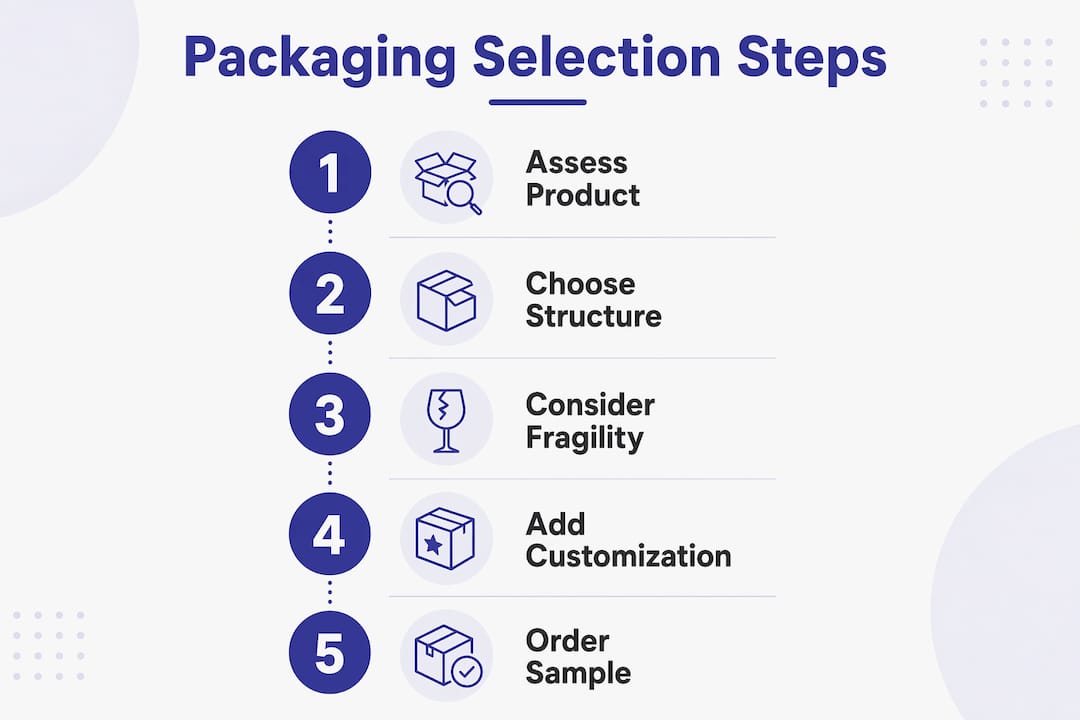
Start by assessing your product’s physical characteristics. Fragile items like ceramic mugs, glass bottles, or tech accessories need rigid or corrugated structures with interior cushioning. Soft goods, apparel, and flat printed materials tolerate flexible pouches or folding cartons without damage risk. The shipping environment matters equally. Products moving through carrier networks face drops, compression, and temperature shifts that a thin folding carton cannot always survive.
Cost is the next filter, but total cost of ownership matters more than unit price alone. Rigid boxes cost up to 500% more in storage and shipping overhead compared to flat-ship folding cartons. That gap compounds fast when you are storing thousands of units before a campaign launch.
Order quantity shapes your printing options. Digital printing reduces minimum order quantities to as low as 100 units for some package types. Traditional offset printing requires 1,000 or more units to reach a competitive cost per unit. For limited-edition promotional runs or seasonal campaigns, digital printing removes the volume barrier that previously made small batches impractical.
- Match structural category to product fragility first
- Factor in storage footprint and assembly time, not just unit price
- Use digital printing for runs under 500 units
- Choose mailer boxes when products ship directly to recipients
- Reserve rigid boxes for high-value items where premium perception justifies the cost
Pro Tip: If your campaign involves multiple product sizes, design your packaging around your largest item and use inserts to stabilize smaller items inside the same box. This reduces SKU complexity and lowers your per-unit cost.
What customization options make promotional packaging more effective?
Customization turns a container into a brand communication tool. The most effective branded packaging ideas combine print treatments on the exterior with strategic inserts on the interior. Both layers work together to create a complete brand experience.
On the exterior, custom printing treatments like embossing, debossing, foil stamping, and full-color digital prints add tactile and visual effects that basic printing cannot replicate. Embossing raises your logo off the surface. Debossing presses it in. Foil stamping adds metallic or holographic finishes that photograph well and signal quality. These treatments increase perceived value without requiring a more expensive packaging structure.
On the interior, inserts are where many brands leave engagement on the table. Smart packaging inserts like QR codes, personalized thank-you cards, and scratch-off discount codes transform a one-time delivery into an ongoing brand interaction. A QR code linking to a product demo video, a loyalty program sign-up, or a social media contest costs almost nothing to produce but extends the brand touchpoint well beyond the unboxing moment.
Packaging inserts such as discount codes, social share requests, and product review prompts build relationships after the sale. A simple card asking recipients to share a photo with a branded hashtag generates user content that no paid campaign can replicate authentically. These inserts work especially well in branded merchandise for events where recipients are already in a sharing mindset.
- Add a QR code insert linking to a landing page, video, or loyalty program
- Include a personalized thank-you card with the recipient’s name or company
- Use a scratch-off card for a discount or prize reveal
- Add a social share prompt with a specific hashtag and a clear call to action
- Include a product review request with a direct link to your review platform
Pro Tip: Keep inserts to a single focal point. A card that asks for a review, a social share, and a referral simultaneously gets ignored. Pick one goal per insert and design around it.
What are the most common pitfalls in promotional packaging execution?
The biggest mistake buyers make is treating unit price as the total cost of packaging. Assembly time and warehousing impact multiply actual expenses significantly beyond what the invoice shows. A rigid box at $5.00 per unit that requires 90 seconds of manual assembly at scale adds labor costs that can exceed the box cost itself on large campaigns.
Material thickness is a durability factor that buyers frequently underestimate. Folding carton material thickness ranges from 14pt to 24pt. Choosing the thinnest option to save cost increases the risk of product damage during shipping. A damaged product inside branded packaging does more harm to brand perception than plain packaging would have. The cost of reprinting and reshipping damaged goods always exceeds the savings from thinner material.
Structural category selection, whether rigid, folding, or corrugated, is the single most critical factor in packaging safety and perceived value. Aesthetics matter, but they cannot compensate for a box that fails in transit.
Minimum order quantities catch buyers off guard when they are working with traditional offset printers. Ordering 2,000 units of a packaging style to meet a printer’s MOQ when your campaign only needs 400 creates storage problems and ties up budget. Digital printing technology solves this directly by enabling high-quality custom packaging for small to medium order sizes. Always confirm MOQs before finalizing a packaging design.
Balancing aesthetics with shipping requirements is the final execution challenge. A box with a full-bleed white exterior shows scuffs and handling marks from carrier transit. Darker base colors and matte finishes hide wear better and arrive looking cleaner. Test your packaging through a simulated shipping cycle before your campaign launches. A single test shipment reveals problems that no design review will catch.
Key takeaways
The most effective promotional packaging strategy matches structural category to product fragility first, then layers customization to extend brand engagement beyond the initial unboxing.
| Point | Details |
|---|---|
| Match structure to product | Choose rigid, folding, or corrugated based on fragility and shipping environment, not aesthetics. |
| Total cost beats unit price | Factor in assembly time and storage footprint, especially for rigid boxes with high overhead. |
| Digital printing enables small runs | Orders as low as 100 units are viable with digital printing, removing volume barriers for limited campaigns. |
| Inserts extend engagement | QR codes, thank-you cards, and review prompts turn packaging into an ongoing brand touchpoint. |
| Material thickness protects ROI | Use 18pt or heavier folding carton stock for shipped items to prevent damage and preserve brand perception. |
The packaging decision most marketers get backwards
Most marketing teams I have worked with spend 80% of their packaging budget on exterior print treatments and almost nothing on what goes inside the box. That ratio is backwards. A foil-stamped lid impresses for three seconds. A personalized insert that connects to a real offer or a genuine thank-you keeps the brand in the recipient’s mind for days.
The other pattern I see constantly is selecting packaging at the end of the product selection process, as if it is a logistical detail rather than a brand decision. Packaging chosen under deadline pressure almost always prioritizes availability over fit. The result is a beautiful product inside a box that communicates nothing, or worse, a fragile item inside a carton that was not built for shipping.
The brands that get packaging right treat it as a brief, not a purchase order. They define the recipient experience they want, then work backwards to the structural category, material spec, and insert strategy that delivers it. That process takes more time upfront. It saves significant money and brand equity on the back end.
My honest advice: run one small test campaign with intentional packaging before scaling. Order 150 units with digital printing, include one well-designed insert, and measure the response. The data from that test will tell you more than any packaging guide, including this one.
— Jerry
Branded packaging solutions from Discountswag
Discountswag helps marketing professionals and promotional product buyers source branded items that pair with the right packaging to create a complete brand experience.
Whether you are building promotional items for brand awareness or assembling giveaway kits for an upcoming event, Discountswag offers a wide catalog of corporate promotional products ready for custom packaging. The team works with buyers at any order size, from small test runs to large campaign fulfillments. Browse the catalog or reach out directly for a quote tailored to your campaign goals and budget.
FAQ
What are the five main types of promotional product packaging?
The five main types are folding cartons, mailer boxes, rigid boxes, flexible pouches, and labels or stickers. Each varies in cost, durability, and best-fit use case for promotional campaigns.
How much does custom promotional packaging cost per unit?
Unit costs range from $0.03 for labels and stickers to $12.00 for rigid boxes, depending on packaging type and order quantity. Folding cartons typically fall between $0.35 and $0.80 per unit at standard volumes.
What is the minimum order quantity for custom packaging?
Digital printing enables minimum order quantities as low as 100 units for some packaging types. Traditional offset printing generally requires 1,000 or more units to reach a cost-effective price per unit.
What packaging inserts are most effective for promotional kits?
QR codes, personalized thank-you cards, discount codes, and social share prompts are the most effective inserts. Each one extends brand engagement beyond the initial delivery and encourages a specific follow-up action.
Why does material thickness matter for folding cartons?
Folding carton stock ranges from 14pt to 24pt, and thinner materials increase the risk of product damage during shipping. Choosing 18pt or heavier stock protects the product and preserves the unboxing experience that branded packaging is designed to deliver.
 Bottle Carriers
 Mugs
Mugs