

What Is a Company Store Online? Guide for Marketers & HR


A company store online is a private, branded e-commerce portal that centralizes the ordering of pre-approved merchandise for authorized users, as defined by ASI, the promotional products industry’s leading trade association. It is not a public shop. Employees, franchisees, and sales partners log in, browse a curated catalog of pre-decorated SKUs, and place orders without ever touching a design file or emailing a vendor.
Three things make it different from a standard e-commerce site:
- Who gets in: Access is gated by password, Single Sign-On (SSO) tied to your corporate identity provider, or role-based permissions that show each user only the products they are allowed to order.
- What they see: Every item in the catalog already carries the correct logo, colorway, and imprint placement, enforcing brand guidelines at the point of order rather than after the fact.
- Why it exists: The primary business outcomes are brand compliance, faster ordering, and reduced administrative overhead for HR and marketing teams managing uniforms, onboarding kits, and event swag.
Table of Contents
- What are the main uses and benefits of an online company store?
- Who needs a company store and how is access typically managed?
- What types of company store platforms are available?
- What KPIs and ROI metrics should you track?
- Key Takeaways
- The case for getting your company store right the first time
- Discountswag makes your company store catalog work harder
- Useful sources for further reading
What are the main uses and benefits of an online company store?
Company stores exist because brand control and ordering convenience are hard to maintain at scale without a dedicated system. When a 500-person company manages swag through email threads and spreadsheets, off-brand items appear, orders get lost, and someone in HR spends hours every month tracking down vendor confirmations.
Primary uses include:
- Onboarding kits: New-hire welcome packages assembled and shipped directly to the employee’s home or office, automating a task that HR teams previously handled manually.
The business benefits follow directly from those uses. CCS, a company store specialist, notes that shifting ordering to a self-service system measurably reduces the administrative hours HR and marketing teams spend on swag fulfillment. Brand compliance improves because users can only order what has already been approved. Fulfillment gets faster because the vendor relationship, decoration specs, and shipping logic are pre-configured. And employee experience improves because the process feels like shopping, not submitting a ticket.
Who needs a company store and how is access typically managed?
The user groups that benefit most from a company store fall into four categories: employees (the largest group by volume), franchisees or licensees who need co-branded materials, field sales and channel partners who order collateral independently, and corporate clients in managed programs.
Each group usually gets a different access tier. A simple private store with a shared password works for a single-company deployment where all employees order from the same catalog. Larger or more complex programs need SSO integration with an identity provider such as Microsoft Entra ID or Okta, which automatically provisions access when an employee joins and revokes it when they leave. Role-based permissions go one level further: a regional manager might see the full apparel catalog, while a new hire sees only the onboarding kit.
Franchise networks add another layer. A franchisee typically sees only the SKUs approved for their territory, at a price tier that reflects their agreement, and may need a franchisor approval step before an order ships. Distributor programs often use a public-facing version of the store with a promotional code or tiered pricing rather than a login wall.
The right access model depends on two questions: how many distinct user groups need different catalog views, and whether any of those groups require approval before an order is fulfilled. A swag store guide for HR teams covers the governance side of this in more detail.
What types of company store platforms are available?
Three platform categories cover most use cases. Choosing the wrong one is the most common and most expensive mistake in a company store launch.
| Platform type | Best for | Time to launch | Control level | Fulfillment complexity |
|---|---|---|---|---|
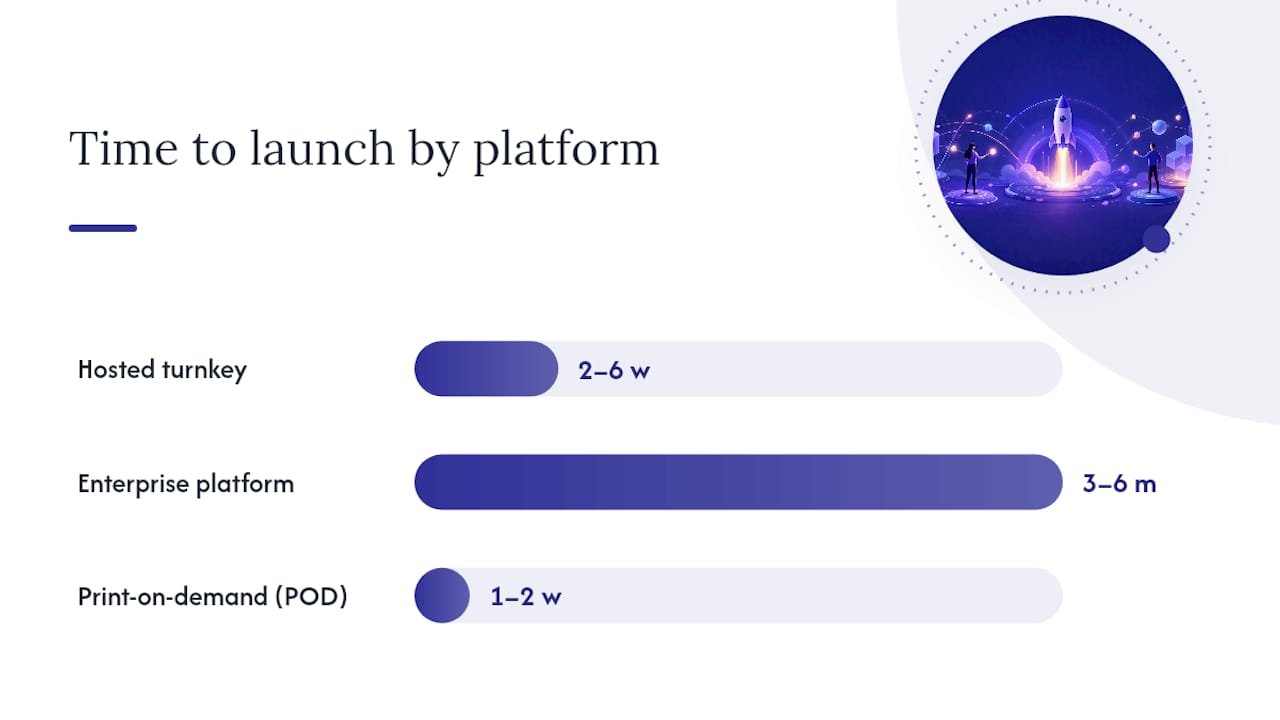
| Hosted turnkey store | SMBs, single-company programs, 50–500 users | 2–6 weeks | Moderate | Low to medium |
| Enterprise / distributed marketing platform | Franchise networks, multi-brand, 500+ users | 3–6 months | High | High |
| Print-on-demand (POD) model | Low SKU counts, no inventory budget, pilot programs | 1–2 weeks | Low to moderate | Low |
Hosted turnkey stores are the most common entry point. A promotional products distributor or swag platform hosts the store, manages the catalog, and handles fulfillment. Setup is fast and cost is predictable, but customization of the platform itself is limited. For most mid-size companies, this is the right starting point.
Enterprise distributed marketing platforms are built for organizations that need to govern brand assets across dozens of locations or franchisees. They typically include digital asset management (DAM), template-based customization, and multi-tier approval workflows. The tradeoff is implementation time and cost.
POD models produce items only when ordered, eliminating inventory carrying costs entirely. Unit costs are higher than bulk pre-stocked inventory, but there is no risk of obsolete stock when a logo changes. POD works well for pilot programs, low-volume SKUs, and items with short shelf lives like seasonal or campaign merchandise.
Zoho’s ecommerce platform guide covers how platform choice shapes control over user experience, pricing, and back-office integration, which applies equally to company store decisions. The buyer signal for choosing POD: fewer than 10 SKUs and no budget for upfront inventory. The buyer signal for enterprise: more than three distinct user groups with different catalog views and approval chains.
What KPIs and ROI metrics should you track?
A company store investment is justified by measurable reductions in admin time, brand incidents, and per-unit cost, plus improvements in fulfillment accuracy and user satisfaction. Understanding why branded giveaways drive ROI provides useful context for building the business case.
| KPI | Definition | How to measure | Cadence |
|---|---|---|---|
| Order turnaround time | Days from order placed to delivery | Fulfillment platform reports | Monthly |
| Admin hours saved | Hours previously spent on manual ordering, now eliminated | Before/after time audit | Quarterly |
| Brand compliance incidents | Off-brand items ordered or produced | Audit of returned/rejected items | Quarterly |
| Cost per unit | Total spend divided by units ordered | Procurement reports | Monthly |
| Kit fulfillment accuracy | Percentage of kits shipped with correct items | Fulfillment partner QA reports | Monthly |
| User NPS | Net Promoter Score from store users | Post-order survey | Quarterly |
A simple ROI calculation example: if your HR team spent significant hours per month managing swag orders manually at a substantial fully loaded hourly cost, a company store that eliminates a large portion of that manual work saves thousands annually, before accounting for further savings from fewer decoration errors, lower per-unit costs from pre-negotiated pricing, and avoided inventory waste from obsolete stock.
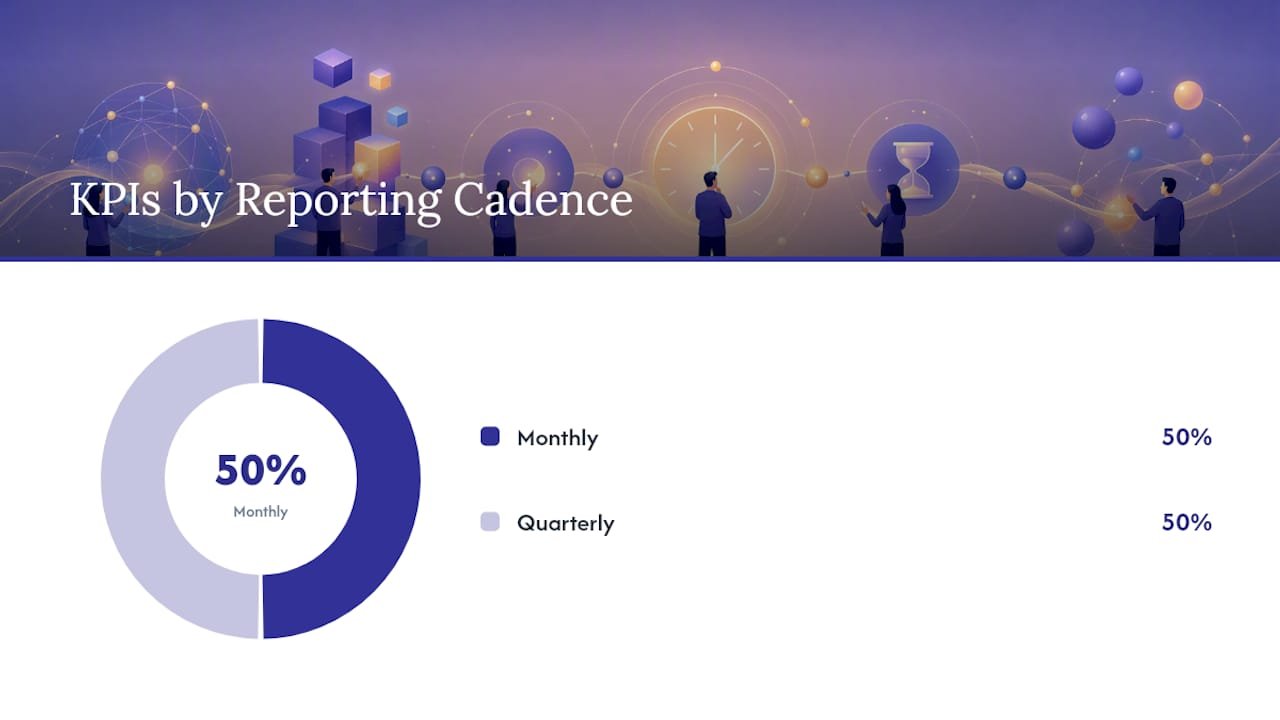
Marketing ops or procurement should own the metrics dashboard. Reporting cadence: pull order and fulfillment data monthly, run a user NPS survey quarterly, and conduct a full catalog and compliance audit twice a year.
Key Takeaways
An online company store is the most direct way to enforce brand compliance at scale while cutting the admin overhead that manual swag ordering creates.
| Point | Details |
|---|---|
| Core definition | A private, branded e-commerce portal where authorized users order pre-approved, pre-decorated merchandise. |
| Top business outcomes | Brand compliance by design, reduced admin hours, faster fulfillment, and improved employee experience. |
| Platform choice matters | Hosted turnkey stores suit most SMBs; enterprise platforms fit franchise networks; POD works for pilots and low-volume SKUs. |
| Measure what matters | Track order turnaround time, admin hours saved, cost per unit, and kit fulfillment accuracy from day one. |
| Discountswag as your partner | Discountswag supplies customizable corporate merchandise with bulk pricing, rush ordering, and multi-location fulfillment for company store programs. |
The case for getting your company store right the first time
Most organizations underestimate how much the setup phase determines long-term success. The temptation is to launch fast with a large catalog and figure out governance later. That approach almost always produces the same result: a store that employees ignore because the product selection feels generic, or a catalog that marketing has to audit constantly because SKUs were added without proper brand review.
The programs that work well share one trait: they launched small and deliberate. A pilot with five to eight SKUs, a clear user group, and agreed fulfillment SLAs teaches you more in 30 days than six months of planning. The catalog grows from there, driven by actual order data rather than assumptions about what employees want.
There is also a tendency to treat the company store as a one-time project rather than an ongoing program. The catalog needs quarterly reviews. The access controls need to sync with HR system changes. The fulfillment partner relationship needs active management. Companies that assign a named owner and a recurring review cadence get compounding returns. Those that treat it as a set-and-forget deployment usually find themselves rebuilding from scratch 18 months later.
Discountswag makes your company store catalog work harder
Building a company store catalog from scratch is where most programs stall. You need products that photograph well, decorate cleanly, arrive on time, and hold up after repeated use. Discountswag supplies exactly that: customizable corporate merchandise across apparel, drinkware, bags, tech accessories, and event swag, with bulk pricing, rush ordering, and fulfillment to single or multiple locations.
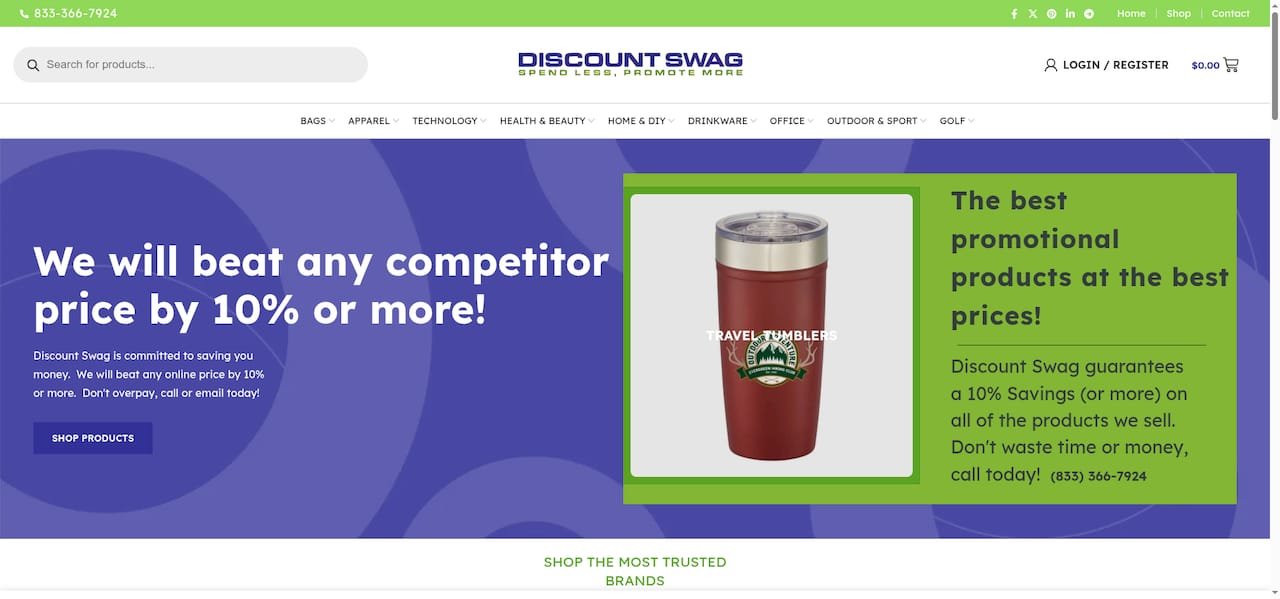
Whether you are stocking an onboarding kit program, building out a rewards catalog, or sourcing high-ROI branded giveaway items for your store’s event section, Discountswag has the product depth and fulfillment infrastructure to support it. Browse the full promotional items guide for brand awareness to identify the SKUs that belong in your catalog, or get a bulk quote directly at discountswag.store.
Useful sources for further reading
- What Is A Company Store? | ASI
- What Is a Company Store? Benefits for Uniforms, Rewards, and Employee
- What Is a Company Store: Centralizing Your Brand Assets — Ansira
- What Is an Online Store? | Stripe
- What is an ecommerce website and how does it work? (2026)
- The Company Store – The Home Depot
 Bottle Carriers
 Mugs
Mugs