

Corporate Event Merchandise Checklist for Planners

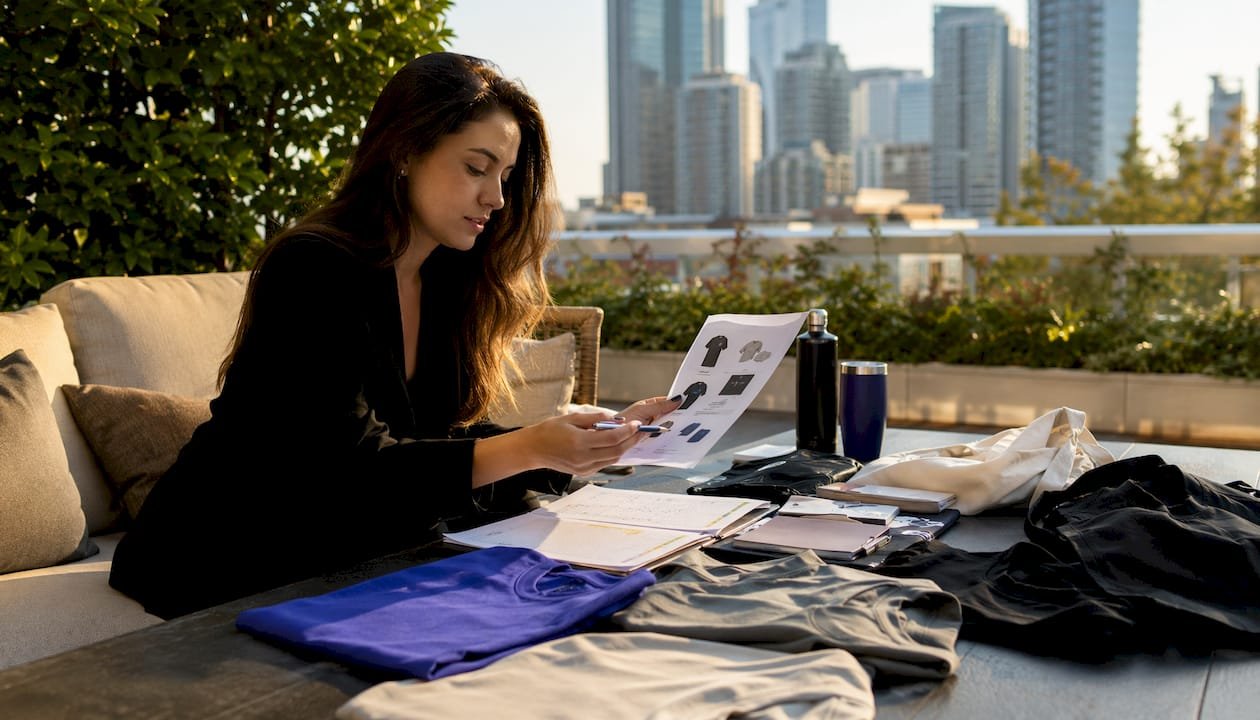
Use this corporate event merchandise checklist to select, order, and deliver branded items on time and within budget. Start planning at least eight weeks out for standard production; compressed schedules are possible but require domestic sourcing. Target spending tiers for walkaway, reusable mid-tier, and VIP gifts.
Immediate action items:
- Confirm final headcount (add a buffer for walk-ins)
- Set per-attendee budget tier: walkaway, mid-value, or VIP
- Finalize logo files in vector format (AI, EPS, or outlined PDF)
- Place a sample order before committing to bulk production
- Confirm venue receiving hours and any shipping restrictions
Pro Tip: The single most common last-minute failure is waiting to approve artwork until after samples arrive. Approve your vector files and color specs before you request samples — that one step alone saves a week.
Table of Contents
- What event type, goals, and audience should drive your merch choices?
- Your merchandise timeline: 8-week plan and 4-week fallback
- Which merchandise categories should you actually order?
- How many should you order, and what will it cost?
- What artwork and print specs do you need to confirm before ordering?
- How do you vet vendors and evaluate samples?
- How do you plan shipping, warehousing, and on-site distribution?
- What sustainability and compliance points should you check?
- Where can you get a downloadable checklist and planner templates?
- Key Takeaways
- What planners consistently get wrong about event merchandise
- Discountswag makes event merchandise planning faster and less risky
- Useful sources and further reading
What event type, goals, and audience should drive your merch choices?
Before you pick a single item, write down what the event is supposed to accomplish. Brand awareness, lead generation, client retention, and employee appreciation each pull toward different product categories and price points. A trade show booth giveaway needs to be lightweight and instantly useful; a VIP client dinner calls for something curated and premium. Getting this wrong means spending real money on items that end up in hotel trash cans; for expert guidance on content calendar planning and strategy, consider insights from Content calendar marki premium: rola i strategia.
Segment your attendees into tiers, then assign item priorities to each. Prospects respond to utility items they will actually use after the event. Existing clients appreciate quality over novelty. Staff and VIPs expect something that signals genuine recognition, not a bulk order afterthought.
| Event type | Primary goal | Recommended item focus | Messaging priority |
|---|---|---|---|
| Trade show / expo | Lead generation | Branded bags, tech accessories, pens | Brand name visibility, booth traffic |
| Corporate conference | Awareness + retention | Drinkware, apparel, notebooks | Thought leadership, community |
| Client appreciation dinner | Retention + loyalty | Gift sets, premium drinkware | Exclusivity, personalization |
| Internal team event | Culture + morale | Apparel, custom kits, fun items | Belonging, recognition |
| Product launch | Awareness + trial | Demo-tied items, tote bags | Product name, tagline |
Checklist questions to finalize before ordering:
- Who attends, and what is their relationship to your brand?
- What is the single message you want them to associate with the item?
- Will items be handed out at a booth, mailed in advance, or placed on seats?
- Do any attendees have sustainability or accessibility requirements?
Your merchandise timeline: 8-week plan and 4-week fallback
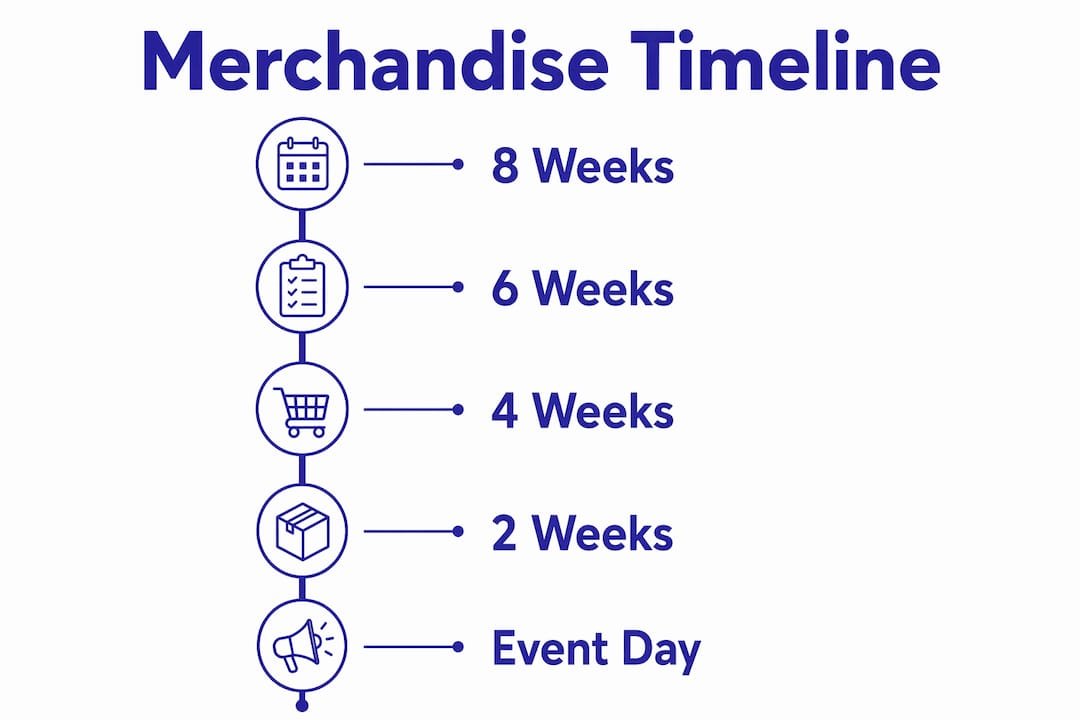
The 8-week schedule
Eight weeks is the standard planning window for domestic production with full customization options. Here is how to use it:
| Week | Milestone | Key tasks |
|---|---|---|
| 8 | Strategy locked | Confirm event goals, attendee count, budget tiers, item categories |
| 7 | Creative ready | Finalize logo files, color specs, messaging; brief vendor |
| 6 | Samples ordered | Request production samples; evaluate color, print, feel |
| 5 | Samples approved | Approve or revise; confirm bulk quantities and size mix |
| 4 | Production starts | Place bulk order; confirm production timeline in writing |
| 3 | Production complete | Confirm ship date; prepare packing manifest |
| 2 | Items in transit | Track shipments; confirm venue receiving window |
| 1 | On-site prep | Unpack, count, organize by distribution point; brief staff |
The 4-week compressed schedule
Four weeks is tight but workable if you accept the trade-offs. Domestic suppliers are non-negotiable at this stage — overseas production at this timeline is a gamble you will almost certainly lose. Expect fewer decoration options (screen print over embroidery, for example) and higher rush fees. Items that require complex tooling or multi-color embroidery should be dropped from the list.
- Week 4: Lock headcount, budget, and item list. Brief domestic vendor same day.
- Week 3: Submit artwork; approve digital proof within 24 hours. Skip physical samples if vendor has produced your logo before.
- Week 2: Production runs. Confirm tracking numbers and venue receiving details.
- Week 1: Receive, count, and stage items. Build a simple manifest so staff know what goes where.
Pro Tip: Domestic vs. overseas is not just a cost question at four weeks — it is a risk question. A shipment delayed at customs with five days to go has no recovery option. Domestic sourcing gives you a phone call and a solution; overseas gives you a claim form.
Which merchandise categories should you actually order?
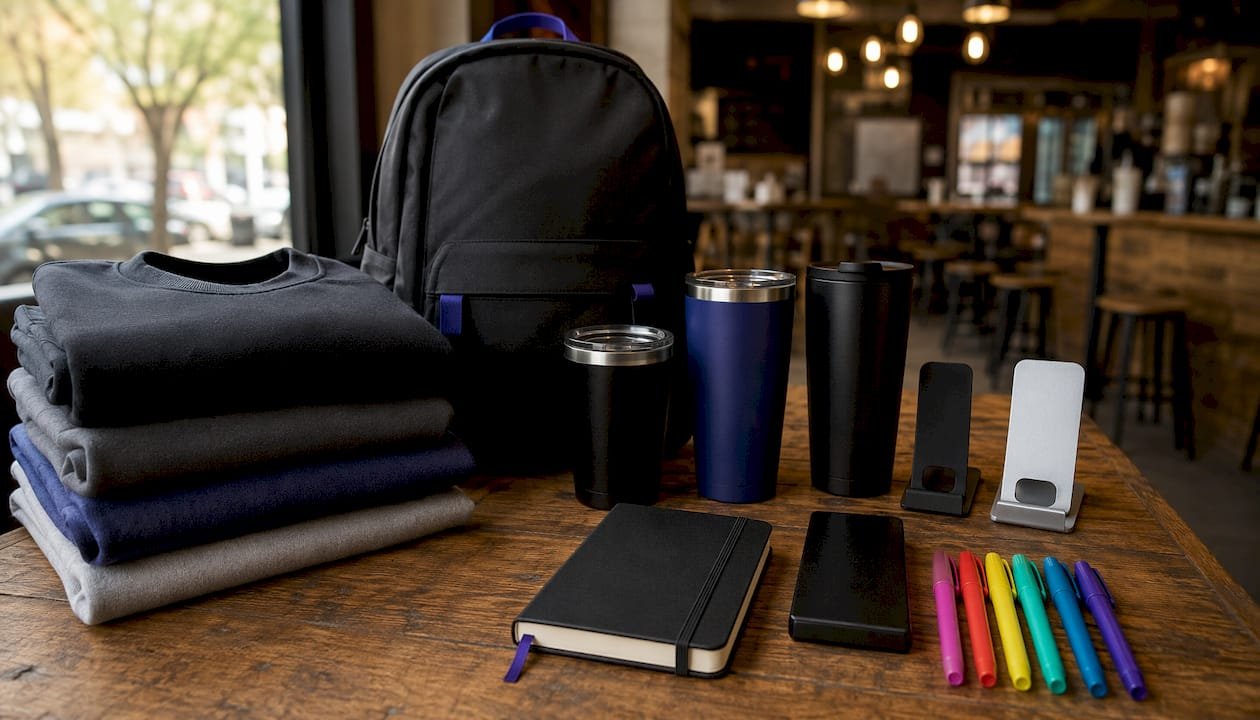
The most useful categories for corporate events are apparel, bags and totes, drinkware, tech accessories, stationery, and curated gift sets. Each serves a different role in your event strategy, and each carries a different cost and logistics profile.
| Category | Best use | Pros | Cons | Ballpark unit cost (US) |
|---|---|---|---|---|
| Apparel (T-shirts, polos, hats) | Staff uniforms, VIP gifts, team events | High perceived value, walking billboard | Sizing complexity, higher MOQ | $8–$30 |
| Bags / totes | Conference walkaways, swag carriers | Practical, high visibility, large print area | Bulky to ship, quality varies widely | $4–$20 |
| Drinkware (mugs, tumblers, bottles) | Mid-tier giveaways, VIP gifts | Daily use, long brand life | Heavier to ship, breakage risk | $6–$20 |
| Tech accessories (power banks, cables) | Tech conferences, premium walkaways | High perceived value, frequent use | Higher cost, compliance considerations | $10–$30 |
| Stationery (notebooks, pens) | General walkaways, conference tables | Low cost, easy to customize | Lower perceived value at premium events | $2–$12 |
| Curated gift sets | VIP clients, speakers, C-suite | Premium feel, memorable unboxing | Higher cost, more lead time | $30+ |
Packaging matters more than most planners expect. A $12 tumbler in a plain poly bag reads as a $6 item. The same tumbler in a kraft box with a branded insert reads as a $20 gift. If budget is tight, spend less on the item and more on the presentation for VIP tiers.
How many should you order, and what will it cost?
A 10–20% buffer on top of confirmed headcount covers walk-ins, staff needs, and post-event requests. For apparel, add a separate sizing buffer per size category — running out of mediums while smalls pile up is one of the most avoidable day-of problems.
| Event size | Confirmed attendees | Order quantity (with 10–20% buffer) | Apparel size buffer |
|---|---|---|---|
| Small | 100 | — | +10–12 per size |
| Medium | — | — | +separate sizing buffer per size |
| Large | 1,— | — | +separate sizing buffer per size |
MOQ realities: Most promotional product vendors set minimum order quantities at 24–72 units for decorated items, and 100–250 units for lower-cost stationery. If your event is small, look for vendors who offer mix-and-match MOQs across colorways, or consider tiered gifting: a lower-cost walkaway for all attendees and a premium item for a smaller VIP group.
Budget math example: Example budgets depend on attendee count, per-attendee spend, buffers, and logistics costs.
For per-attendee spend guidance tied to event goals, the $2–$6 walkaway tier covers pens, stickers, and basic totes. The $7–$20 mid-tier covers branded drinkware and quality notebooks. Anything above $30 should be reserved for VIPs, speakers, or key clients.
What artwork and print specs do you need to confirm before ordering?
Artwork problems are the leading cause of production delays, and almost all of them are preventable. Confirm these specs before you send a single file to a vendor.
File format checklist:
- Vector files only: AI, EPS, or PDF with fonts converted to outlines
- No embedded raster images inside vector files
- Pantone color codes for color-critical items (apparel, drinkware); sRGB hex codes for digital proofs
- Separate files for light and dark backgrounds
- Print area dimensions confirmed against the specific item’s template
Print method guide:
- Screen print: Best for flat surfaces, 1–4 colors, high volume. Sharp edges, cost-effective at scale.
- DTG (direct-to-garment): Full-color photos on apparel, lower MOQs. Less durable than screen print on dark fabrics.
- Embroidery: Premium look on hats, polos, and bags. Not suitable for fine detail or gradients.
- Pad print: Small, flat surfaces like pens and USB drives. Limited color count.
- Laser etch: Metal and hard surfaces (tumblers, power banks). No color, but extremely durable.
Confirm vector files and Pantone specs with your vendor before requesting samples. For color-critical items, always request a physical proof — a digital mockup on screen will not show you how your navy logo reads on a charcoal fabric.
Pre-order approval checklist:
- Digital proof reviewed and signed off by brand team
- Physical proof approved for color-critical items (apparel, drinkware)
- Fit-check sample approved for apparel before bulk run
- Print placement confirmed against actual item dimensions
Pro Tip: Scale your logo to the actual print area before approving. A logo that looks bold at 4 inches wide on a tote bag becomes illegible at 1 inch on a pen clip. Always review artwork at 1:1 scale on the actual item template.
How do you vet vendors and evaluate samples?
Vendor selection is where planners most often cut corners and most often regret it. A low quote means nothing if the vendor misses your ship date or delivers items that fail a basic color check.
Vendor-vetting checklist:
- Confirmed domestic production lead time in writing
- References from at least two events of similar size
- Clear policy on rush fees, reprint guarantees, and defect thresholds
- Proof of general liability insurance for branded goods
Sampling is non-negotiable for any new vendor or new item. Request both a production sample (made on the actual production line) and a color-accurate sample for brand-critical items.
| Inspection criterion | Pass | Fail |
|---|---|---|
| Color match | Within one Pantone step of approved spec | Noticeably off; visible shift in hue or saturation |
| Print placement | Centered within 1/8 inch of approved position | Skewed, off-center, or clipped |
| Stitch quality (embroidery) | Clean edges, no loose threads, consistent density | Puckering, thread breaks, uneven fill |
| Print clarity | Sharp edges, no bleeding or pixelation | Blurry edges, ink spread, missing detail |
| Product feel / finish | Matches spec sheet description | Noticeably lighter, rougher, or cheaper than spec |
Pro Tip: Domestic vs. overseas is not just a timeline question — it is a quality-control question. Domestic vendors allow you to request a production sample mid-run and course-correct before the full order ships. With overseas production, by the time you see a problem, 5,000 units are already packed.
How do you plan shipping, warehousing, and on-site distribution?
Logistics is where well-planned events fall apart. A shared packing manifest with SKU, count, lot number, and arrival date makes accountability clear across your team and any third-party vendors.

Packing manifest template fields:
| Field | Description |
|---|---|
| SKU / item name | Unique identifier for each product |
| Quantity ordered | Total units placed with vendor |
| Quantity received | Count confirmed on arrival |
| Lot / batch number | For tracking defects or reprints |
| Arrival date | Confirmed delivery date to venue or warehouse |
| Distribution point | Booth, swag station, VIP room, or registration |
| Staff responsible | Named person accountable for that item |
Fulfillment options and trade-offs:
- Ship direct to venue: Lowest cost, but requires venue approval and confirmed receiving hours. Risk: venue loses boxes or charges storage fees.
- Third-party warehouse: Staged deliveries, better control, higher cost. Best for large events with multiple SKUs.
- Ship to hotel: Works for distributed attendee packages or speaker gifts. Confirm hotel receiving policy and per-package fees in advance.
On-site distribution checklist:
- Swag station staffed and stocked before doors open
- VIP items separated and labeled by name or tier
- Overflow stock stored in a locked, accessible back-of-house location
- Staff briefed on item descriptions and distribution rules (one per person, VIP-only items)
- End-of-day count recorded for post-event inventory reconciliation
What sustainability and compliance points should you check?
Sustainability claims on promotional products are easy to make and hard to verify. When a vendor says an item is “eco-friendly,” ask for the specific certification or material datasheet. Recycled fabrics, FSC-certified paper, and reusable drinkware are all verifiable; “green” or “sustainable” with no backing documentation is marketing copy.
Certifications worth asking for:
- GOTS (Global Organic Textile Standard): Organic fiber content in apparel, verified by third-party audit
- FSC (Forest Stewardship Council): Responsibly sourced paper and wood-based products
- Recycled content claim: Ask for percentage and material type (post-consumer vs. post-industrial)
- OEKO-TEX Standard 100: Tests for harmful substances in textiles — relevant for apparel given to children or used in food-adjacent settings
Basic U.S. safety and labeling points:
- Items with small parts (keychains, small accessories) should carry appropriate age-restriction labeling if there is any chance they reach children
- Food-contact items (mugs, bottles) should meet FDA material standards — confirm with your vendor
- Branded items containing batteries (power banks) must comply with DOT shipping regulations for lithium cells
Practical sustainability move: Replace single-use plastic bags with recycled kraft paper bags or reusable totes as your primary packaging. The cost difference is modest, and the perceived quality lift is immediate.
Where can you get a downloadable checklist and planner templates?
Discountswag provides planner templates and sample SKU mixes you can download and adapt directly. The package includes the BLUF checklist from this guide, an editable 8-week timeline you can copy into Google Sheets or Excel, a packing manifest template, and sample SKU mixes for three event sizes.
Sample SKU mixes by event size:
| Event size | Attendees | Suggested SKU mix | Notes |
|---|---|---|---|
| Small | Under 100 | 1 walkaway item + 1 premium item for VIPs | Keep it simple; focus budget on quality |
| Medium | 100–250 | 2 walkaway items + 1 mid-tier item + VIP gift set | Differentiate tiers clearly |
| Large | 250+ | 3 walkaway items + 1 mid-tier + premium VIP kit | Use packing manifest; assign staff per SKU |
The editable timeline template includes milestone columns for concept, sample, approval, production, shipping, and on-site prep. Copy it into your project management tool (Asana, Monday.com, or a shared Sheets file) and assign owners to each milestone. The packing manifest template mirrors the fields in the shipping section above and includes a running count column for day-of reconciliation.
To request the full template package or a planner consult, visit Discountswag and use the contact form to describe your event size, date, and budget tier.
Key Takeaways
A successful event merchandise program requires locking goals, timelines, and artwork before production starts — every delay traces back to one of those three.
| Point | Details |
|---|---|
| Start eight weeks out | Eight weeks covers concept through domestic shipping; four weeks requires domestic sourcing and fewer customization options. |
| Set spend tiers early | Budget $2–$6 for walkaways, $7–$20 for mid-tier reusables, and $30+ for VIP gifts before selecting any items. |
| Buffer quantities | Add buffers to headcount and sizing to avoid day-of stockouts. |
| Approve artwork first | Submit vector files with Pantone specs and get digital proof sign-off before requesting samples — this saves at least a week. |
| Use Discountswag templates | Discountswag’s downloadable planner package includes the 8-week timeline, packing manifest, and sample SKU mixes for three event sizes. |
What planners consistently get wrong about event merchandise
The mistakes Discountswag sees most often are not exotic. They are the same three problems, repeated across events of every size.
Late artwork approvals are the biggest timeline killer. Planners treat artwork as a final step rather than a prerequisite. By the time the brand team signs off on the logo file, the production window has shrunk from four weeks to two, and rush fees have eaten 20–30% of the budget. The fix is simple: treat artwork approval as a Week 7 milestone, not a Week 4 scramble.
Skipping samples is the second. A digital mockup looks nothing like a finished embroidered polo under event lighting. Planners who skip the physical sample to save a week often spend two weeks dealing with a reprint. If you have worked with a vendor before on the same item, a digital proof may be enough. For any new vendor or new item, the sample is not optional.
Under-ordering sizes is the third, and it is almost always apparel. Planners order based on a general population size distribution and forget that conference attendees skew toward larger sizes. Order more larges and XLs than you think you need, and fewer smalls. Running out of a size on day one, with two days left in the event, is a problem with no good solution.
The common thread across all three: they are all decisions made too late. The planners who avoid them are the ones who treat merchandise as a project track, not an afterthought.
Discountswag makes event merchandise planning faster and less risky
Planning branded merchandise for a corporate event involves a lot of moving parts: artwork approvals, vendor vetting, size buffers, shipping logistics, and on-site distribution. Discountswag handles the sourcing and production side so you can focus on the event itself.
Discountswag’s promotional items catalog covers every category in this guide, from $2 walkaway pens to $30+ curated gift sets, with domestic production options that fit both 8-week and compressed 4-week timelines. You get a dedicated account contact, digital proofs before production, and a reprint guarantee on defective items. No minimum-order surprises — MOQs are listed upfront.
To get started, visit Discountswag and submit a quote request with your event date, confirmed headcount, budget per attendee, and any existing logo files. The team will respond with item recommendations, unit pricing, and a production timeline matched to your event date.
Useful sources and further reading
- Branded Merchandise for Events: A 2026 Planner’s Guide — Discountswag: The primary reference for timelines, sampling strategy, and downloadable templates used throughout this guide.
- How to Choose Corporate Swag That Works — Discountswag: Covers buffer calculations, MOQ guidance, and decision criteria for item selection.
- Logo Apparel Buying Guide for Bulk Orders — Discountswag: Detailed artwork specs, print method comparisons, and proof requirements for apparel.
- Types of Branded Promotional Products for Marketers — Discountswag: Category taxonomy with use-case examples across all major product types.
- Branded Merchandise That Delivers More — Discountswag: Covers sustainability certifications, material options, and effectiveness considerations.
- Promotional Items for Brand Awareness: 2026 Marketer’s Guide — Discountswag: Per-attendee spend tiers and campaign alignment guidance for event planners.
- 12 Top Branded Giveaway Items That Earn Repeat Use — Discountswag: Quick reference for high-utility item ideas across event types and budget levels.
 Bottle Carriers
 Mugs
Mugs