

Trade Show Giveaways That Drive Leads, Not Just Foot Traffic

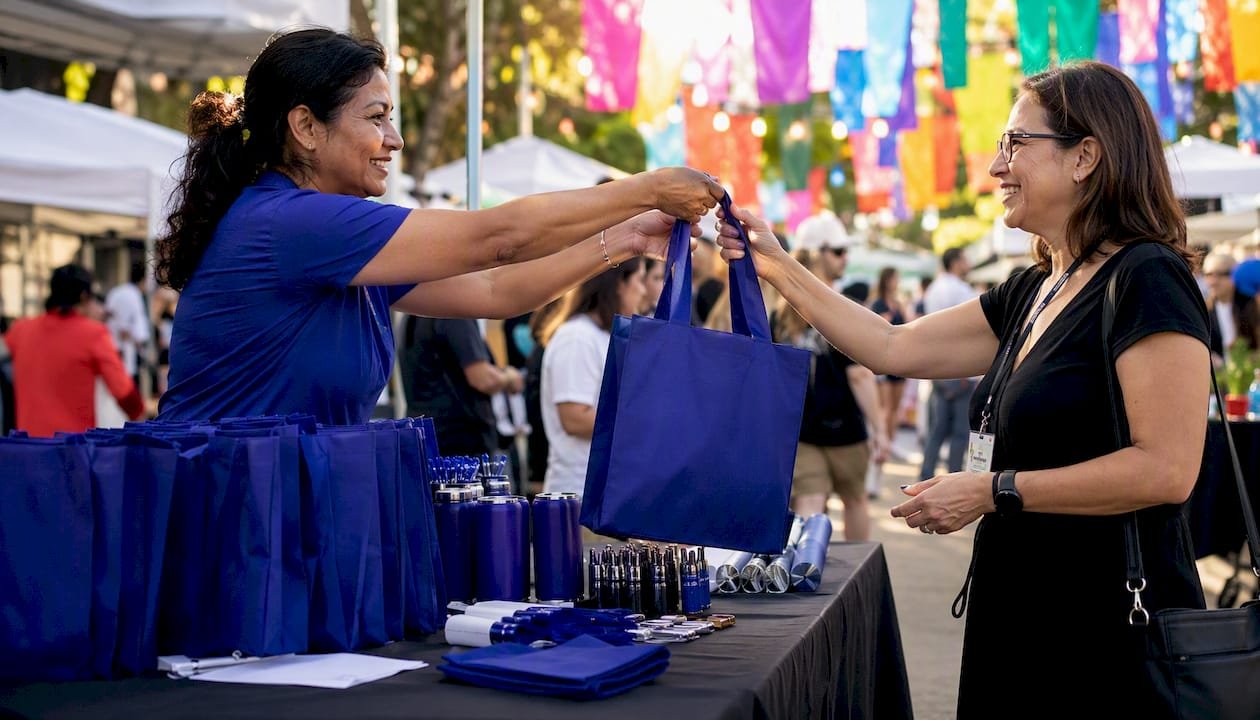
Use a two-tier giveaway strategy at your next show: a high-volume utility item at the front of the booth to pull in traffic, and a reserved premium item held back for qualified conversations. That single structural decision separates exhibitors who leave with a badge scan spreadsheet from those who leave with real pipeline. According to ASI, a trade show giveaway is any branded promotional item distributed at an exhibit to attract visitors and reinforce brand recall. The industry standard budget guidance suggests allocating roughly 15–20% of your total show budget to giveaways, and splitting that about 70/30 between high-volume Tier One items and Tier Two premium items for qualified leads. Discountswag is a reliable starting point for sourcing both tiers, with customizable options across every category below.
Top categories to prioritize on most B2B floors:
- Tote bags (canvas or rPET): front-of-booth traffic driver, turns attendees into moving billboards
- Tech accessories (power banks, USB-C cable kits): high perceived value, stays on desks
- Insulated drinkware (stainless tumblers): premium Tier Two anchor, used daily
- Notebooks or branded playbooks: conversation-starter, especially for SaaS and consulting brands
- Digital-first tokens (QR assessment cards, seed-paper cards): low cost, high relevance for data-driven ICPs
Table of Contents
- What are the best trade show giveaway categories?
- Best trade show giveaways under $5 that still deliver ROI
- How to customize giveaways so the branding actually works
- Pricing, MOQs, lead times, and what to ask your supplier
- Make giveaways strategic: turn swag into a measurable engine for conversations and pipeline
- Safety, labeling, and compliance notes for U.S. shows
- How do you measure whether your trade show giveaways actually worked?
- Key Takeaways
- What most exhibitors get wrong about trade show giveaways
- Discountswag makes ordering trade show giveaways straightforward
- Authoritative sources and suggested further reading
What are the best trade show giveaway categories?
Utility, relevance, and quality are the three predictors that determine whether a giveaway survives the trip home. Every category below earns its place by meeting at least one of those three.
Bags
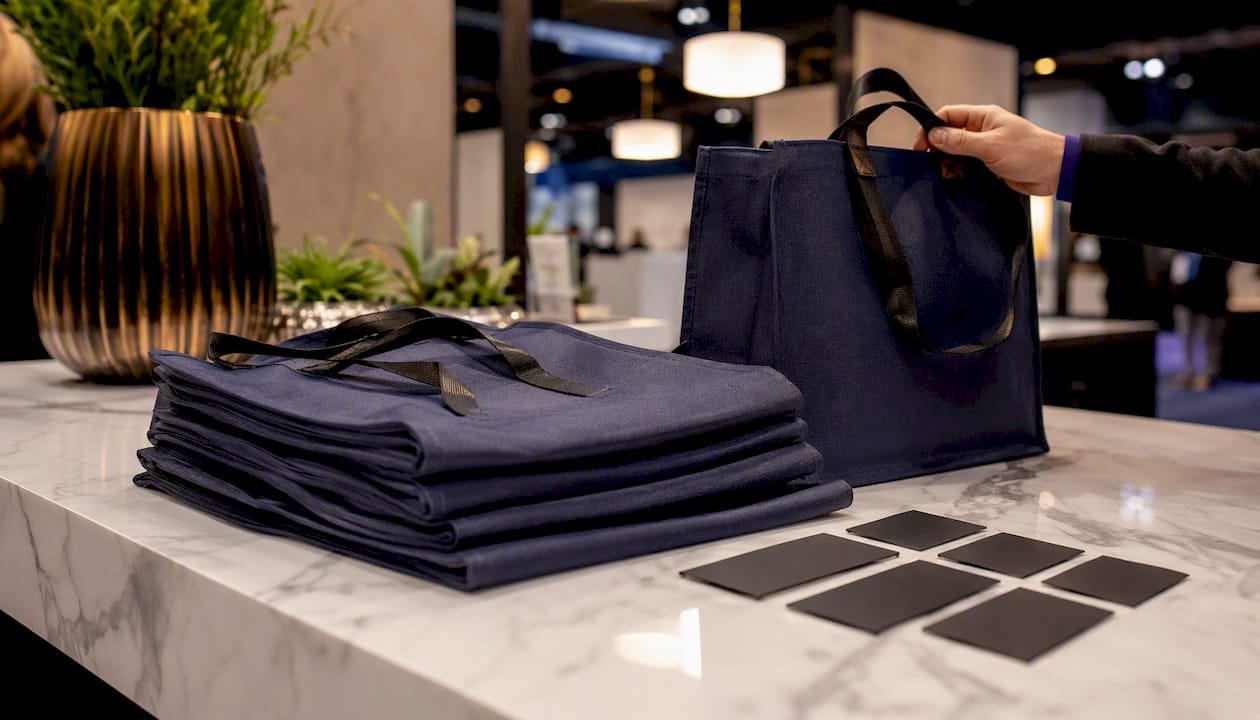
A quality tote bag priced in the low to mid-range bracket is an efficient traffic driver on the show floor. People need somewhere to put everything they collect, and a branded bag solves that problem immediately. An rPET tote made from recycled plastic bottles adds an eco-friendly story that resonates with sustainability-minded buyers. Small booths should lead with this one item alone; it does the heavy lifting.
Drinkware
An insulated stainless tumbler is a classic Tier Two anchor, costing more per unit than a tote but earning daily desk time for months. Reserve it for attendees who complete a demo or product conversation. A vacuum-insulated bottle with a clean logo imprint signals quality more effectively than a low-cost pen.

Pens and office items
Pens are the most ordered promotional item in the U.S. for a reason: they are cheap, universally useful, and sit on desks. The catch is that a flimsy pen gets tossed. Spend a little more on a metal-barrel or soft-grip option, and the retention rate climbs. Branded sticky note pads and compact notebooks round out this category and work well as conversation-starters when they include a printed worksheet or one-page playbook relevant to your ICP’s daily workflow.
Apparel
A branded cap or quarter-zip is a Tier Two item, full stop. Apparel costs too much per unit for mass distribution, but given to a warm lead after a meaningful conversation, it becomes a walking endorsement. Sizing logistics are real: pre-size your stock based on historical show demographics, or use a post-show fulfillment model where the recipient picks their size online and you ship directly.
Tech accessories
USB-C multi-cable kits, wireless charging pads, and compact power banks sit in the $6–$22 cost band and carry the highest perceived value per dollar of any category. They stay in bags and on desks, which means your logo travels. For flagship booths, a branded cable kit works as a Tier One item at the mid-range; a power bank moves to Tier Two.
Health and safety items
Branded hand sanitizer, lip balm, and travel-size sunscreen are low-cost, high-utility items that attendees genuinely appreciate. They fit in pockets, get used on the show floor, and carry your logo through the rest of the event day. Compact sanitizer spray bottles priced in the lower cost range are a natural add-on to any giveaway bag.
Eco-friendly options
Seed-paper cards, bamboo utensil kits, and recycled-material notebooks signal environmental awareness without requiring a premium budget. Seed-paper cards double as a leave-behind: the attendee plants it, and your brand message is literally embedded in the experience. These items work especially well for brands in sustainability, food, agriculture, or consumer wellness sectors.
Best trade show giveaways under $5 that still deliver ROI
Budget items fail when they feel cheap. The ones below earn desk time or repeat impressions because they solve a real problem.
- Printed playbooks or worksheets ($1–$2): A one-page laminated guide relevant to your ICP’s job (a checklist, a framework, a quick-reference card) is more likely to stay on a desk than a generic flyer. It positions your brand as a resource, not just a vendor.
- QR assessment cards ($0.50–$1.50): A card that links to a free self-assessment or ROI calculator drives post-show digital engagement and gives your team a warm follow-up trigger.
- Seed-paper cards ($1–$2): Plantable, memorable, and genuinely different from everything else in an attendee’s tote bag.
- Silicone cable ties ($1–$2): Small, useful, and used every time someone packs a laptop bag. Your logo is on it every time.
- Branded lip balm ($1.50–$2.50): High utility, pocket-sized, and used multiple times per day at a show.
- Compact hand sanitizer ($2–$4): Attendees reach for it constantly at shows. A clean logo on the bottle gets repeated impressions throughout the day.
- Quality click pens ($1.50–$3): Skip the cheapest tier. A pen that writes smoothly and feels solid in the hand stays in a pocket; a scratchy one goes in the trash.
- Sticker packs or die-cut magnets ($1–$2): Niche but effective for tech, gaming, and creative brands. Stickers end up on laptops; magnets end up on refrigerators.
Minimum order note: Most budget SKUs carry MOQs of 100–250 units. Plan Tier One quantities to cover 60–70% of your expected daily foot traffic. Ordering too few means running out by noon on day one; ordering too many of a low-value item wastes budget that could fund a better Tier Two piece. Check Discountswag’s catalog for current MOQs across budget categories.
How to customize giveaways so the branding actually works
The imprint method you choose affects perceived quality as much as the item itself. A beautifully decorated $3 tote outperforms a sloppily printed $8 bag every time.
| Imprint method | Best substrates | Color limits | Typical lead time | Perceived quality |
|---|---|---|---|---|
| Screen print | Cotton, canvas, polyester | 1–4 spot colors | 7–14 business days | High for flat surfaces |
| Pad print | Hard plastics, metal, pens | 1–4 spot colors | 5–8 business days | Good for small curved areas |
| Full-color digital | Polyester, coated hard goods | Unlimited | 5–7 business days | High for photo-quality art |
| Laser engraving | Metal, wood, leather | No color (etched) | 5–8 business days | Premium, permanent |
| Embroidery | Caps, apparel, soft goods | 6–12 thread colors | 7–14 business days | Premium, tactile |
Placement matters more than most buyers realize. Put your logo where the user sees it repeatedly: the rim band of a tumbler, the front pocket of a tote, the inside cover of a notebook. Avoid decorating the bottom of a mug or the back panel of a bag. One logo and one short URL or tagline is almost always better than a full brand story crammed onto a 2-inch imprint area.
Keep art files clean. A logo with fine gradients or thin serifs will not survive screen print at small sizes. Ask your supplier for a minimum imprint size recommendation before finalizing artwork, and always request a digital proof before production starts.
Pro Tip: Order a physical pre-production sample for any item over $5 per unit or any order over 500 pieces. A digital mockup looks great on screen; a physical sample tells you whether the imprint color matches your brand standards and whether the item quality justifies the price.
Pricing, MOQs, lead times, and what to ask your supplier
Getting the logistics right is where most first-time exhibitors lose time and money. Here is a numbered checklist of what to confirm before placing any order:
- Exact MOQ per SKU. Some items have a 50-unit floor; others start at 250. Know this before you fall in love with a product.
- Sample availability and cost. Ask whether pre-production samples are available and whether the cost applies toward your order minimum.
- Standard production lead time. Typical standard production runs 7–14 business days after art approval, not after order placement.
- Rush production options and pricing. Rush lanes often exist for 3–5 business day turnarounds, but they carry a premium. Confirm the exact upcharge before committing.
- Decoration proof turnaround. Art approval can add 1–3 days to your timeline if revisions are needed. Build that in.
- Shipping and fulfillment options. Can the supplier ship to multiple locations, or only to a single address? If you need items at a venue and overflow stock at your office, confirm split-ship capability.
- Defect and return policy. Understand what percentage of defects triggers a reorder or credit, and what the process looks like.
| Lead-time scenario | Typical timeline | Notes |
|---|---|---|
| Standard production | 7–14 business days after art approval | Most common; plan 3 weeks total with shipping |
| Rush production | 3–5 business days after art approval | Carries a cost premium; confirm availability |
| Sample only | 3–7 business days | Separate from production; order early |
| Multi-location fulfillment | Add 2–3 business days | Requires confirmed addresses at order time |
Decoration setup fees are common and often not included in the per-unit price. A typical setup fee runs $40–$75 per color or per location, though this varies by supplier and method. When comparing quotes, always ask for a total landed cost that includes setup, production, and shipping.
Pro Tip: Place your order at least six weeks before the show date. That buffer covers standard production, a proof revision cycle, and ground shipping without touching rush pricing. If you are inside four weeks, budget for rush lanes from the start.
Make giveaways strategic: turn swag into a measurable engine for conversations and pipeline
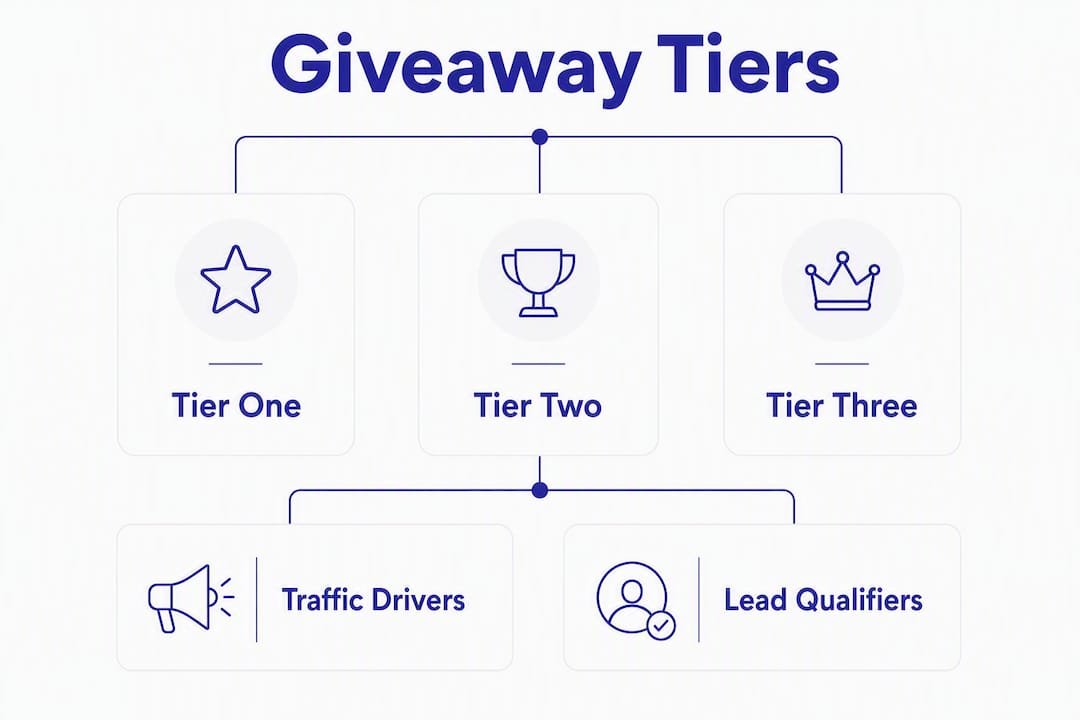
Event-marketing practitioners are clear on this: treating giveaways as random freebies is the most common and most expensive mistake exhibitors make. The fix is a distribution model with three tiers, each tied to a specific behavioral outcome.
Tier One (cold traffic): A low-cost item given freely at the front of the booth to anyone who stops. Its job is to create a reason to pause and start a conversation. A tote bag, a cable tie, or a QR card works here. Reserve 70% of your giveaway budget for this tier.
Tier Two (warm desk items): A mid-range item given to attendees who engage in a real conversation, watch a demo, or scan their badge. A branded notebook, a cable kit, or a quality pen set fits here. This is the item that stays on their desk and keeps your brand visible after the show.
Tier Three (hot premium): A reserved item for qualified leads only, typically 30–50 units. An insulated tumbler, a curated gift kit, or an experience-linked activation reward. Reserving premium items for demo completions measurably increases lead quality because it creates a behavioral gate: the attendee has to earn it.
Pre-show and post-show tactics that lift ROI:
- Pre-mail half of a two-part kit to your VIP target list before the show. They come to your booth to collect the other half. This is one of the most reliable appointment-driving mechanics in B2B event marketing.
- Reserve Tier Three items for attendees who complete a scheduled demo or pre-booked meeting.
- Ship a follow-up premium gift within one week of a qualified post-show conversation. The window for post-show recall closes fast; a physical item arriving at their desk reopens it.
- Tie item fulfillment to CRM lead scores. When a lead hits a qualification threshold, trigger a fulfillment workflow automatically.
Pro Tip: Apply the carry-on test to every item you consider. If a traveling attendee would leave it at the hotel because it is too heavy or too bulky to fit in a carry-on, it will not make it back to their office. Compact, lightweight items with high utility travel better and generate more post-show impressions.
For a deeper look at measuring experiential ROI, including specific metrics frameworks for event programs, the Ulala guide covers methods that translate directly to trade show giveaway measurement.
Safety, labeling, and compliance notes for U.S. shows
Compliance is not glamorous, but a rejected item at the venue or a post-show liability claim is far more disruptive than a five-minute supplier conversation upfront.
- Consumables and food items: Any edible or drinkable item distributed at a U.S. trade show must carry a full ingredient list and allergen warnings under FDA labeling requirements. Many convention centers have their own rules about food distribution on the show floor; confirm with venue management before ordering.
- Lip balm and personal care: These are regulated as cosmetics by the FDA. Request a Certificate of Compliance from your supplier confirming the product meets FDA cosmetic labeling standards.
- Tech items and batteries: Lithium-ion batteries in power banks are subject to DOT and IATA regulations for air freight. If your team is flying items to the show, confirm that the battery capacity (measured in watt-hours) falls within carry-on limits. Request a UN 38.3 test report from your supplier for any battery-containing item.
- Electronic certifications: Ask for FCC and RoHS certifications on any electronic item (wireless chargers, Bluetooth speakers, USB hubs). These confirm the product meets U.S. electromagnetic and hazardous-substance standards.
- Children’s product safety: If your show audience includes any consumer-facing context where items might reach children under 12, CPSC labeling and ASTM F963 toy safety standards apply. For standard B2B shows, this is rarely relevant, but worth confirming for items with small parts.
- Wearables and apparel: Request OEKO-TEX or equivalent certification for any apparel item that will be worn against skin, particularly for items marketed with a wellness or sustainability angle.
A note on venue rules: Convention centers like McCormick Place, the Las Vegas Convention Center, and the Javits Center each have their own exhibitor guidelines on food distribution, electrical items, and giveaway mechanics. Download the exhibitor manual for your specific show and read the giveaway section before finalizing your item list.
How do you measure whether your trade show giveaways actually worked?
Measurement starts before the show, not after. Define one primary metric per giveaway tier before you order a single item.
For Tier One items, the relevant metric is booth traffic volume: how many badge scans or conversations did the booth generate per hour, and did that rate correlate with the giveaway distribution rate? If you ran out of tote bags by 2 PM on day one and traffic dropped afterward, that is a data point worth capturing.
For Tier Two and Tier Three items, the metrics shift to lead quality indicators: demo completion rate, meeting-to-opportunity conversion, and cost per qualified lead. Tie item fulfillment to a CRM action so every Tier Two or Tier Three distribution is logged against a specific contact record. That linkage lets you calculate pipeline influenced per item category at the end of the show.
Post-show, track 30-day and 90-day follow-up conversion rates for contacts who received each tier. If Tier Three recipients convert to pipeline at a meaningfully higher rate than Tier Two recipients, that justifies the per-unit cost differential and informs your budget allocation for the next show.
Branded giveaway ROI frameworks from Discountswag cover the specific metrics worth tracking, including repeat-use impressions and post-show brand recall data. For event-management tools that integrate giveaway gating with lead capture and appointment scheduling, this event software analysis covers platforms built for exactly that workflow.
Key Takeaways
The most effective trade show giveaway strategy pairs a high-volume utility item for traffic with a reserved premium item gated behind a qualified conversation.
| Point | Details |
|---|---|
| Use a two-tier strategy | Spend roughly 15–20% of your total show budget on giveaways, allocating about 70% of that to Tier One traffic items and around 30% to Tier Two premium items reserved for qualified leads. |
| Match items to ICP workflow | Choose items your specific buyer uses daily: tech accessories, drinkware, and notebooks outperform generic novelty items. |
| Order six weeks out | Standard production plus proof revision plus shipping requires a minimum six-week lead time to avoid rush premiums. |
| Gate premium items | Reserve Tier Two and Tier Three items for demo completions or pre-booked meetings to improve lead quality and pipeline conversion. |
| Discountswag for sourcing | Discountswag offers customizable items across all tiers, with sample packs, rush production, and multi-location fulfillment options. |
What most exhibitors get wrong about trade show giveaways
The conventional wisdom says “give away something useful and people will remember you.” That is half right. The part most exhibitors miss is that the item is not the strategy. The distribution mechanic is.
A $2 cable tie handed to everyone who walks past your booth is a traffic tool. The same cable tie handed only to people who complete a product demo is a qualification signal. The item did not change. The gate did. And the gate is what determines whether your giveaway budget generates pipeline or just goodwill.
The other thing worth saying plainly: most exhibitors over-index on the Tier One item and under-invest in Tier Two. They spend the bulk of their budget on 1,000 tote bags and then have nothing meaningful to offer the 40 people who were genuinely interested. That is a math problem as much as a strategy problem. A smaller quantity of a better item, reserved for the right conversations, will almost always outperform a large quantity of a mediocre item distributed indiscriminately.
The pre-mail tactic is the most underused tool in B2B event marketing. Sending half a kit to a VIP prospect before the show creates a guaranteed booth visit. It is not complicated, and it works. Most exhibitors never try it because it requires coordinating a fulfillment step before the show, which feels like extra work. It is. It is also worth it.
Discountswag makes ordering trade show giveaways straightforward
Sourcing both tiers of your giveaway strategy from a single supplier saves time and reduces the coordination overhead that kills pre-show timelines. Discountswag carries customizable items across every category covered in this article, from budget tote bags and cable ties to insulated tumblers and branded apparel, with decoration options including screen print, pad print, full-color digital, laser engraving, and embroidery.
Sample packs are available so you can evaluate item quality and imprint accuracy before committing to a full production run. Rush production lanes cover situations where your timeline is tighter than ideal. Multi-location fulfillment handles split shipments to a venue address and a backup office location simultaneously. For post-show follow-up kits shipped directly to qualified leads, Discountswag’s fulfillment options cover that workflow too.
Browse the 2026 brand awareness guide to match items to your campaign goals, or go directly to the branded promotional products catalog to evaluate decoration options and request a quote. If you know your show date, start there: confirm your MOQ, request a sample, and lock in your production timeline before the six-week window closes.
Authoritative sources and suggested further reading
- ASI: What Is a Trade Show Giveaway? — The Advertising Specialty Institute’s glossary definition and category overview; a primary industry reference for promotional product standards and terminology.
- Event Marketer: Swag That Works — The New Rules for Trade Show Giveaways — Industry publication covering how modern exhibitors integrate giveaways into full event strategy rather than treating them as afterthoughts.
- ExhibitionsVoice: Trade Show Giveaway Ideas 2026 — Current cost band data, tiered distribution tactics, and category mapping for B2B shows; useful for budget planning and Tier Two item selection.
- TPG Trade Show + Event Marketing: Best Tradeshow Giveaways for Maximum ROI — Focused on appointment-setting and post-show follow-up mechanics; strong on using promotional products as incentives tied to specific actions rather than blanket handouts.
- PPAI (Promotional Products Association International) — The U.S. trade association for the promotional products industry; publishes research on product performance, safety standards, and supplier certification guidance.
- Wikipedia: Promotional Merchandise — Background reference on the history and definition of promotional products, including trade show distribution context.
- Discountswag: 12 Best Trade Show Giveaway Items — Product-focused catalog with category examples and ordering guidance for both budget and premium tiers.
- Discountswag: How to Choose Corporate Swag That Works — Decision framework for matching giveaway items to ICP profiles and campaign goals.
 Bottle Carriers
 Mugs
Mugs