

What Is a Promotional Product Audit for Marketers?


A promotional product audit is a systematic evaluation of your branded merchandise program that measures effectiveness, checks quality compliance, and tracks ROI across every campaign touchpoint. Brand managers who skip this process routinely overspend, receive defective items, and miss the data they need to justify budgets. The audit process draws on industry standards like ANSI/ASQ Z1.4, operational frameworks such as friction auditing, and brand recall benchmarking to give marketing professionals a complete picture of what their swag is actually doing. Understanding what is a promotional product audit is the first step toward running merchandise programs that perform as well on paper as they do at the event table.
What is a promotional product audit?
A promotional product audit is a structured review of four interconnected areas: brand recall performance, product quality, operational workflow, and supplier compliance. Each area produces measurable data that tells you whether your merchandise program is working or quietly draining budget.
The industry term for this process is a promotional merchandise program review, though “promotional product audit” is the phrase most marketing teams use in practice. Both terms describe the same structured evaluation. The goal is not just to find problems. It is to build a repeatable measurement system that improves every campaign cycle.

The four core components
Brand recall tracking measures whether recipients remember your brand after receiving a product. The benchmark for unaided recall sits at 40–60% in competitive categories, with surveys conducted 2–4 weeks post-event for the most accurate results. Personalized merchandise delivers roughly 30% higher ROI than generic alternatives. That gap alone justifies building recall measurement into every campaign.
Quality control inspection uses ANSI/ASQ Z1.4 sampling standards to set Acceptable Quality Limits of 2.5 for major defects and 4.0 for minor defects. This standard prevents you from inspecting every unit while still catching defects early. Critical defects, such as a logo printed on the wrong side or a safety hazard in a children’s item, carry zero tolerance.
Operational friction measurement converts workflow inefficiencies into dollar costs. Manual order management and status chasing consume 20–30% of total program capacity. That is not a minor inconvenience. It is a measurable labor cost that belongs in your audit report.
Supplier and factory compliance evaluation checks whether your vendors meet regulatory requirements like CPSIA and Proposition 65. Supplier audits reduce supply chain risk and unnecessary testing costs while protecting brand reputation. A single non-compliant product reaching a trade show floor can create legal and reputational exposure that no giveaway budget can absorb.
Pro Tip: Run your brand recall survey exactly 2–4 weeks after an event, not immediately after. Recipients need time to process the experience before their recall reflects genuine brand association.
| Audit Component | Key Metric or Standard |
|---|---|
| Brand recall | 40–60% unaided recall benchmark, surveyed 2–4 weeks post-event |
| Quality control | ANSI/ASQ Z1.4, AQL 2.5 major / 4.0 minor defects |
| Operational friction | 20–30% program capacity lost to manual processes |
| Supplier compliance | CPSIA, Proposition 65 regulatory adherence |
How does a promotional product audit benefit marketing campaigns?
A well-executed audit translates directly into budget protection and campaign performance. The financial case is straightforward: defined budget guardrails such as per-unit cost ceilings and contingency reserves prevent campaign overspending by up to 20%. Without those guardrails, freight delays and logo errors quietly cause overruns before any approval triggers.
“Framing workflow inefficiencies as dollar costs helps marketers secure leadership buy-in to optimize operating models. Converting time logs of status chasing and data reconciliation into measurable labor costs is a strategic audit tool, not just an operational one.”
The benefits extend beyond cost control. A complete promotional item evaluation gives brand managers the data to make smarter decisions at every stage of a campaign.
- CFO buy-in: Friction audits convert operational drag into dollar figures that finance teams understand. A 25% capacity loss in your order management workflow is not an abstract complaint. It is a line item.
- Risk reduction: Supplier compliance audits catch regulatory failures before products ship. Discovering a CPSIA violation after 10,000 units arrive is far more expensive than auditing the factory beforehand.
- Campaign optimization: Recall data tells you which product categories drive the strongest brand association. That insight shapes your next product selection, not just your post-event report.
- Brand consistency: A brand consistency review during the audit catches logo color drift, incorrect taglines, and off-spec materials before they reach recipients.
The audit also supports smarter branded merchandise ROI conversations with leadership. When you can show recall rates, cost-per-impression, and defect rates in one report, budget requests become much easier to defend.
What are common pitfalls in conducting a promotional product audit?
The most damaging mistake is treating the audit as a one-time checklist. Audits must be integrated into every campaign cycle, not pulled out once a year when something goes wrong. A single post-campaign review tells you what broke. A continuous audit process tells you why it keeps breaking.
- Skipping mid-production QA. Inspecting first-line pieces and randomly sampling across production shifts catches defects before they scale. Waiting until the full order arrives means reprinting thousands of units at full cost.
- Relying on factory promises without sampling. A supplier’s compliance history means nothing without physical sample approval. Request pre-production samples and test them against your spec sheet before authorizing the full run.
- No defined ownership. Clear ownership and shared tracking systems prevent distribution errors and waste. When everyone assumes someone else is tracking delivery confirmations, items get lost and budgets absorb the replacement cost silently.
- Ignoring operational friction data. Most teams log complaints about slow order processing but never convert those complaints into dollar figures. Without a friction audit, you cannot build the business case to fix the workflow.
- Treating recall surveys as optional. Brand recall data is the only direct evidence that your merchandise is doing its job. Skipping it leaves you with spend data but no performance data.
Pro Tip: Assign a single named owner to each audit component before the campaign launches. Shared responsibility without named accountability produces the same result as no accountability at all.
How to conduct a promotional product audit step by step
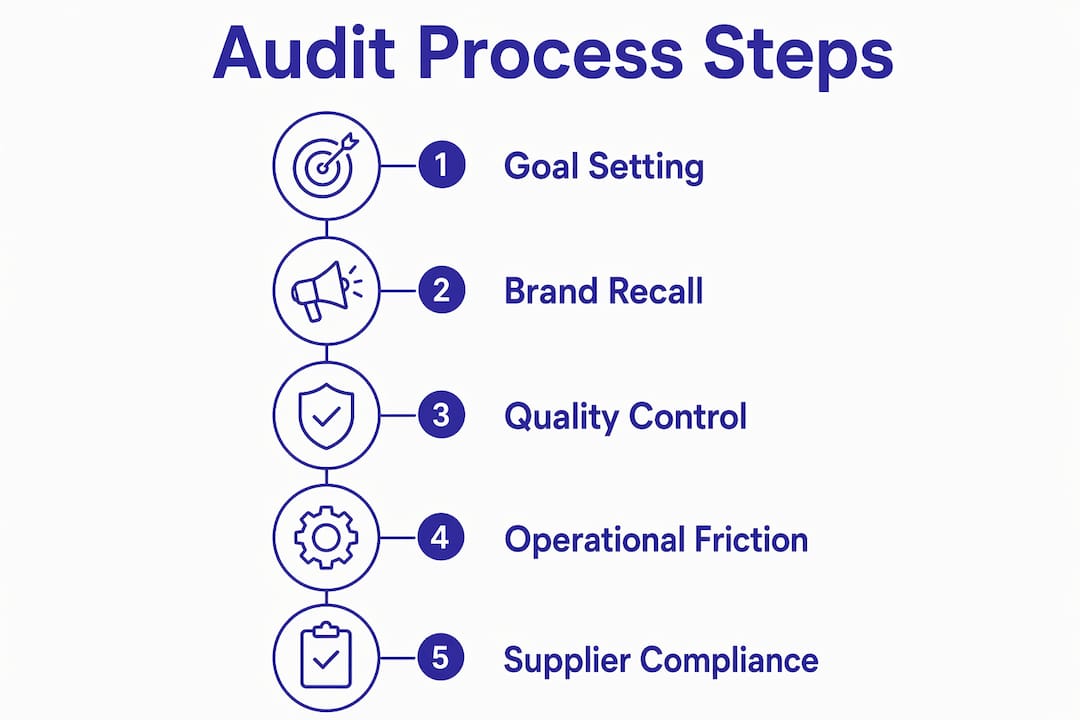
A practical promotional product analysis follows five phases. Each phase produces a specific output that feeds the next.
- Set audit goals aligned with campaign objectives. Define what success looks like before you order anything. Are you measuring brand recall at a trade show, cost efficiency in a direct mail drop, or supplier reliability across a multi-location rollout? Your goals determine which audit components matter most.
- Conduct the brand recall survey. Deploy a short survey 2–4 weeks after the campaign ends. Ask recipients whether they remember the brand on the product and whether it influenced their perception. Compare results against the 40–60% unaided recall benchmark to gauge performance.
- Execute quality control inspections using ANSI/ASQ Z1.4. Apply AQL sampling at two points: pre-production sample approval and mid-production inspection. Zero tolerance applies to critical defects. Major defects trigger a hold and corrective action request before shipment continues.
- Run the friction audit. Log every manual step in your order management workflow. Time how long status chasing, data entry, and fulfillment reporting actually take. Convert those hours into labor costs. A swag campaign strategy built on friction data runs leaner than one built on assumptions.
- Compile findings into a single audit report. Combine recall rates, defect rates, friction costs, and supplier compliance scores into one document. Use that report to set benchmarks for the next campaign and to identify which suppliers, product categories, and workflows need improvement.
| Audit Phase | Output |
|---|---|
| Goal setting | Defined KPIs per campaign type |
| Brand recall survey | Recall rate vs. 40–60% benchmark |
| QC inspection (ANSI/ASQ Z1.4) | Defect rate report and corrective actions |
| Friction audit | Labor cost estimate for manual processes |
| Audit report | Benchmarks and improvement priorities |
Key Takeaways
A promotional product audit is the only reliable way to measure whether your branded merchandise program is generating returns, maintaining quality, and operating efficiently across every campaign.
| Point | Details |
|---|---|
| Define the four components | Every audit must cover brand recall, quality control, operational friction, and supplier compliance. |
| Use industry standards | Apply ANSI/ASQ Z1.4 AQL sampling and conduct recall surveys 2–4 weeks post-event. |
| Quantify friction costs | Convert manual workflow time into labor dollars to build a leadership-ready business case. |
| Audit continuously | Integrate the review into every campaign cycle, not just after a problem surfaces. |
| Assign clear ownership | Name a single owner for each audit component before the campaign launches to prevent gaps. |
Why most promotional product audits fail before they start
Brand managers often treat the audit as a finance exercise rather than a campaign tool. That framing is the root cause of most audit failures. When the audit lives in a spreadsheet that only comes out at budget review time, it produces historical data with no operational value. The teams that get the most out of their audits treat them the way a production manager treats a quality gate: built into the process, not bolted on afterward.
The friction audit component is the most underused part of the whole process. I have seen marketing teams spend weeks debating which tote bag to order while their order management workflow quietly consumed a third of their program capacity in manual status emails. Converting that time into a dollar figure changes the conversation immediately. It stops being a process complaint and starts being a budget line that leadership can act on.
The other shift worth making is moving from product-level thinking to program-level thinking. A single item’s recall rate matters less than the pattern across your entire merchandise mix. Which categories consistently outperform the 40–60% unaided recall benchmark? Which suppliers have clean compliance histories? Which workflows finish on time without manual intervention? Those patterns are what a mature audit reveals. And they are what separates a brand manager who controls their merchandise program from one who is controlled by it.
— Jerry
How Discountswag supports audit-ready merchandise programs
Discountswag works with marketing professionals who need branded merchandise that holds up under scrutiny, not just at the event but in the audit report afterward.
The Discountswag catalog is built around product categories that support traceability, consistent quality, and clear spec documentation. That makes post-campaign recall tracking and QC reporting significantly easier. Brand managers can use the promotional items for brand awareness guide to select items with strong recall histories, or browse the full branded promotional products catalog to match product categories to specific campaign objectives. Every order comes with the documentation support that a proper audit requires.
FAQ
What is a promotional product audit?
A promotional product audit is a structured evaluation of your branded merchandise program covering brand recall, product quality, operational efficiency, and supplier compliance. It produces measurable data to improve campaign ROI and budget control.
How often should you conduct a promotional product audit?
Audits should run as part of every campaign cycle, not just annually. Continuous integration catches quality and workflow issues before they compound across multiple campaigns.
What is the benchmark for promotional product brand recall?
The benchmark for unaided brand recall is 40–60% in competitive categories. Surveys conducted 2–4 weeks after an event produce the most accurate results.
What quality standard applies to promotional product inspections?
ANSI/ASQ Z1.4 sets the sampling standard, with Acceptable Quality Limits of 2.5 for major defects and 4.0 for minor defects. Critical defects carry zero tolerance.
What is a friction audit in promotional products?
A friction audit measures the time and labor cost of manual processes in your order management workflow. Research shows these inefficiencies consume 20–30% of total program capacity, representing a hidden but quantifiable cost.
 Bottle Carriers
 Mugs
Mugs