

15–20% Stronger: Ringspun vs Open End Cotton for Product Managers

For soft, premium knitwear, choose ring spun cotton. For lower cost, high volume basics, choose open end. The key differences include fiber alignment, surface hairiness, and production rate, which affect how a shirt feels, prints, and holds up in the wash.
TL;DR:
- Ring spun cotton is typically 15 to 20 percent stronger and softer than open end yarns of the same count, making it ideal for premium apparel.
- Despite its advantages, ring spun yarn has up to 90 percent protruding fiber ends, leading to more pilling and surface fuzz over time.
- Open end yarns are more uniform, produced at a rate seven to ten times faster, and are more cost-effective for high-volume basic garments.
- Fabric properties such as shrinkage and pilling depend significantly on finishing processes, so testing washed samples is essential before bulk ordering.
- Choosing between the two depends on priorities: premium feel and print quality favor ring spun, while cost and consistency favor open end.
Table of Contents
- Ring Spun vs Open End: The Quick Comparison
- How Ring Spun and Open End Yarn Are Actually Made
- What the Measurements Actually Tell You
- From Yarn to Fabric: What You’ll Actually Feel and See
- Choosing the Right Yarn for Your Product
- The Economics Behind the Choice
- A Publisher’s Take on Sourcing Bulk Apparel
- A Straight Answer on Which One to Pick
- Let Discount Swag Handle Your Bulk Apparel Sourcing
- Sources
- FAQ
Ring Spun vs Open End: The Quick Comparison
Before the mechanics, here is how the two yarns stack up on the properties that actually drive a sourcing decision.
- Strength: Ring spun yarn is generally 15 to 20 percent stronger than open end yarn of the same count, because its fibers are more parallel and twisted more tightly together.
- Softness: Ring spun wins here too. The tighter fiber alignment produces a smoother, cleaner yarn surface that reads as softer against skin.
- Hairiness: Counterintuitively, ring spun yarn has far more protruding fiber ends, up to 90 percent versus roughly 25 percent or fewer for open end, which affects pilling and print clarity differently than most buyers expect.
- Evenness: Open end yarn is generally more uniform along its length, with fewer thick and thin spots.
- Production rate: Open end spinning runs far faster per position, which keeps unit costs down.
- Cost: Open end is the cheaper yarn to produce at scale; ring spun carries a premium tied to its slower process and finer fiber handling.
- Best use: Ring spun for anything sold on hand feel or print quality; open end for high volume basics where uniformity and price matter more than softness.
Quick picks by category: premium retail tees and fashion basics lean ring spun; heavily printed shirts lean ring spun for surface clarity; denim can go either way depending on the aesthetic; socks and heavyweight workwear often favor open end for abrasion resistance; everyday promotional basics frequently split the difference with open end blends.
How Ring Spun and Open End Yarn Are Actually Made
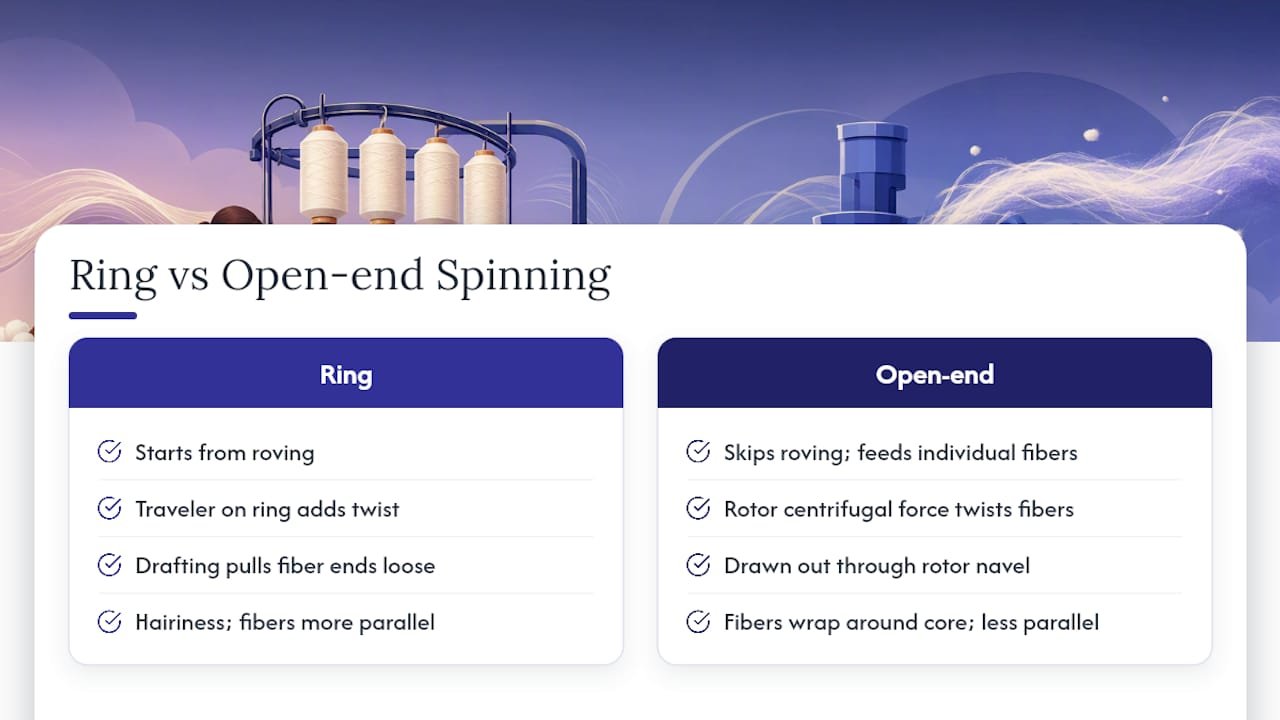
Ring spinning starts with roving, a loosely twisted rope of aligned cotton fibers. That roving feeds into a ring frame, where a traveler (a small metal clip riding a circular ring) adds twist while drawing the fiber down to final yarn thickness. The traveler’s friction and the drafting process pull some fiber ends loose from the main bundle, which is exactly where ring spun yarn picks up its characteristic hairiness. The yarn is then wound onto a bobbin, a separate step that adds time and cost.
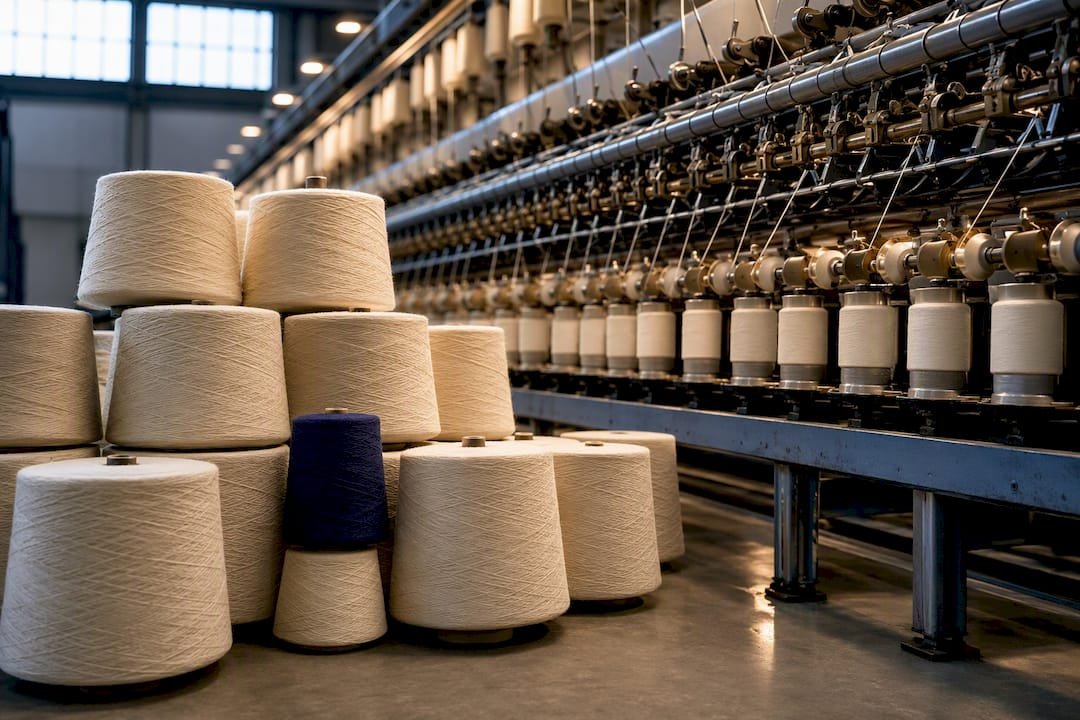
Open end, or rotor, spinning skips roving entirely. Individual fibers are fed into a spinning rotor where centrifugal force twists the fibers together as they’re drawn out through a navel at the rotor’s center. Because fibers wrap around the yarn’s core instead of lying fully parallel, open end yarn typically has lower strength but a smoother, more uniform surface.
These mechanical differences also set hard limits on what each system can produce. Open end spinning is generally economical only from about 1s up to roughly Ne 40/1, while ring frames can spin yarns well beyond Ne 100/1, which is why fine knitwear almost always runs on ring spinning. Mills can also tune rotor grooves, navel material, and feed rate to push open end yarn toward a rougher, more ring-like character, a technique used deliberately in some denim production.
What the Measurements Actually Tell You
Ring spun yarn tests roughly 15 to 20 percent stronger than open end yarn of the same count, a gap that traces directly back to fiber parallelism in the spinning process. That strength difference matters most in seams, high stress areas, and any product expected to survive repeated laundering and abrasion.
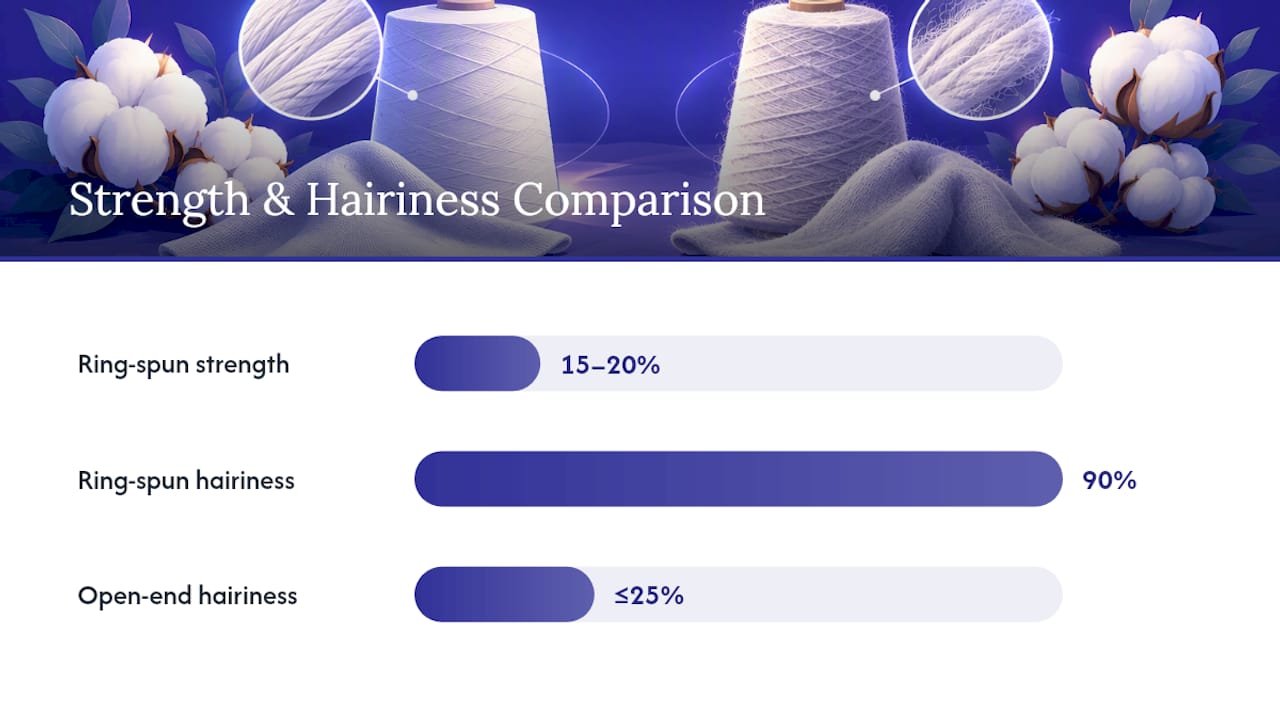
Hairiness works the other way. Ring spun yarn can show up to 90 percent protruding fiber ends against open end’s 25 percent or fewer, according to the same comparative testing. Those loose fiber ends are what create the soft, brushed feel buyers associate with premium tees, but they also give pilling more surface area to grab onto over time.
A few practical translations of these numbers:
- Higher hairiness (ring spun) means a softer initial hand but more surface fuzz to manage in finishing.
- Lower hairiness (open end) means a cleaner, flatter surface that resists shedding and lint transfer.
- Better evenness (open end) reduces thick and thin spots that can cause visible streaking in dyed fabric.
- Torque and twist balance affect fabric skew during cutting and sewing, and ring spun’s tighter twist can require more careful tensioning on high speed sewing lines.
Cotton Incorporated’s technical bulletins confirm the pattern at the mill level: open end wins on productivity, evenness, and fewer imperfections, while ring spun wins on strength, softness, and the ability to produce the finest counts.
From Yarn to Fabric: What You’ll Actually Feel and See
Yarn properties only matter once they hit finished fabric, and that’s where buying decisions get made or unmade.
Softness is the clearest case. Ring spun cotton, especially when combed or compact ring spun, reads noticeably softer against skin and tends to stay that way through repeated washing, since the fiber alignment resists the kind of surface roughening that cheaper yarns develop over time. Printability follows a similar pattern: a smoother, more aligned yarn surface gives screen printing and direct-to-garment printing a cleaner substrate to lay ink on, which is why ring spun is the default choice for heavily printed apparel.
Open end fabric has its own advantages. Because its fibers wrap tightly around a denser core, open end yarn often holds up better against surface abrasion and sheds less lint, which is useful in workwear and anything that sees heavy friction. Pilling, though, depends less on spinning method alone and more on fiber quality, twist level, and finishing, so a well-finished open end shirt can outperform a poorly finished ring spun one.
- Shrinkage runs comparably between the two once fabric is preshrunk correctly; the bigger variable is finishing, not spinning method.
- Laundering behavior favors testing before a bulk order regardless of yarn type, since dye lot and knit structure both affect shrink and color retention.
Pro Tip: Always request a washed sample, not just a swatch, before approving a bulk apparel order. A washed sample provides the best indication of shrinkage and pilling behavior.
Choosing the Right Yarn for Your Product
- Premium retail tees: Choose ring spun, ideally combed or compact ring spun, for the softest hand and the best shelf appeal.
- Heavily printed shirts: Choose ring spun for its smoother surface and sharper ink lay down, especially for detailed logos.
- Denim: Either works. Open end rough-spun effects can mimic a vintage, slubby look at a lower cost, while ring spun gives a cleaner, more refined finish.
- Socks and heavyweight workwear: Lean toward open end for its abrasion resistance and lower lint shedding under repeated friction.
- High volume basics and giveaways: Choose open end when unit cost and consistency matter more than premium hand feel.
- When budget allows an upgrade: Request combed or compact ring spun variants for a noticeably softer product without moving to a specialty fiber.
The Economics Behind the Choice
Cost differences between the two methods trace directly back to speed. Open end spinning runs at roughly seven to ten times the productivity of a ring spinning position, largely because it skips roving and a separate winding step entirely. That throughput advantage is the single biggest reason open end yarn costs less at the mill level.
- Roving and winding are extra steps unique to ring spinning, and each adds machine time and labor cost.
- Combing, an optional step that removes short fibers before spinning, adds cost but improves softness and evenness further.
- Compacting, a finishing pass that presses ring spun yarn’s surface fibers down, narrows the softness gap with open end but adds another cost layer.
For branded apparel, the math usually comes down to perceived value: a softer, better printing shirt can justify a higher price point or stronger brand impression, while a basic giveaway item rarely needs the premium.
A Publisher’s Take on Sourcing Bulk Apparel
A reliable distributor works with corporate buyers ordering branded apparel at scale, where yarn type is one of several specs that determine final quality. Before approving a bulk order, ask suppliers to confirm yarn type, count, whether it’s combed or compact, any available lab test results, and to provide a washed sample rather than a dry swatch. Getting these specs in writing before production avoids the most common surprises in bulk apparel orders.
A Straight Answer on Which One to Pick
Neither yarn is universally better. Ring spun wins when softness, fine counts, or print clarity are the priority, and open end wins when cost and consistency at volume matter more. Before ordering, ask yourself three questions: Is hand feel the priority? Is unit cost the priority? Will the product carry heavy printing? Your answers point to the yarn.
— Jerry
Let Discount Swag Handle Your Bulk Apparel Sourcing
Once you know which yarn fits your product, the harder part is finding a supplier who can deliver it consistently across sizes and locations. Discount Swag distributes branded apparel alongside bags, drinkware, technology items, and other promotional categories, and supports rush orders and fulfillment to single or multiple locations for corporate buyers who need reliable turnaround.
- Request fabric and yarn specs before committing to a bulk order.
- Ask about rush order timelines if your event date is fixed.
- Compare fully custom branded boxes for onboarding kits or event giveaways.
Check current apparel and promotional product options to start a spec conversation for your next order, or review our corporate apparel buying guide for procurement details. For a broader look at branding strategy beyond apparel, see this retail branding guide from our partners at CrispSign.
Sources
- Open-end vs ring spinning cotton yarn quality — Cotton Gins / Cotton Ginners resources
- ISP-1006 Cotton spun yarns for knit and woven fabrics — Cotton Incorporated
FAQ
Is 100% ringspun cotton the same as 100% cotton?
Not exactly. “100% cotton” only describes the fiber content, while “ring spun” describes the spinning method used to turn that cotton into yarn, so a shirt can be 100% cotton and either ring spun or open end.
Is ringspun cotton better?
It depends on the priority. Ring spun cotton is 15 to 20 percent stronger and softer to the touch, making it the better choice for premium apparel and heavily printed shirts, while open end suits high volume basics where cost matters more.
What is open-ended cotton?
Open end, or rotor spun, cotton is yarn made by feeding separated fibers into a spinning rotor that twists them together using centrifugal force rather than the roving and traveler system used in ring spinning. It runs seven to ten times faster per position than ring spinning, which keeps its cost lower.
Will 100% ringspun cotton shrink?
Yes, ring spun cotton can shrink like most untreated cotton fabrics, though the amount depends more on finishing and preshrinking than on the spinning method itself. Requesting a washed sample before a bulk order is the most reliable way to confirm shrinkage behavior for a specific fabric.
 Bottle Carriers
 Mugs